Key Takeaway
Learn about personal knowledge requirements for EUO no-show affidavits in NY no-fault cases. Expert analysis from JT Law. Call 516-750-0595.
This article is part of our ongoing no-fault coverage, with 271 published articles analyzing no-fault issues across New York State. Attorney Jason Tenenbaum brings 24+ years of hands-on experience to this analysis, drawing from his work on more than 1,000 appeals, over 100,000 no-fault cases, and recovery of over $100 million for clients throughout Nassau County, Suffolk County, Queens, Brooklyn, Manhattan, and the Bronx. For personalized legal advice about how these principles apply to your specific situation, contact our Long Island office at (516) 750-0595 for a free consultation.
EUO No-Show Affidavits: The Personal Knowledge Debate That Affects Your No-Fault Claim
If you’ve been involved in a motor vehicle accident in New York and are dealing with no-fault insurance claims, you may encounter something called an Examination Under Oath (EUO). But what happens when someone doesn’t show up for their scheduled EUO? A recent case, SVP Med Supply, Inc. v GEICO, 2022 NY Slip Op 50775(U)(App. Term 2d Dept. 2022), highlights ongoing concerns about how insurance companies prove EUO no-shows – and why this matters for your case.
The SVP Med Supply Case: What Courts Accept as Proof
In this case, GEICO defended against a no-fault claim by arguing that the plaintiff failed to appear for a scheduled EUO. To prove this no-show, they submitted an attorney’s affirmation with some interesting language:
“Defendant submitted the affirmation of an attorney who stated that she was in her firm’s office on the dates on which the EUOs were scheduled, that she would have either conducted the EUO herself or assigned another attorney to do so, and that plaintiff did not appear. She was not required to state that she was present in the office at any specific time on the scheduled dates.”
The court accepted this as sufficient proof of personal knowledge, but this ruling raises important questions about the quality and reliability of such evidence.
Jason Tenenbaum’s Honest Assessment
As Jason Tenenbaum notes in his candid analysis: “I honestly dislike those affidavits. They read as a lazy person’s way to prove a no-show, and I tend to wonder if this practice or protocol really happens.”
This frank assessment from an experienced personal injury attorney highlights a critical issue: are these affidavits truly based on personal knowledge, or are they formulaic documents that may not reflect what actually occurred?
What This Means For You: Understanding EUO Requirements
If you’re dealing with a no-fault insurance claim in New York, understanding how EUOs work and how no-shows are proven is crucial for protecting your interests.
What is an Examination Under Oath (EUO)?
An EUO is a formal proceeding where you’re required to answer questions under oath about your accident and related claims. Insurance companies often use EUOs to:
- Gather additional information about the claim
- Assess the credibility of the claimant
- Look for inconsistencies in the claim
- Sometimes, create grounds for denying the claim
The Personal Knowledge Standard
When an insurance company claims someone didn’t show up for an EUO, they must prove this with personal knowledge. The SVP Med Supply case establishes that this can be satisfied by an attorney who:
- Was present in the office on the scheduled date
- Would have conducted or supervised the EUO
- Can attest that the person didn’t appear
However, as the case notes, the attorney doesn’t need to specify exactly when they were present during the scheduled time.
The Problem with “Cookie-Cutter” Affidavits
Jason Tenenbaum’s criticism of these affidavits reflects a broader concern in the legal community about the quality and authenticity of routine legal documents. Here’s why this matters:
Lack of Specific Details
Many EUO no-show affidavits follow a template format that provides minimal specific information about what actually occurred on the scheduled date. This generic approach can raise questions about whether the affiant truly has personal knowledge of the events.
Questions About Office Protocols
As Jason notes, it’s worth questioning whether the described practice “really happens.” Do attorneys actually follow the protocols described in these affidavits, or are these documents created after the fact based on assumptions?
Impact on Case Outcomes
These affidavits can be used to deny claims or obtain summary judgment, making their accuracy critically important for claimants who may lose benefits based on questionable evidence.
The Virtual EUO Revolution
Jason Tenenbaum also predicts that virtual EUOs will improve this situation: “In the new virtual world, I think the no-show affidavits will be cleaner and more accurate.”
Why Virtual EUOs May Be Better
Virtual proceedings offer several advantages for documenting no-shows:
- Digital Records: Most virtual platforms automatically create logs of who joined and when
- Screenshot Evidence: Attorneys can capture screenshots showing empty waiting rooms
- Email Trails: Virtual invitations and reminders create clearer documentation
- Real-Time Documentation: Easier to document exactly what happened as it occurs
Reducing Ambiguity
Virtual EUOs eliminate many of the ambiguities present in traditional in-office proceedings. There’s less room for interpretation about whether someone showed up when the technology provides clear records of participation.
Common Scenarios and How They’re Handled
The Traditional In-Office EUO
In traditional EUOs, proving a no-show often relies on testimonial evidence from office staff or attorneys. This can create opportunities for disputes about what really happened.
Technical Issues in Virtual EUOs
Virtual EUOs can have their own complications, such as:
- Technology failures that prevent attendance
- Incorrect meeting links or passwords
- Internet connectivity issues
However, these issues are often easier to document and verify than claims about in-person no-shows.
Protecting Yourself During EUO Proceedings
Before the EUO
- Confirm all details: Verify the date, time, location (or virtual link), and required documents
- Test technology: For virtual EUOs, test your equipment and connection beforehand
- Document communications: Keep copies of all scheduling correspondence
- Plan for contingencies: Have backup plans for transportation or technology issues
During the EUO
- Arrive early: Whether in-person or virtual, early arrival demonstrates good faith
- Bring required documents: Have all requested materials organized and ready
- Stay calm and truthful: Answer questions honestly and don’t speculate
- Ask for clarification: If you don’t understand a question, ask for clarification
If You Can’t Attend
- Notify immediately: Contact the insurance company as soon as you know you can’t attend
- Provide documentation: If you have a legitimate excuse, provide supporting documentation
- Request rescheduling: Ask to reschedule promptly
- Keep records: Document all communications about the rescheduling
Frequently Asked Questions
Q: Can I challenge an EUO no-show affidavit if I believe it’s inaccurate?
A: Yes, you can challenge affidavits that lack proper personal knowledge or contain inaccuracies. However, you’ll need evidence to support your challenge.
Q: What happens if I miss an EUO due to a legitimate emergency?
A: Contact the insurance company immediately and provide documentation of the emergency. Most companies will allow rescheduling for legitimate reasons if you act promptly.
Q: Do I have to attend an EUO if I have legal representation?
A: Yes, EUOs typically require your personal attendance, even if you have an attorney. Your lawyer can usually attend with you to provide guidance.
Q: Can insurance companies use EUO no-shows to deny my entire claim?
A: Depending on the circumstances and your insurance policy terms, failure to attend an EUO can potentially result in claim denial. This is why attendance is so important.
Q: How can I prove I attended an EUO if the insurance company claims I didn’t?
A: Keep your own records, including travel receipts, parking stubs, or screenshots from virtual meetings. Consider bringing a witness or asking for written confirmation of your attendance.
The Bigger Picture: Evidence Quality in Legal Proceedings
The SVP Med Supply case reflects broader concerns about evidence quality in legal proceedings. While courts may accept minimal evidence of personal knowledge, the practical implications for claimants can be significant.
Implications for Legal Practice
Jason Tenenbaum’s critique highlights the need for legal professionals to maintain high standards of evidence, even when courts might accept lower standards. This approach ultimately serves clients better and maintains the integrity of the legal process.
The Role of Technology
As legal proceedings increasingly move online, technology may help address some of the concerns about evidence quality and authenticity that have plagued traditional processes.
Best Practices for Legal Professionals
For Insurance Defense Attorneys
- Maintain detailed, contemporaneous records of EUO proceedings
- Use specific rather than generic language in affidavits
- Implement clear office protocols for documenting no-shows
- Consider using technology to create better documentation
For Plaintiff’s Attorneys
- Scrutinize no-show affidavits for lack of personal knowledge
- Prepare clients thoroughly for EUO proceedings
- Document any scheduling or communication issues
- Challenge insufficient evidence when appropriate
Looking Forward: The Evolution of EUO Practice
As Jason Tenenbaum predicts, virtual proceedings may lead to cleaner, more accurate documentation of EUO attendance and no-shows. This evolution could benefit all parties by:
- Reducing disputes about attendance
- Providing clearer evidence for court proceedings
- Improving efficiency in the claims process
- Enhancing fairness for all parties involved
The Bottom Line: Quality and Accuracy Matter
The SVP Med Supply case and Jason Tenenbaum’s commentary highlight an important truth: while courts may accept minimal evidence standards, the quality and accuracy of evidence affects real people’s lives and legal rights.
Whether you’re dealing with EUO proceedings, challenging no-show claims, or navigating other aspects of personal injury law, having experienced legal counsel can help ensure that evidence standards work in your favor rather than against you.
Don’t let questionable evidence or procedural technicalities undermine your legitimate claim. If you’re facing EUO requirements or challenges with no-fault insurance claims, professional legal guidance can help protect your rights and ensure that proper evidence standards are applied to your case.
Call 516-750-0595 for a free consultation to discuss your no-fault insurance claim or EUO concerns. Experience the difference that thorough, professional legal representation can make in your case.
Related Articles
Legal Context
Why This Matters for Your Case
New York's no-fault insurance system, established under Insurance Law Article 51, is one of the most complex insurance frameworks in the country. Every motorist must carry Personal Injury Protection coverage that pays medical expenses and lost wages regardless of fault, up to $50,000 per person.
But insurers routinely deny valid claims using peer reviews, EUO scheduling tactics, fee schedule reductions, and coverage defenses. The Law Office of Jason Tenenbaum has handled over 100,000 no-fault cases since 2002 — from initial claim submissions through arbitration before the American Arbitration Association, trials in Civil Court and Supreme Court, and appeals to the Appellate Term and Appellate Division. Jason Tenenbaum is one of the few attorneys in the state who both writes his own appellate briefs and tries his own cases.
His 2,353+ published legal articles on no-fault practice are cited by attorneys throughout New York. Whether you are dealing with a medical necessity denial, an EUO no-show defense, a fee schedule dispute, or a coverage question, this article provides the kind of detailed case-law analysis that helps practitioners and claimants understand exactly where the law stands.
About This Topic
New York No-Fault Insurance Law
New York's no-fault insurance system requires every driver to carry Personal Injury Protection (PIP) coverage that pays medical expenses and lost wages regardless of who caused the accident. But insurers routinely deny, delay, and underpay valid claims — using peer reviews, IME no-shows, and fee schedule defenses to avoid paying providers and injured claimants. Attorney Jason Tenenbaum has litigated thousands of no-fault arbitrations and court cases since 2002.
271 published articles in No-Fault
Keep Reading
More No-Fault Analysis
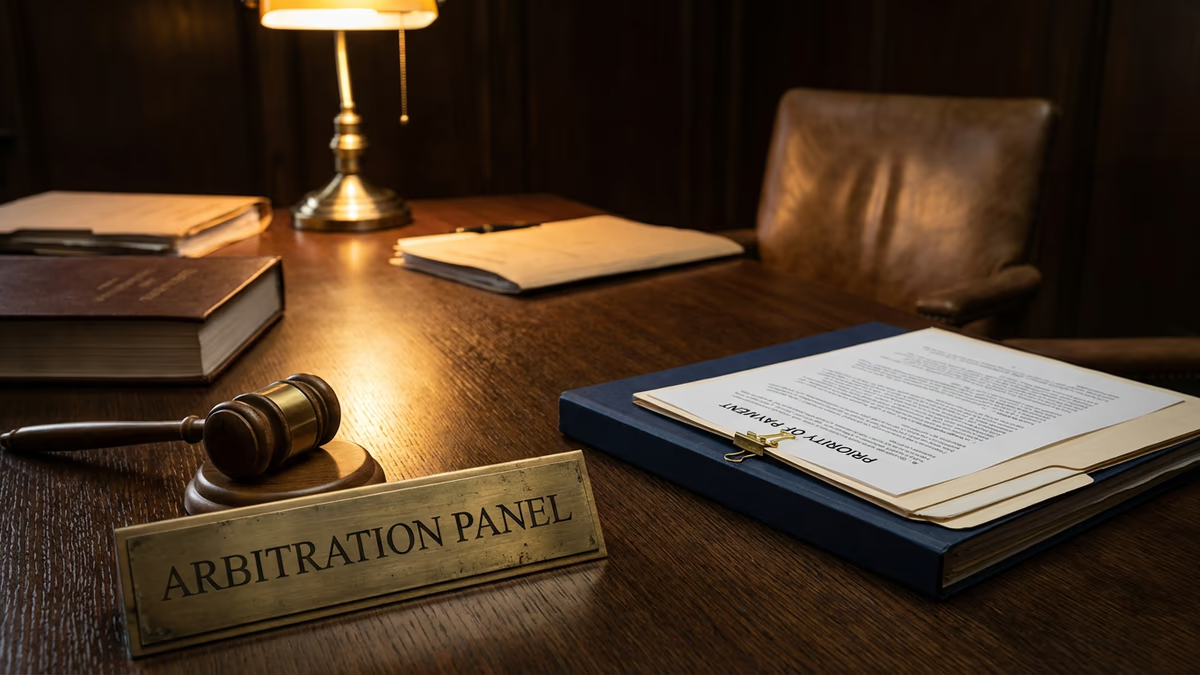
Priority of Payment Regulation Has No Force in Arbitration: First and Second Departments Agree
Both the First and Second Departments have held that the priority of payment regulation under 11 NYCRR 65-3.15 is of no force or effect in no-fault arbitration proceedings....
Feb 25, 2026
How Insurance Companies Use Colossus Software to Undervalue Your Injury Claim
Insurance companies use Colossus software to lowball your injury claim. Learn how this system works and how a Long Island attorney can fight back. Call 516-750-0595.
Feb 18, 2026
Credit Card Debt Collection Defense: Understanding Your Rights in Long Island and NYC
Expert credit card debt collection defense for Long Island and NYC residents. Understand your rights and defenses against credit card lawsuits. Call 516-750-0595.
Feb 3, 2012
Self imposed ROM limitation
Learn how range of motion limitations affect personal injury cases on Long Island. Expert medical evidence standards after Mahler v Lewis. Call 516-750-0595.
Nov 5, 2022
Reasonable excuse/ default
Court finds insurance company established reasonable excuse for default by demonstrating detailed record-keeping practices that would have captured service of process.
Aug 21, 2021
Arrest warrant not issued
Court denies arrest warrant for defendant who failed to comply with post-judgment subpoena in no-fault insurance case, despite contempt finding.
Jul 17, 2017Was this article helpful?

About the Author
Jason Tenenbaum, Esq.
Jason Tenenbaum is the founding attorney of the Law Office of Jason Tenenbaum, P.C., headquartered at 326 Walt Whitman Road, Suite C, Huntington Station, New York 11746. With over 24 years of experience since founding the firm in 2002, Jason has written more than 1,000 appeals, handled over 100,000 no-fault insurance cases, and recovered over $100 million for clients across Long Island, Nassau County, Suffolk County, Queens, Brooklyn, Manhattan, the Bronx, and Staten Island. He is one of the few attorneys in the state who both writes his own appellate briefs and tries his own cases.
Jason is admitted to practice in New York, New Jersey, Florida, Texas, Georgia, and Michigan state courts, as well as multiple federal courts. His 2,353+ published legal articles analyzing New York case law, procedural developments, and litigation strategy make him one of the most prolific legal commentators in the state. He earned his Juris Doctor from Syracuse University College of Law.
Disclaimer: This article is published by the Law Office of Jason Tenenbaum, P.C. for informational and educational purposes only. It does not constitute legal advice, and no attorney-client relationship is formed by reading this content. The legal principles discussed may not apply to your specific situation, and the law may have changed since this article was last updated.
New York law varies by jurisdiction — court decisions in one Appellate Division department may not be followed in another, and local court rules in Nassau County Supreme Court differ from those in Suffolk County Supreme Court, Kings County Civil Court, or Queens County Supreme Court. The Appellate Division, Second Department (which covers Long Island, Brooklyn, Queens, and Staten Island) and the Appellate Term (which hears appeals from lower courts) each have distinct procedural requirements and precedents that affect litigation strategy.
If you need legal help with a no-fault matter, contact our office at (516) 750-0595 for a free consultation. We serve clients throughout Long Island (Huntington, Babylon, Islip, Brookhaven, Smithtown, Riverhead, Southampton, East Hampton), Nassau County (Hempstead, Garden City, Mineola, Great Neck, Manhasset, Freeport, Long Beach, Rockville Centre, Valley Stream, Westbury, Hicksville, Massapequa), Suffolk County (Hauppauge, Deer Park, Bay Shore, Central Islip, Patchogue, Brentwood), Queens, Brooklyn, Manhattan, the Bronx, Staten Island, and Westchester County. Prior results do not guarantee a similar outcome.