Key Takeaway
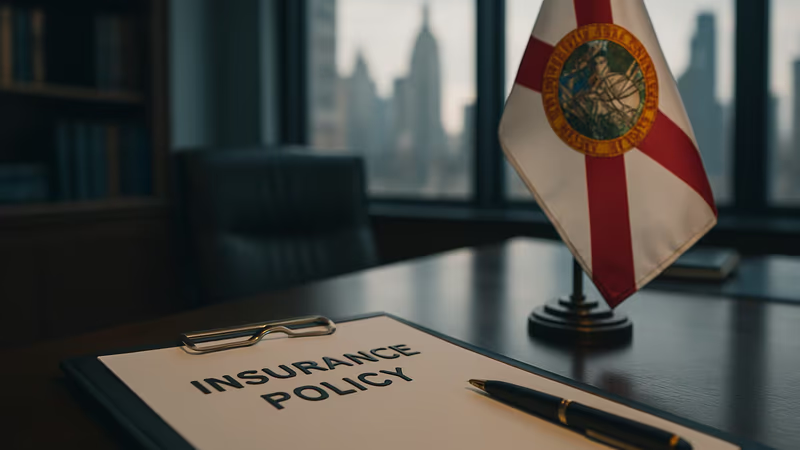
A Florida choice of law analysis leads to successful retroactive rescission, highlighting the importance of understanding different state laws in no-fault insurance cases.
This article is part of our ongoing choice of law coverage, with 35 published articles analyzing choice of law issues across New York State. Attorney Jason Tenenbaum brings 24+ years of hands-on experience to this analysis, drawing from his work on more than 1,000 appeals, over 100,000 no-fault cases, and recovery of over $100 million for clients throughout Nassau County, Suffolk County, Queens, Brooklyn, Manhattan, and the Bronx. For personalized legal advice about how these principles apply to your specific situation, contact our Long Island office at (516) 750-0595 for a free consultation.
Understanding Retroactive Rescission Under Florida Law
No-fault insurance cases often involve complex choice of law analyses that can dramatically impact case outcomes. In Omphil Care, Inc. v Pearl Holding Group, we see how Florida law’s approach to retroactive rescission differs from New York’s standards, creating strategic challenges for attorneys unfamiliar with out-of-state requirements.
When insurance companies seek to void policies retroactively (ab initio), they must meet specific procedural requirements that vary significantly by jurisdiction. The case demonstrates how defendant insurers can successfully establish prima facie grounds for rescission when they understand and properly apply the relevant state’s legal framework.
Jason Tenenbaum’s Analysis:
Omphil Care, Inc. v Pearl Holding Group Managing Gen. Agent for Ocean Harbor Cas. Ins. Co. 2020 NY Slip Op 50946(U)(App. Term 2d Dept. 2020)
“It is undisputed by the parties that Florida law applies. Inasmuch as defendant’s cross motion papers demonstrated that a rescission notice was sent to the insured, and that defendant had returned, or tendered, all premiums paid to the insured within a reasonable period of time after defendant’s discovery of the grounds for rescinding the policy, defendant established, prima facie, that it had voided the policy ab initio pursuant to Florida law (see W.H.O. Acupuncture, P.C. v Infinity Prop. & Cas. Co., 36 Misc 3d 4, 6-7 , citing Leonardo v State Farm Fire and Cas. Co., 675 So 2d 176, 179 ).”
I love how attorneys when told Florida law applies do not put in any effort in to beating back the Defendant’s motion. Has anyone checked out what a Florida attorney fee in a PIP case is?
Key Takeaway
This case illustrates the critical importance of understanding applicable state law requirements in no-fault insurance litigation. When Florida law governs rescission claims, attorneys must be prepared to challenge defendants’ procedural compliance under Florida-specific standards. The failure to adequately respond to policy rescission motions can result in unfavorable outcomes that might have been avoided with proper preparation.
Related Articles
Legal Context
Why This Matters for Your Case
New York law is among the most complex and nuanced in the country, with distinct procedural rules, substantive doctrines, and court systems that differ significantly from other jurisdictions. The Civil Practice Law and Rules (CPLR) governs every stage of civil litigation, from service of process through trial and appeal. The Appellate Division, Appellate Term, and Court of Appeals create a rich and ever-evolving body of case law that practitioners must follow.
Attorney Jason Tenenbaum has practiced across these areas for over 24 years, writing more than 1,000 appellate briefs and publishing over 2,353 legal articles that attorneys and clients rely on for guidance. The analysis in this article reflects real courtroom experience — from motion practice in Civil Court and Supreme Court to oral arguments before the Appellate Division — and a deep understanding of how New York courts actually apply the law in practice.
About This Topic
Choice of Law in New York Insurance & Injury Cases
When an accident or insurance dispute involves multiple states, New York courts must determine which state's law governs the claim. Choice-of-law analysis in New York uses an interest analysis approach for tort claims and a grouping-of-contacts test for contract-based insurance disputes. The choice between New York and another state's law can dramatically affect the outcome — particularly regarding no-fault thresholds, damage caps, and procedural requirements. These articles examine the analytical framework New York courts apply to resolve choice-of-law disputes.
35 published articles in Choice of law
Keep Reading
More Choice of law Analysis

Choice of law?
Court applies New York no-fault law over New Jersey law based on most significant relationship test, despite accident occurring in New Jersey.
Mar 17, 2021
Pa retroactive rescission
Analysis of Pennsylvania retroactive rescission law in NY courts, including Monroe v Omni and burden of proof requirements for insurers seeking policy rescission.
Jun 30, 2020
Pennsylvania Insurance Law in New York Courts: Navigating Choice of Law and the Innocent Third Party Doctrine
Navigate complex choice of law issues when Pennsylvania insurance policies meet New York litigation. Learn the innocent third party doctrine. Call 516-750-0595.
Oct 24, 2019
Innocent third-party plays out under Pennsylvania law analysis
Pennsylvania insurance law case shows that policy rescission may not affect innocent third parties, highlighting complex choice of law issues in no-fault insurance disputes.
Dec 22, 2016
Pennsylvania law
Delta Diagnostic v Infinity Group case shows NY court vacating consent order due to changed Pennsylvania insurance law interpretation affecting retroactive policy rescission burden...
Oct 6, 2015
New Jersey Law – but see where it all went wrong
New York court applies New Jersey insurance law in medical provider dispute, highlighting conflicts between state no-fault laws and mandatory dispute resolution requirements.
Feb 16, 2013Common Questions
Frequently Asked Questions
How do New York courts decide which state's law applies?
New York follows an 'interest analysis' approach to choice-of-law questions, examining which jurisdiction has the greatest interest in having its law applied. In insurance and personal injury cases, relevant factors include where the accident occurred, where the policy was issued, where the insured resides, and where the insurer is domiciled. Choice-of-law issues frequently arise in cross-border accidents and when out-of-state insurance policies cover New York accidents.
Was this article helpful?

About the Author
Jason Tenenbaum, Esq.
Jason Tenenbaum is the founding attorney of the Law Office of Jason Tenenbaum, P.C., headquartered at 326 Walt Whitman Road, Suite C, Huntington Station, New York 11746. With over 24 years of experience since founding the firm in 2002, Jason has written more than 1,000 appeals, handled over 100,000 no-fault insurance cases, and recovered over $100 million for clients across Long Island, Nassau County, Suffolk County, Queens, Brooklyn, Manhattan, the Bronx, and Staten Island. He is one of the few attorneys in the state who both writes his own appellate briefs and tries his own cases.
Jason is admitted to practice in New York, New Jersey, Florida, Texas, Georgia, and Michigan state courts, as well as multiple federal courts. His 2,353+ published legal articles analyzing New York case law, procedural developments, and litigation strategy make him one of the most prolific legal commentators in the state. He earned his Juris Doctor from Syracuse University College of Law.
Disclaimer: This article is published by the Law Office of Jason Tenenbaum, P.C. for informational and educational purposes only. It does not constitute legal advice, and no attorney-client relationship is formed by reading this content. The legal principles discussed may not apply to your specific situation, and the law may have changed since this article was last updated.
New York law varies by jurisdiction — court decisions in one Appellate Division department may not be followed in another, and local court rules in Nassau County Supreme Court differ from those in Suffolk County Supreme Court, Kings County Civil Court, or Queens County Supreme Court. The Appellate Division, Second Department (which covers Long Island, Brooklyn, Queens, and Staten Island) and the Appellate Term (which hears appeals from lower courts) each have distinct procedural requirements and precedents that affect litigation strategy.
If you need legal help with a choice of law matter, contact our office at (516) 750-0595 for a free consultation. We serve clients throughout Long Island (Huntington, Babylon, Islip, Brookhaven, Smithtown, Riverhead, Southampton, East Hampton), Nassau County (Hempstead, Garden City, Mineola, Great Neck, Manhasset, Freeport, Long Beach, Rockville Centre, Valley Stream, Westbury, Hicksville, Massapequa), Suffolk County (Hauppauge, Deer Park, Bay Shore, Central Islip, Patchogue, Brentwood), Queens, Brooklyn, Manhattan, the Bronx, Staten Island, and Westchester County. Prior results do not guarantee a similar outcome.