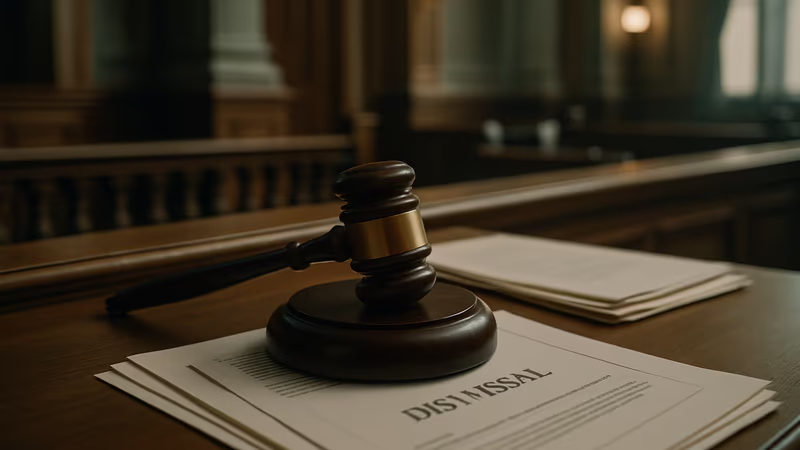
Key Takeaway
New York's First Department issued a conditional order of dismissal for discovery noncompliance, but the two-step process raises doctrinal concerns about court consistency.
This article is part of our ongoing discovery coverage, with 97 published articles analyzing discovery issues across New York State. Attorney Jason Tenenbaum brings 24+ years of hands-on experience to this analysis, drawing from his work on more than 1,000 appeals, over 100,000 no-fault cases, and recovery of over $100 million for clients throughout Nassau County, Suffolk County, Queens, Brooklyn, Manhattan, and the Bronx. For personalized legal advice about how these principles apply to your specific situation, contact our Long Island office at (516) 750-0595 for a free consultation.
Understanding Conditional Orders of Dismissal in New York Discovery Practice
When parties fail to comply with discovery obligations in New York litigation, courts have several enforcement mechanisms at their disposal. One such tool is the conditional order of dismissal, which gives a non-compliant party one final opportunity to cure their default before facing case dismissal. A recent First Department decision illustrates both the proper application of this remedy and some concerning trends in appellate court jurisprudence.
The conditional order serves as a middle ground between allowing continued discovery abuse and the harsh remedy of outright dismissal. Under CPLR 3126, courts can impose various sanctions for discovery violations, including striking pleadings or dismissing claims. However, the conditional order allows courts to avoid the difficult inquiry into whether a party’s noncompliance was willful — a standard that can be challenging to prove and often leads to inconsistent applications across different cases.
This approach becomes particularly relevant when dealing with discovery disputes that can delay summary judgment motions, as courts seek efficient ways to move cases forward while ensuring compliance with procedural requirements.
Jason Tenenbaum’s Analysis:
Mehler v Jones, 2020 NY Slip Op 02103 (1st Dept. 2020)
“The motion court providently exercised its discretion in issuing a conditional order of dismissal, in light of plaintiff’s history of noncompliance with court orders requiring her to appear for a further deposition (see CPLR 3126; Fish & Richardson, P.C. v Schindler, 75 AD3d 219, 220 ).
Plaintiff contends that her behavior was neither willful nor contumacious. However, by issuing a conditional order, the court “relieve of the unrewarding inquiry into whether resistance was willful” (Board of Mgrs. of the 129 Lafayette St. Condominium v 129 Lafayette St., LLC, 103 AD3d 511, 511 ).”
I find it hard to believe that the decision to impost a conditional order is a two step process. This Court lately has been all over the place doctrinally. There was a CPLR 2309 case that was off the charts stupid that I did not post because I did not want to encourage anyone to make those arguments. I am losing faith in this Court quickly.
Key Takeaway
The First Department’s approval of conditional dismissal orders as a way to bypass willfulness inquiries may streamline discovery enforcement, but raises questions about procedural consistency. This decision reflects broader concerns about doctrinal coherence in the court’s recent rulings, particularly regarding procedural timing issues and discovery sanctions.
Legal Context
Why This Matters for Your Case
New York law is among the most complex and nuanced in the country, with distinct procedural rules, substantive doctrines, and court systems that differ significantly from other jurisdictions. The Civil Practice Law and Rules (CPLR) governs every stage of civil litigation, from service of process through trial and appeal. The Appellate Division, Appellate Term, and Court of Appeals create a rich and ever-evolving body of case law that practitioners must follow.
Attorney Jason Tenenbaum has practiced across these areas for over 24 years, writing more than 1,000 appellate briefs and publishing over 2,353 legal articles that attorneys and clients rely on for guidance. The analysis in this article reflects real courtroom experience — from motion practice in Civil Court and Supreme Court to oral arguments before the Appellate Division — and a deep understanding of how New York courts actually apply the law in practice.
About This Topic
Discovery Practice in New York Courts
Discovery is the pre-trial process through which parties exchange information relevant to the dispute. In New York, discovery practice is governed by CPLR Article 31 and involves depositions, interrogatories, document demands, and physical examinations. Disputes over the scope of discovery, compliance with demands, and sanctions for noncompliance are frequent in both no-fault and personal injury cases. These articles analyze discovery rules, court decisions on discovery disputes, and strategies for effective discovery practice.
97 published articles in Discovery
Keep Reading
More Discovery Analysis
Another Discovery
Appellate Term ruling on discovery objections shows courts won't disturb trial court discretion when defendants fail to timely object within CPLR's 20-day period.
May 22, 2021
Deposition rulings
New York appellate court clarifies that deposition rulings cannot be appealed as of right, even when made through formal motion practice rather than during examination.
Sep 25, 2020
MSJ + EBT = disaster for plaintiff
Court case analysis showing how failed summary judgment motion led to mandatory EBT order for medical provider in no-fault insurance dispute.
Apr 5, 2013
An interesting discovery case involving the right to obtain alcohol treatment records
Expert analysis of medical records discovery rights in NY personal injury cases. L.T. v Teva Pharms case study. Call (516) 750-0595 for consultation.
Mar 24, 2010
Facebook is discoverable upon a proper foundation
New York court establishes proper foundation requirements for Facebook discovery in personal injury cases, rejecting automatic disclosure of entire accounts.
Feb 19, 2018
A worthless preclusion order
Court rules discovery preclusion orders are worthless when insurance denials admit receipt of medical bills, allowing no-fault providers to prove their case at trial.
Dec 23, 2014Common Questions
Frequently Asked Questions
What is discovery in New York civil litigation?
Discovery is the pre-trial phase where parties exchange relevant information and evidence. Under CPLR Article 31, discovery methods include depositions (oral questioning under oath), interrogatories (written questions), document demands, requests for admission, and physical or mental examinations. Discovery in New York is governed by the principle of full disclosure of all relevant, non-privileged information — but courts can issue protective orders to limit discovery that is overly broad or burdensome.
What happens if a party fails to comply with discovery requests?
Under CPLR 3126, a court can impose penalties for failure to comply with discovery, including preclusion of evidence, striking of pleadings, or even dismissal of the action or entry of a default judgment. Before seeking sanctions, the requesting party typically must demonstrate a good-faith effort to resolve the dispute and may need to file a motion to compel disclosure under CPLR 3124.
What are interrogatories and how are they used in New York litigation?
Interrogatories are written questions served on the opposing party that must be answered under oath within a specified timeframe. Under CPLR 3130, interrogatories in New York are limited — a party may serve a maximum of 25 interrogatories, including subparts, without court permission. Interrogatories are useful for obtaining basic factual information such as witness names, insurance details, and factual contentions. Objections must be specific and timely or they may be waived.
What is a bill of particulars in New York personal injury cases?
A bill of particulars under CPLR 3043 and 3044 provides the defendant with the specific details of the plaintiff's claims — including the injuries sustained, the theory of liability, and the damages sought. In personal injury cases, it must specify each injury, the body parts affected, and the nature of the damages claimed. An amended or supplemental bill may be served to include new injuries or updated information discovered during the course of litigation.
Was this article helpful?

About the Author
Jason Tenenbaum, Esq.
Jason Tenenbaum is the founding attorney of the Law Office of Jason Tenenbaum, P.C., headquartered at 326 Walt Whitman Road, Suite C, Huntington Station, New York 11746. With over 24 years of experience since founding the firm in 2002, Jason has written more than 1,000 appeals, handled over 100,000 no-fault insurance cases, and recovered over $100 million for clients across Long Island, Nassau County, Suffolk County, Queens, Brooklyn, Manhattan, the Bronx, and Staten Island. He is one of the few attorneys in the state who both writes his own appellate briefs and tries his own cases.
Jason is admitted to practice in New York, New Jersey, Florida, Texas, Georgia, and Michigan state courts, as well as multiple federal courts. His 2,353+ published legal articles analyzing New York case law, procedural developments, and litigation strategy make him one of the most prolific legal commentators in the state. He earned his Juris Doctor from Syracuse University College of Law.
Disclaimer: This article is published by the Law Office of Jason Tenenbaum, P.C. for informational and educational purposes only. It does not constitute legal advice, and no attorney-client relationship is formed by reading this content. The legal principles discussed may not apply to your specific situation, and the law may have changed since this article was last updated.
New York law varies by jurisdiction — court decisions in one Appellate Division department may not be followed in another, and local court rules in Nassau County Supreme Court differ from those in Suffolk County Supreme Court, Kings County Civil Court, or Queens County Supreme Court. The Appellate Division, Second Department (which covers Long Island, Brooklyn, Queens, and Staten Island) and the Appellate Term (which hears appeals from lower courts) each have distinct procedural requirements and precedents that affect litigation strategy.
If you need legal help with a discovery matter, contact our office at (516) 750-0595 for a free consultation. We serve clients throughout Long Island (Huntington, Babylon, Islip, Brookhaven, Smithtown, Riverhead, Southampton, East Hampton), Nassau County (Hempstead, Garden City, Mineola, Great Neck, Manhasset, Freeport, Long Beach, Rockville Centre, Valley Stream, Westbury, Hicksville, Massapequa), Suffolk County (Hauppauge, Deer Park, Bay Shore, Central Islip, Patchogue, Brentwood), Queens, Brooklyn, Manhattan, the Bronx, Staten Island, and Westchester County. Prior results do not guarantee a similar outcome.