Key Takeaway
Court takes judicial notice of permanent stay order in no-fault insurance case, rendering declaratory judgment appeal academic under NY law.
This article is part of our ongoing coverage coverage, with 268 published articles analyzing coverage issues across New York State. Attorney Jason Tenenbaum brings 24+ years of hands-on experience to this analysis, drawing from his work on more than 1,000 appeals, over 100,000 no-fault cases, and recovery of over $100 million for clients throughout Nassau County, Suffolk County, Queens, Brooklyn, Manhattan, and the Bronx. For personalized legal advice about how these principles apply to your specific situation, contact our Long Island office at (516) 750-0595 for a free consultation.
The doctrine of judicial notice allows appellate courts to consider matters of public record that may not have been before the trial court but affect the viability of continued litigation. When supervening events render an appeal moot or academic, appellate courts exercise discretion to take notice of those developments rather than issue advisory opinions on controversies no longer requiring resolution. The Second Department Appellate Term’s decision in Actual Chiropractic, P.C. v Global Liberty Insurance Co. demonstrates how permanent stay orders can terminate the justiciability of pending appeals in New York no-fault litigation.
Appellate courts generally decide cases based on the record developed in the trial court. However, New York law recognizes limited exceptions permitting appellate consideration of extra-record materials. Courts may take judicial notice of reliable public documents whose existence and accuracy are undisputed, including orders and judgments entered in other proceedings involving the same parties. This doctrine serves judicial economy by preventing wasteful adjudication of issues that supervening developments have rendered academic.
The permanent stay order at issue in Actual Chiropractic arose from Supreme Court’s inherent authority to prevent fraud on the court and protect the integrity of judicial proceedings. When evidence suggests a pattern of fraudulent billing or systematic abuse of the no-fault system, courts may enter broad injunctive relief prohibiting further litigation by identified providers. Such orders represent extraordinary remedies reserved for egregious circumstances where ordinary case-by-case adjudication cannot adequately protect defendants and the courts from ongoing fraudulent conduct.
Case Background
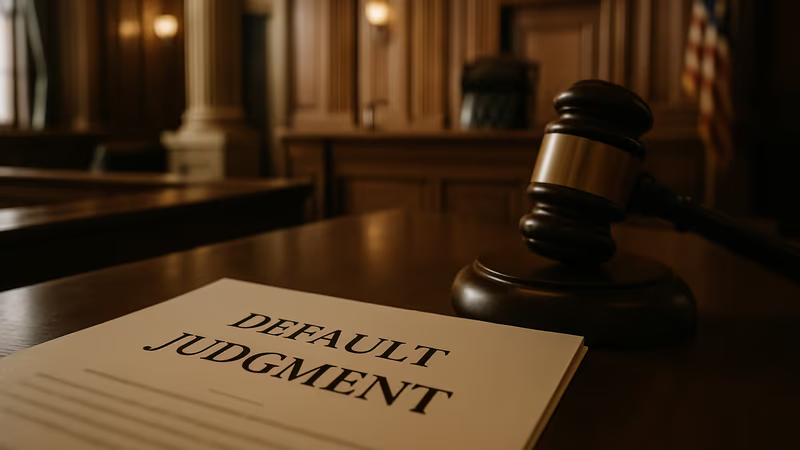
Actual Chiropractic, P.C. sued Global Liberty Insurance Co. of New York seeking no-fault benefits for services allegedly provided to an injured person. Global Liberty failed to appear and answer the complaint, resulting in entry of a default judgment in favor of Actual Chiropractic. The insurer subsequently moved to vacate the default judgment, but the Civil Court denied that motion. Global Liberty appealed both the default judgment and the order denying its motion to vacate.
While the appeal was pending before the Appellate Term, Supreme Court, Bronx County entered an order on February 9, 2018 addressing litigation involving Actual Chiropractic. That order determined that Actual Chiropractic had engaged in a pattern of submitting fraudulent claims and permanently stayed “all civil lawsuits, judgments and other proceedings that have been brought or may be brought by Actual Chiropractic, P.C.” seeking no-fault benefits under specified claim numbers, including the claim number at issue in the Global Liberty litigation.
Global Liberty appended the Supreme Court’s permanent stay order to its appellate brief, bringing it to the Appellate Term’s attention for the first time on appeal. The Appellate Term had to determine whether it could properly consider this extra-record document and, if so, what effect the permanent stay had on the pending appeal from the default judgment.
Actual Chiropractic, P.C. v Global Liberty Ins. Co. of N.Y., 2020 NY Slip Op 50185(U)(App. Term 2d Dept. 2020)
“On the instant appeal, defendant has annexed to its brief an order of the Supreme Court, Bronx County, entered February 9, 2018, which held, among other things, that all civil lawsuits, judgments and other proceedings “that have been brought or may be brought by … Actual [*2]Chiropractic, P.C.” seeking no-fault benefits under the same claim number and regarding the same assignor and motor vehicle accident as in the case at bar are permanently stayed. As a court may take judicial notice “on appeal, of reliable documents, the existence and accuracy of which are not disputed” and, generally, “of matters of public record” (Brandes Meat Corp. v Cromer, 146 AD2d 666, 667 ; see Headley v New York City Tr. Auth., 100 AD3d 700 ), this court, in the interest of judicial economy, takes judicial notice of the Supreme Court’s order entered February 9, 2018, which permanently “stays” the parties from proceeding further in the action at bar.
In light of the stay issued by the Supreme Court, this appeal has “been rendered academic as any determination on appeal[ ] would not, under the facts of this case, have a direct effect upon the parties” (Matter of Claudia G. , 71 AD3d 894, 895 ).”
Legal Significance
The Appellate Term’s decision reinforces important principles governing appellate jurisdiction and the limits of justiciability. Courts possess authority to adjudicate only actual controversies requiring resolution; they cannot issue advisory opinions on abstract questions or disputes that supervening events have mooted. When a permanent stay order prohibits continued prosecution of an action, any appeal from judgments in that action becomes academic because the appellate court’s determination cannot affect the parties’ rights or obligations.
The judicial notice doctrine applied here serves critical efficiency objectives. Requiring parties to return to the trial court to seek recognition of the stay order, followed by a new appeal if that motion were denied, would waste judicial resources and delay final resolution. By taking judicial notice of the publicly recorded stay order on appeal, the Appellate Term efficiently disposed of an appeal that the stay rendered pointless.
The decision also illustrates the serious consequences providers face when courts determine they have engaged in systematic fraud. The Supreme Court’s permanent stay order effectively shut down Actual Chiropractic’s ability to pursue any no-fault litigation involving specified claims. This remedy goes far beyond denying individual claims on their merits; it represents a judicial determination that the provider’s litigation activity itself constitutes abuse of process warranting extraordinary injunctive relief.
Practical Implications
For insurance carriers, Actual Chiropractic demonstrates the value of investigating patterns of suspicious billing activity and pursuing coordinated litigation strategies when evidence suggests systematic fraud. Rather than defending each fraudulent claim individually, insurers may seek Supreme Court’s intervention through declaratory judgment actions seeking permanent stays against providers engaged in pervasive fraudulent billing. Such relief requires substantial evidence of fraud but, when obtained, provides comprehensive protection against further litigation by bad actors.
Defense counsel should monitor whether providers opposing their clients have been subject to stay orders in other proceedings. When such orders exist, counsel should bring them to the court’s attention through judicial notice, potentially disposing of cases without need for merits adjudication. Appellate counsel should specifically research whether any supervening developments affect the justiciability of pending appeals before expending resources on substantive briefing.
For medical providers, the decision serves as a stark warning about the consequences of fraudulent billing practices. Providers who systematically submit false or inflated claims risk not only denial of those specific claims but complete prohibition from pursuing any litigation involving their services. The permanent stay remedy can effectively terminate a provider’s ability to collect no-fault reimbursement, making fraud detection and prevention essential for preserving legitimate business operations.
Providers should also understand that judgments obtained through default provide little security when underlying fraud allegations remain viable. Even after entry of a default judgment, defendants may seek vacatur and Supreme Court may enter broad stay orders that render the judgment unenforceable regardless of whether it is formally vacated.
Related Articles
- Default Judgment Pitfalls: Why Non-Hearsay Evidence Is Critical in New York Declaratory Judgment Actions
- Where was the reasonable excuse?
- Supplemental affirmation on a DJ case acceptable and res judicata mandates dismissal of complaint
- Declaratory judgment action (again) moots the underlying Civil Court action
- New York No-Fault Insurance Law
Legal Context
Why This Matters for Your Case
New York law is among the most complex and nuanced in the country, with distinct procedural rules, substantive doctrines, and court systems that differ significantly from other jurisdictions. The Civil Practice Law and Rules (CPLR) governs every stage of civil litigation, from service of process through trial and appeal. The Appellate Division, Appellate Term, and Court of Appeals create a rich and ever-evolving body of case law that practitioners must follow.
Attorney Jason Tenenbaum has practiced across these areas for over 24 years, writing more than 1,000 appellate briefs and publishing over 2,353 legal articles that attorneys and clients rely on for guidance. The analysis in this article reflects real courtroom experience — from motion practice in Civil Court and Supreme Court to oral arguments before the Appellate Division — and a deep understanding of how New York courts actually apply the law in practice.
About This Topic
Insurance Coverage Issues in New York
Coverage disputes determine whether an insurance policy provides benefits for a particular claim. In the no-fault context, coverage questions involve policy inception, named insured status, vehicle registration requirements, priority of coverage among multiple insurers, and the applicability of exclusions. These articles examine how New York courts resolve coverage disputes, the burden of proof on coverage defenses, and the interplay between regulatory requirements and policy language.
268 published articles in Coverage
Keep Reading
More Coverage Analysis

IME no-show is a policy defense triggering the hourly attorney fee provision
Learn how IME no-show defenses trigger hourly attorney fee provisions in NY no-fault insurance. Court rules failure to attend IME is policy defense.
May 22, 2021
Contractual deemer
New York courts examine when out-of-state insurers can avoid no-fault coverage obligations through contractual deemer provisions and policy language analysis.
Apr 24, 2021
The hourly attorney fee
Court rules hourly attorney fees only allowed for specifically enumerated NF-10 form policy issues in NY no-fault insurance cases, restricting fee recovery scope.
Apr 27, 2020
5102(d) examined at trial against MVAIC
Court ruling demonstrates that expert testimony on range of motion limitations and orthopedic tests can establish serious injury threshold under NY Insurance Law 5102(d).
Dec 15, 2016
Insurable interest
Court ruling clarifies insurable interest requirements in NY auto insurance, showing vehicle owners have valid coverage interests that insurers cannot improperly cancel.
Nov 14, 2014
MVAIC Loses Again: Court Rejects Coverage Defense in New York No-Fault Case
New York appellate court denies MVAIC summary judgment in no-fault insurance case, rejecting burden-shifting on coverage eligibility and exhaustion of remedies defense.
Mar 25, 2011Common Questions
Frequently Asked Questions
What are common coverage defenses in no-fault insurance?
Common coverage defenses include policy voidance due to material misrepresentation on the insurance application, lapse in coverage, the vehicle not being covered under the policy, staged accident allegations, and the applicability of policy exclusions. Coverage issues are often treated as conditions precedent, meaning the insurer bears the burden of proving the defense. Unlike medical necessity denials, coverage defenses go to whether any benefits are owed at all.
What happens if there's no valid insurance policy at the time of the accident?
If there is no valid no-fault policy covering the vehicle, the injured person can file a claim with MVAIC (Motor Vehicle Accident Indemnification Corporation), which serves as a safety net for people injured in accidents involving uninsured vehicles. MVAIC provides the same basic economic loss benefits as a standard no-fault policy, but the application process has strict requirements and deadlines.
What is policy voidance in no-fault insurance?
Policy voidance occurs when an insurer declares that the insurance policy is void ab initio (from the beginning) due to material misrepresentation on the application — such as listing a false garaging address or failing to disclose drivers. Under Insurance Law §3105, the misrepresentation must be material to the risk assumed by the insurer. If the policy is voided, the insurer has no obligation to pay any claims, though the burden of proving the misrepresentation falls on the insurer.
How does priority of coverage work in New York no-fault?
Under 11 NYCRR §65-3.12, no-fault benefits are paid by the insurer of the vehicle the injured person occupied. For pedestrians and non-occupants, the claim is made against the insurer of the vehicle that struck them. If multiple vehicles are involved, regulations establish a hierarchy of coverage. If no coverage is available, the injured person can apply to MVAIC. These priority rules determine which insurer bears financial responsibility and are frequently litigated.
What is SUM coverage in New York?
Supplementary Uninsured/Underinsured Motorist (SUM) coverage, governed by 11 NYCRR §60-2, provides additional protection when the at-fault driver has no insurance or insufficient coverage. SUM allows you to recover damages beyond basic no-fault benefits, up to your policy's SUM limits, when the at-fault driver's liability coverage is inadequate. SUM arbitration is mandatory and governed by the policy terms, and claims must be made within the applicable statute of limitations.
Was this article helpful?

About the Author
Jason Tenenbaum, Esq.
Jason Tenenbaum is the founding attorney of the Law Office of Jason Tenenbaum, P.C., headquartered at 326 Walt Whitman Road, Suite C, Huntington Station, New York 11746. With over 24 years of experience since founding the firm in 2002, Jason has written more than 1,000 appeals, handled over 100,000 no-fault insurance cases, and recovered over $100 million for clients across Long Island, Nassau County, Suffolk County, Queens, Brooklyn, Manhattan, the Bronx, and Staten Island. He is one of the few attorneys in the state who both writes his own appellate briefs and tries his own cases.
Jason is admitted to practice in New York, New Jersey, Florida, Texas, Georgia, and Michigan state courts, as well as multiple federal courts. His 2,353+ published legal articles analyzing New York case law, procedural developments, and litigation strategy make him one of the most prolific legal commentators in the state. He earned his Juris Doctor from Syracuse University College of Law.
Disclaimer: This article is published by the Law Office of Jason Tenenbaum, P.C. for informational and educational purposes only. It does not constitute legal advice, and no attorney-client relationship is formed by reading this content. The legal principles discussed may not apply to your specific situation, and the law may have changed since this article was last updated.
New York law varies by jurisdiction — court decisions in one Appellate Division department may not be followed in another, and local court rules in Nassau County Supreme Court differ from those in Suffolk County Supreme Court, Kings County Civil Court, or Queens County Supreme Court. The Appellate Division, Second Department (which covers Long Island, Brooklyn, Queens, and Staten Island) and the Appellate Term (which hears appeals from lower courts) each have distinct procedural requirements and precedents that affect litigation strategy.
If you need legal help with a coverage matter, contact our office at (516) 750-0595 for a free consultation. We serve clients throughout Long Island (Huntington, Babylon, Islip, Brookhaven, Smithtown, Riverhead, Southampton, East Hampton), Nassau County (Hempstead, Garden City, Mineola, Great Neck, Manhasset, Freeport, Long Beach, Rockville Centre, Valley Stream, Westbury, Hicksville, Massapequa), Suffolk County (Hauppauge, Deer Park, Bay Shore, Central Islip, Patchogue, Brentwood), Queens, Brooklyn, Manhattan, the Bronx, Staten Island, and Westchester County. Prior results do not guarantee a similar outcome.