Key Takeaway
Learn when NY appellate courts can review bench trial credibility findings. Expert legal analysis of appellate standards. Call 516-750-0595 for consultation.
This article is part of our ongoing evidence coverage, with 126 published articles analyzing evidence issues across New York State. Attorney Jason Tenenbaum brings 24+ years of hands-on experience to this analysis, drawing from his work on more than 1,000 appeals, over 100,000 no-fault cases, and recovery of over $100 million for clients throughout Nassau County, Suffolk County, Queens, Brooklyn, Manhattan, and the Bronx. For personalized legal advice about how these principles apply to your specific situation, contact our Long Island office at (516) 750-0595 for a free consultation.
Understanding Appellate Review Standards in New York Bench Trials
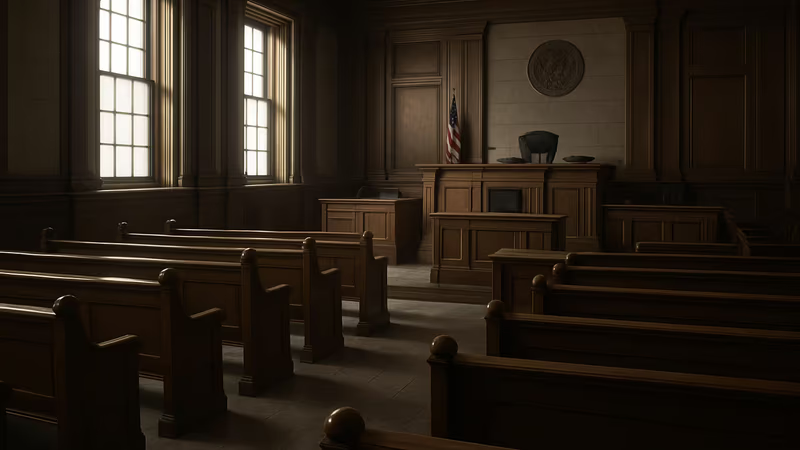
When a trial court conducts a bench trial (a trial without a jury), the judge serves as both the finder of fact and the arbiter of law. However, what happens when that judge fails to properly assess witness credibility or provide adequate explanations for their factual findings? This critical issue can significantly impact your case on appeal.
The Fundamental Principle: Trial Court’s Duty in Credibility Assessment
In bench trials throughout New York, including Nassau County and Suffolk County courts, trial judges must carefully evaluate witness testimony and expert opinions. The case of Matter of State of New York v Jesus H., 2019 NY Slip Op 07858 (1st Dept. 2019), provides crucial guidance on when appellate courts can intervene.
The First Department explained that “with regard to the appropriate scope of this Court’s review on this appeal, it is well settled that as to the review of a judgment following a nonjury trial, this Court’s authority is as broad as that of the trial court.” This means appellate courts have significant power to review and overturn bench trial decisions under the right circumstances.
When Deference Is Not Required
Traditionally, appellate courts give deference to trial judges who observed witnesses firsthand. However, this deference disappears when the trial court fails to properly assess credibility. As the court noted in Jesus H., “Supreme Court is owed no deference in light of its lack of explanation or indication as to why it declined to credit the expert testimony.”
This principle was reinforced in Bernard v State of New York, where the Third Department held that “where a trial court did not resolve issues of credibility, no deference is owed.”
Implications for Personal Injury Cases on Long Island
For personal injury victims in Nassau and Suffolk Counties, this principle can be game-changing. Whether you’re pursuing a personal injury claim, a slip and fall case, or a motor vehicle accident lawsuit, expert testimony often plays a crucial role.
Medical Expert Testimony in Personal Injury Cases
In personal injury litigation, medical experts frequently testify about:
- The extent of injuries sustained
- Causation between the accident and injuries
- Future medical needs and costs
- Disability and limitations
- Pain and suffering assessments
When a trial judge accepts some aspects of an expert’s testimony while rejecting others without explanation, it creates grounds for appeal. The Jesus H. decision provides the legal framework to challenge such inconsistent credibility determinations.
Practical Applications for Appeal Attorneys
For attorneys handling appeals in New York’s appellate divisions, this case provides essential ammunition. When a trial court:
Accepts Partial Expert Testimony
If a judge credits an expert’s diagnosis of one condition while inexplicably rejecting their opinion on related conditions, this inconsistency undermines the credibility determination and eliminates the usual deference afforded to trial courts.
Fails to Explain Credibility Findings
Trial courts must provide reasoning when rejecting expert testimony, especially when that same expert’s opinions are accepted on other issues. A bare conclusion without explanation is insufficient.
Strategic Considerations for Trial Attorneys
Understanding this principle helps trial attorneys better prepare their cases. When presenting expert testimony, consider:
Comprehensive Expert Preparation
- Ensure experts can explain the consistency of their opinions
- Address potential contradictions proactively
- Create detailed records of expert methodologies
- Prepare experts for cross-examination on consistency
Preserving the Record for Appeal
Trial attorneys must create a strong appellate record by:
- Requesting specific findings on credibility determinations
- Highlighting any inconsistencies in the court’s treatment of expert testimony
- Ensuring all expert opinions are clearly articulated
- Preserving objections to inadequate credibility assessments
The Broader Impact on New York Civil Litigation
This standard of review extends beyond personal injury cases to all civil litigation in New York. Whether you’re dealing with construction accident claims, medical malpractice cases, or other complex litigation, the principles established in Jesus H. apply.
Construction Accident Applications
In construction accident cases, multiple experts often testify about safety violations, industry standards, and causation. When trial courts inconsistently apply expert testimony without explanation, successful appeals become more likely.
Frequently Asked Questions
What constitutes inadequate credibility assessment in a bench trial?
Inadequate credibility assessment occurs when a trial judge fails to explain why they accept some portions of expert testimony while rejecting others, especially from the same expert. The court must provide reasoning for credibility determinations, particularly when dealing with uncontroverted expert testimony.
Can appellate courts completely review bench trial findings?
Yes, when trial courts fail to properly assess credibility or provide adequate explanations, appellate courts can exercise broad review authority. As stated in Northern Westchester Professional Park Assoc. v Town of Bedford, appellate courts’ authority can be “as broad as that of the trial court” in these circumstances.
How does this affect the standard of review on appeal?
When credibility isn’t properly assessed, the usual deference given to trial courts disappears. Appellate courts can then render the judgment they find warranted by the facts without giving special consideration to the trial court’s advantage of observing witnesses.
What should attorneys do to preserve appellate rights?
Attorneys should request specific findings on credibility, highlight inconsistencies in expert testimony treatment, ensure clear articulation of all expert opinions, and preserve objections to inadequate credibility assessments. This creates a strong record for potential appeals.
Does this principle apply to all types of expert testimony?
Yes, this principle applies broadly to all expert testimony in bench trials. Whether dealing with medical experts, engineering experts, accident reconstruction specialists, or any other professional testimony, the requirement for consistent and explained credibility determinations remains the same.
Conclusion: Protecting Your Rights in New York Courts
The Jesus H. decision reinforces the fundamental principle that trial courts cannot arbitrarily accept or reject expert testimony without explanation. For personal injury victims and civil litigants throughout Nassau and Suffolk Counties, this provides an important avenue for appellate relief when trial courts fail in their duty to properly assess credibility.
If you believe a trial court improperly assessed expert testimony in your case, or if you need experienced legal representation for any personal injury matter, don’t hesitate to seek professional guidance. Understanding your appellate rights can make the difference between accepting an unjust result and obtaining the justice you deserve.
Call 516-750-0595 for a free consultation with experienced New York personal injury attorneys who understand both trial strategy and appellate advocacy.
Related Articles
Legal Context
Why This Matters for Your Case
New York law is among the most complex and nuanced in the country, with distinct procedural rules, substantive doctrines, and court systems that differ significantly from other jurisdictions. The Civil Practice Law and Rules (CPLR) governs every stage of civil litigation, from service of process through trial and appeal. The Appellate Division, Appellate Term, and Court of Appeals create a rich and ever-evolving body of case law that practitioners must follow.
Attorney Jason Tenenbaum has practiced across these areas for over 24 years, writing more than 1,000 appellate briefs and publishing over 2,353 legal articles that attorneys and clients rely on for guidance. The analysis in this article reflects real courtroom experience — from motion practice in Civil Court and Supreme Court to oral arguments before the Appellate Division — and a deep understanding of how New York courts actually apply the law in practice.
About This Topic
Evidentiary Issues in New York Litigation
The rules of evidence determine what information a court or arbitrator may consider in deciding a case. In New York no-fault and personal injury practice, evidentiary issues arise constantly — from the admissibility of business records and medical reports to the foundation requirements for expert testimony and the application of hearsay exceptions. These articles examine how New York courts apply evidentiary rules in insurance and injury litigation, with practical guidance for building admissible evidence at every stage of a case.
126 published articles in Evidence
Keep Reading
More Evidence Analysis

CPLR § 2106 Amendment Eliminates Affidavit Notarization Requirement: What This Means for New York Litigation
NY CPLR 2106 amendment eliminates notarized affidavits and certificates of conformity. Learn how this changes litigation practice. Call 516-750-0595.
Feb 18, 2026
How much error is harmless?
NY appellate court case examining when evidentiary errors are considered harmless, covering social media photo admissibility and medical record authentication standards.
May 1, 2019
Business records from the Fourth Department
Fourth Department case demonstrates exacting standards for business records exception, requiring detailed testimony about record-keeping procedures and contemporaneous creation...
Oct 6, 2010
A civil court judge correctly rejects a so-called Wagman based peer hearsay challenge
New York civil court judge correctly rejects Wagman-based peer hearsay challenge in medical expert testimony case, analyzing evidentiary standards for expert opinions.
Nov 26, 2009
The Reply that introduced a proper reply was itself proper
Court rules that unsigned peer review reports can be properly remedied when identical signed versions are submitted in reply papers without prejudicing the opposing party.
Oct 6, 2015
Oral application granted (untimely papers accepted) and the deeming acceptable of an affirmation of a physician in a different specialty
Court grants oral application accepting untimely expert papers and physician affirmation from different specialty in Buffalo General Hospital case.
Jun 18, 2012Was this article helpful?

About the Author
Jason Tenenbaum, Esq.
Jason Tenenbaum is the founding attorney of the Law Office of Jason Tenenbaum, P.C., headquartered at 326 Walt Whitman Road, Suite C, Huntington Station, New York 11746. With over 24 years of experience since founding the firm in 2002, Jason has written more than 1,000 appeals, handled over 100,000 no-fault insurance cases, and recovered over $100 million for clients across Long Island, Nassau County, Suffolk County, Queens, Brooklyn, Manhattan, the Bronx, and Staten Island. He is one of the few attorneys in the state who both writes his own appellate briefs and tries his own cases.
Jason is admitted to practice in New York, New Jersey, Florida, Texas, Georgia, and Michigan state courts, as well as multiple federal courts. His 2,353+ published legal articles analyzing New York case law, procedural developments, and litigation strategy make him one of the most prolific legal commentators in the state. He earned his Juris Doctor from Syracuse University College of Law.
Disclaimer: This article is published by the Law Office of Jason Tenenbaum, P.C. for informational and educational purposes only. It does not constitute legal advice, and no attorney-client relationship is formed by reading this content. The legal principles discussed may not apply to your specific situation, and the law may have changed since this article was last updated.
New York law varies by jurisdiction — court decisions in one Appellate Division department may not be followed in another, and local court rules in Nassau County Supreme Court differ from those in Suffolk County Supreme Court, Kings County Civil Court, or Queens County Supreme Court. The Appellate Division, Second Department (which covers Long Island, Brooklyn, Queens, and Staten Island) and the Appellate Term (which hears appeals from lower courts) each have distinct procedural requirements and precedents that affect litigation strategy.
If you need legal help with a evidence matter, contact our office at (516) 750-0595 for a free consultation. We serve clients throughout Long Island (Huntington, Babylon, Islip, Brookhaven, Smithtown, Riverhead, Southampton, East Hampton), Nassau County (Hempstead, Garden City, Mineola, Great Neck, Manhasset, Freeport, Long Beach, Rockville Centre, Valley Stream, Westbury, Hicksville, Massapequa), Suffolk County (Hauppauge, Deer Park, Bay Shore, Central Islip, Patchogue, Brentwood), Queens, Brooklyn, Manhattan, the Bronx, Staten Island, and Westchester County. Prior results do not guarantee a similar outcome.