Key Takeaway
Learn when NY insurance companies can demand EUOs without objective basis. Expert analysis of Actual Chiropractic v State Farm. Call 516-750-0595.
This article is part of our ongoing euo issues coverage, with 197 published articles analyzing euo issues issues across New York State. Attorney Jason Tenenbaum brings 24+ years of hands-on experience to this analysis, drawing from his work on more than 1,000 appeals, over 100,000 no-fault cases, and recovery of over $100 million for clients throughout Nassau County, Suffolk County, Queens, Brooklyn, Manhattan, and the Bronx. For personalized legal advice about how these principles apply to your specific situation, contact our Long Island office at (516) 750-0595 for a free consultation.
Understanding Insurance Company EUO Requirements in New York
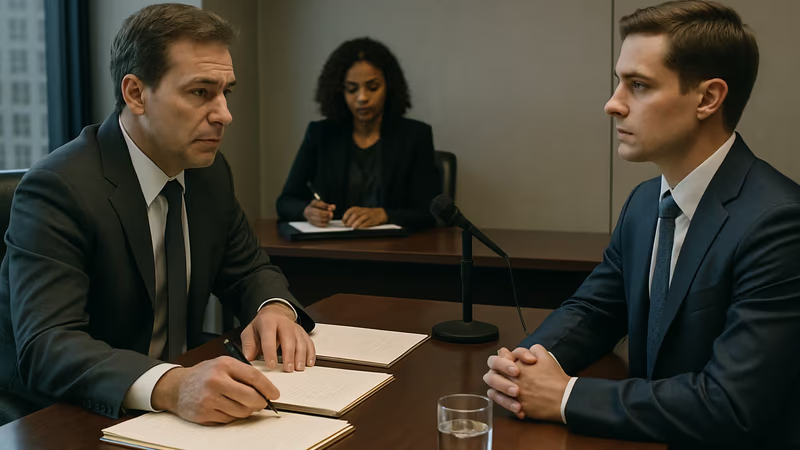
In a significant ruling that impacts how insurance companies can demand Examinations Under Oath (EUOs) in New York, the Appellate Term Second Department clarified that insurers do not need to provide objective reasons for requesting these examinations. This decision in Actual Chiropractic, P.C. v State Farm Ins, 2019 NY Slip Op 51552(U)(App. Term 2d Dept 2019) has important implications for both healthcare providers and patients seeking no-fault benefits.
The Court’s Ruling on EUO Requirements
The court stated clearly: “Contrary to plaintiff’s contention, defendant was not required to set forth objective reasons for requesting the EUOs in order to establish its prima facie entitlement to summary judgment, as an insurer need only demonstrate ‘as a matter of law that it twice duly demanded an from the … that the twice failed to appear, and that the issued a timely denial of the claim.’ ”
This ruling establishes that insurance companies have broad discretion in demanding EUOs from healthcare providers, even without presenting specific objective justifications for their request.
What This Means for Healthcare Providers
For medical providers treating accident victims in New York, this decision creates several important considerations:
Compliance is Critical
Healthcare providers must take all EUO requests seriously, regardless of whether they believe the insurer has valid grounds. Failure to appear for two properly scheduled EUOs can result in claim denials that are difficult to overturn.
Legal Strategy Implications
Providers can no longer successfully challenge EUO denials solely on the basis that the insurer lacked objective reasons for the examination request. The focus must shift to procedural compliance and proper notice requirements.
Documentation Requirements
While insurers don’t need objective basis, they still must follow proper procedures. Providers should carefully document all communications and ensure they receive proper notice of EUO requirements, including adequate time and location details.
The Broader Context of New York No-Fault Law
This ruling reflects the ongoing tension between insurance companies seeking to control costs and healthcare providers trying to obtain payment for legitimate services. The New York No-Fault Insurance Law was designed to provide prompt payment for medical treatment following motor vehicle accidents, but disputes over EUO requirements have become increasingly common.
Impact on Personal Injury Cases
For individuals involved in car accidents in New York, this ruling means that their healthcare providers may face additional scrutiny from insurance companies. Patients should be aware that treatment delays could occur if their providers are required to attend EUOs.
The decision also highlights the importance of having experienced legal representation when dealing with insurance claim disputes. An attorney familiar with personal injury law can help address these complex procedural requirements.
Historical Perspective and Recurring Issues
As noted in the original commentary, this type of challenge has appeared before in New York courts. The repeated appeals on similar issues suggest that some parties may be “appealing the same issue and expecting different results” – a pattern that the legal community has observed with concern.
The consistency of rulings in this area indicates that insurance companies have significant leverage when it comes to EUO requirements, and healthcare providers must adapt their practices accordingly.
Practical Steps for Providers and Patients
For Healthcare Providers:
- Respond promptly to all EUO requests
- Maintain detailed records of all communications with insurers
- Ensure proper legal representation for EUO proceedings
- Consider the cost-benefit analysis of pursuing disputed claims
For Accident Victims:
- Stay informed about your provider’s insurance disputes
- Maintain copies of all medical documentation
- Consider seeking legal counsel if treatment is delayed due to EUO issues
- Understand your rights under New York’s No-Fault Insurance Law
When to Seek Legal Assistance
If you’re dealing with insurance claim disputes, EUO requirements, or delays in receiving no-fault benefits following a motor vehicle accident, it’s crucial to have experienced legal representation. The complexity of New York’s no-fault system requires attorneys who understand both the statutory requirements and the evolving case law.
Issues that warrant immediate legal attention include:
- Denied no-fault claims following EUO proceedings
- Improper EUO notice or scheduling
- Disputes over the scope of EUO examinations
- Delays in benefit payments affecting medical treatment
- Insurance company bad faith practices
Frequently Asked Questions
Do insurance companies need a reason to request an EUO?
No, according to the Actual Chiropractic v State Farm decision, insurance companies do not need to provide objective reasons for requesting an EUO. They simply must follow proper procedures in making the demand.
What happens if a provider misses an EUO appointment?
If a healthcare provider fails to appear for two properly scheduled EUOs, the insurance company can deny the claim and will likely prevail in any subsequent litigation challenging that denial.
Can patients do anything if their provider’s EUO causes treatment delays?
Patients should maintain documentation of any treatment delays and may want to consult with a personal injury attorney to understand their options, including potential claims against the insurance company for unreasonable delays.
Are there any limits on insurance company EUO requests?
While insurers don’t need objective basis for the initial request, they still must follow procedural requirements including proper notice, reasonable scheduling, and adherence to regulatory guidelines.
How can providers protect themselves in EUO situations?
Providers should respond promptly to all requests, maintain detailed records, seek legal counsel when appropriate, and ensure they understand their obligations under New York’s no-fault regulations.
Contact an Experienced New York Personal Injury Attorney
Navigating insurance claim disputes and EUO requirements requires experienced legal guidance. If you’re dealing with denied no-fault benefits, EUO complications, or other insurance-related issues following a motor vehicle accident, don’t face the insurance companies alone.
The Law Office of Jason Tenenbaum has extensive experience handling complex no-fault insurance disputes and personal injury cases throughout New York. We understand the intricacies of EUO procedures and can help protect your rights while pursuing the compensation you deserve.
Call 516-750-0595 for a free consultation to discuss your case and learn how we can help you address the complex world of New York’s no-fault insurance system.
Related Articles
Legal Context
Why This Matters for Your Case
New York law is among the most complex and nuanced in the country, with distinct procedural rules, substantive doctrines, and court systems that differ significantly from other jurisdictions. The Civil Practice Law and Rules (CPLR) governs every stage of civil litigation, from service of process through trial and appeal. The Appellate Division, Appellate Term, and Court of Appeals create a rich and ever-evolving body of case law that practitioners must follow.
Attorney Jason Tenenbaum has practiced across these areas for over 24 years, writing more than 1,000 appellate briefs and publishing over 2,353 legal articles that attorneys and clients rely on for guidance. The analysis in this article reflects real courtroom experience — from motion practice in Civil Court and Supreme Court to oral arguments before the Appellate Division — and a deep understanding of how New York courts actually apply the law in practice.
Keep Reading
More EUO issues Analysis

EUO No-Show: Attorney Affirmation Sufficient Despite Time Lapse Between No-Shows and Execution
Appellate Term reverses Civil Court, holding that an attorney's affirmation attesting to plaintiff's failure to appear at EUOs was sufficient despite a 'significant lapse in time.'...
Feb 25, 2026
EUO no-show – correct statement of law
Court ruling clarifies that insurers cannot enforce EUO requests sent more than 30 days after receiving claims, making late requests nullities under New York no-fault law.
May 22, 2021
EUO no show – discovery is waived when objection not lodged
Court ruling clarifies that healthcare providers who fail to respond to EUO requests cannot later challenge their reasonableness, waiving discovery rights in no-fault litigation.
Jul 13, 2016
Obligations of Assignee and Authorized entity
Key court ruling on EUO obligations for healthcare providers with assigned benefits or authorization to pay in New York no-fault insurance cases.
Mar 19, 2015
EUO statements of law
Court ruling establishes that healthcare providers who fail to respond to EUO requests cannot later raise objections, reinforcing insurer notification requirements.
May 16, 2013
An objective standard is not necessary
New York court clarifies that insurers don't need to provide objective reasons for EUO requests when seeking summary judgment for provider no-shows.
Jul 24, 2019Was this article helpful?

About the Author
Jason Tenenbaum, Esq.
Jason Tenenbaum is the founding attorney of the Law Office of Jason Tenenbaum, P.C., headquartered at 326 Walt Whitman Road, Suite C, Huntington Station, New York 11746. With over 24 years of experience since founding the firm in 2002, Jason has written more than 1,000 appeals, handled over 100,000 no-fault insurance cases, and recovered over $100 million for clients across Long Island, Nassau County, Suffolk County, Queens, Brooklyn, Manhattan, the Bronx, and Staten Island. He is one of the few attorneys in the state who both writes his own appellate briefs and tries his own cases.
Jason is admitted to practice in New York, New Jersey, Florida, Texas, Georgia, and Michigan state courts, as well as multiple federal courts. His 2,353+ published legal articles analyzing New York case law, procedural developments, and litigation strategy make him one of the most prolific legal commentators in the state. He earned his Juris Doctor from Syracuse University College of Law.
Disclaimer: This article is published by the Law Office of Jason Tenenbaum, P.C. for informational and educational purposes only. It does not constitute legal advice, and no attorney-client relationship is formed by reading this content. The legal principles discussed may not apply to your specific situation, and the law may have changed since this article was last updated.
New York law varies by jurisdiction — court decisions in one Appellate Division department may not be followed in another, and local court rules in Nassau County Supreme Court differ from those in Suffolk County Supreme Court, Kings County Civil Court, or Queens County Supreme Court. The Appellate Division, Second Department (which covers Long Island, Brooklyn, Queens, and Staten Island) and the Appellate Term (which hears appeals from lower courts) each have distinct procedural requirements and precedents that affect litigation strategy.
If you need legal help with a euo issues matter, contact our office at (516) 750-0595 for a free consultation. We serve clients throughout Long Island (Huntington, Babylon, Islip, Brookhaven, Smithtown, Riverhead, Southampton, East Hampton), Nassau County (Hempstead, Garden City, Mineola, Great Neck, Manhasset, Freeport, Long Beach, Rockville Centre, Valley Stream, Westbury, Hicksville, Massapequa), Suffolk County (Hauppauge, Deer Park, Bay Shore, Central Islip, Patchogue, Brentwood), Queens, Brooklyn, Manhattan, the Bronx, Staten Island, and Westchester County. Prior results do not guarantee a similar outcome.