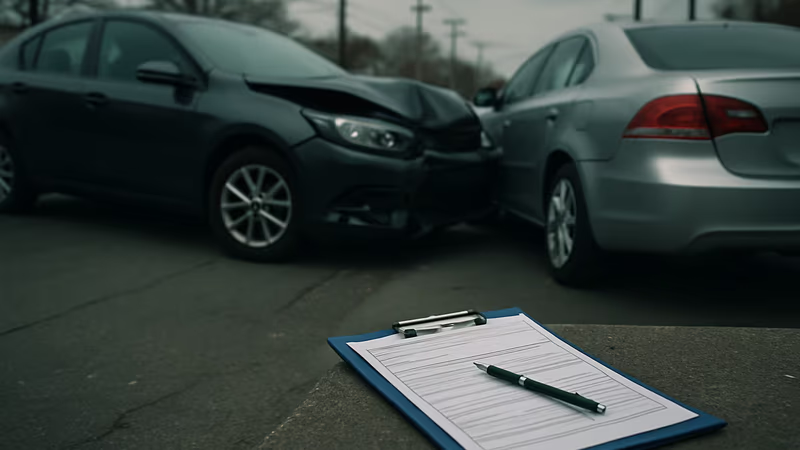
Key Takeaway
Court finds that medical reports citing only degenerative changes fail to eliminate factual disputes when they don't address patient's lack of pre-accident pain complaints.
This article is part of our ongoing no-fault coverage, with 271 published articles analyzing no-fault issues across New York State. Attorney Jason Tenenbaum brings 24+ years of hands-on experience to this analysis, drawing from his work on more than 1,000 appeals, over 100,000 no-fault cases, and recovery of over $100 million for clients throughout Nassau County, Suffolk County, Queens, Brooklyn, Manhattan, and the Bronx. For personalized legal advice about how these principles apply to your specific situation, contact our Long Island office at (516) 750-0595 for a free consultation.
Understanding Medical Causation in No-Fault Insurance Cases
In New York no-fault insurance litigation, establishing causation between a motor vehicle accident and claimed injuries is crucial for coverage. Insurance companies frequently rely on medical experts who review imaging studies and conclude that findings represent only “pre-existing degenerative changes” — essentially arguing that the patient’s condition existed before the accident. However, as demonstrated in a recent Fourth Department decision, such conclusions may not be sufficient to eliminate all factual disputes, particularly when the medical analysis fails to address key evidence about the patient’s pre-accident condition.
This case highlights an important principle in New York no-fault insurance law: even when imaging studies show degenerative changes, courts will look beyond the raw medical findings to determine whether causation questions remain for trial.
Jason Tenenbaum’s Analysis:
Barnes v Occhino, 2019 NY Slip Op 03159 (4th Dept. 2019)
(1) ” That report contains a review of plaintiff’s imaging studies, which showed disc herniations, and plaintiff’s medical records, which noted that plaintiff had significant limited range of motion as well as muscle spasms, thus raising a triable issue of fact whether there was objective evidence of an injury ”
(2)“Defendants’ submissions in support of their motion also raised a triable issue of fact whether the motor vehicle accident caused plaintiff’s alleged injuries (see Schaubroeck v Moriarty, 162 AD3d 1608, 1609 ). In the affirmed report of the same physician, he opined that the imaging studies showed only preexisting degenerative changes, but he ” fail to account for evidence that plaintiff had no complaints of pain prior to the accident’ ” (Crane, 151 AD3d at 1842; see Thomas v Huh, 115 AD3d 1225, 1226 ). ”
This is really interesting. A physician who reviews a study and says it is all degenerative will not eliminate all issues of fact where the report fails to account for evidence of a lack of pain prior to the incident.
Key Takeaway
Medical experts cannot simply declare injuries as “pre-existing degenerative changes” without addressing the complete clinical picture. When a physician’s report fails to account for evidence that a patient had no pain complaints before the accident, factual questions about causation remain that must be resolved at trial rather than dismissed on summary judgment.
Related Articles
- Understanding CPLR 3212(a): Critical Timing Rules for Summary Judgment Motions in New York
- The CPLR 3212(g) paradigm
- Understanding IME No-Shows in New York No-Fault Insurance: Rights, Consequences, and Strategic Considerations
- No-Fault Verification Requirements: When Partial Compliance Isn’t Enough
- New York No-Fault Insurance Law
Legal Context
Why This Matters for Your Case
New York's no-fault insurance system, established under Insurance Law Article 51, is one of the most complex insurance frameworks in the country. Every motorist must carry Personal Injury Protection coverage that pays medical expenses and lost wages regardless of fault, up to $50,000 per person.
But insurers routinely deny valid claims using peer reviews, EUO scheduling tactics, fee schedule reductions, and coverage defenses. The Law Office of Jason Tenenbaum has handled over 100,000 no-fault cases since 2002 — from initial claim submissions through arbitration before the American Arbitration Association, trials in Civil Court and Supreme Court, and appeals to the Appellate Term and Appellate Division. Jason Tenenbaum is one of the few attorneys in the state who both writes his own appellate briefs and tries his own cases.
His 2,353+ published legal articles on no-fault practice are cited by attorneys throughout New York. Whether you are dealing with a medical necessity denial, an EUO no-show defense, a fee schedule dispute, or a coverage question, this article provides the kind of detailed case-law analysis that helps practitioners and claimants understand exactly where the law stands.
About This Topic
New York No-Fault Insurance Law
New York's no-fault insurance system requires every driver to carry Personal Injury Protection (PIP) coverage that pays medical expenses and lost wages regardless of who caused the accident. But insurers routinely deny, delay, and underpay valid claims — using peer reviews, IME no-shows, and fee schedule defenses to avoid paying providers and injured claimants. Attorney Jason Tenenbaum has litigated thousands of no-fault arbitrations and court cases since 2002.
271 published articles in No-Fault
Keep Reading
More No-Fault Analysis
Priority of Payment Regulation Has No Force in Arbitration: First and Second Departments Agree
Both the First and Second Departments have held that the priority of payment regulation under 11 NYCRR 65-3.15 is of no force or effect in no-fault arbitration proceedings....
Feb 25, 2026
How Insurance Companies Use Colossus Software to Undervalue Your Injury Claim
Insurance companies use Colossus software to lowball your injury claim. Learn how this system works and how a Long Island attorney can fight back. Call 516-750-0595.
Feb 18, 2026
MVAIC issues
Key MVAIC case law on timely claim filing requirements and police reporting obligations under New York no-fault insurance law, including coverage defenses.
May 6, 2017
Is this our Judge Cooper from Nassau?
Nassau County Judge Cooper's long career in no-fault insurance law cases, including IME no-show cross-motions and summary judgment practice in District Court.
Jul 18, 2011
The Declaratory Judgment Order v. The Civil Court order
Court rules that timing matters in no-fault litigation when declaratory judgment orders conflict with civil court proceedings - first in time, first in right principle applies.
Sep 25, 2022
Lost wages and first party: to arbitrate or to litigate
New York no-fault lost wages cases: when to arbitrate vs litigate for first-party claims. Expert analysis of NF-6 workers, evidentiary issues, and medical complications.
Jul 27, 2021Common Questions
Frequently Asked Questions
What is New York's no-fault insurance system?
New York's no-fault insurance system, codified in Insurance Law Article 51, requires all drivers to carry Personal Injury Protection (PIP) coverage. This pays for medical expenses, lost wages (up to $2,000/month), and other basic economic loss regardless of who caused the accident, up to $50,000 per person. However, to sue for pain and suffering, you must meet the 'serious injury' threshold under Insurance Law §5102(d).
How do I fight a no-fault insurance claim denial?
When a no-fault claim is denied, you can challenge it through mandatory arbitration under the American Arbitration Association's no-fault rules, or by filing a lawsuit in court. Common defenses to denials include challenging the timeliness of the denial, the adequacy of the peer review report, or the insurer's compliance with regulatory requirements. An experienced no-fault attorney can evaluate which strategy gives you the best chance of overturning the denial.
What is the deadline to file a no-fault claim in New York?
Under 11 NYCRR §65-1.1, you must submit a no-fault application (NF-2 form) within 30 days of the accident. Medical providers must submit claims within 45 days of treatment. Missing these deadlines can result in claim denial, though there are limited exceptions for late notice if the claimant can demonstrate a reasonable justification.
What no-fault benefits am I entitled to after a car accident in New York?
Under Insurance Law §5102(b), no-fault PIP covers necessary medical expenses, 80% of lost earnings up to $2,000/month, up to $25/day for other reasonable expenses, and a $2,000 death benefit. These benefits are available regardless of fault, up to the $50,000 policy limit. Claims are paid by your own insurer — not the at-fault driver's.
Can I choose my own doctor for no-fault treatment in New York?
Yes. Under New York's no-fault regulations, you have the right to choose your own physician, chiropractor, physical therapist, or other licensed healthcare provider. The insurer cannot dictate which providers you see. However, the insurer can request an IME with their chosen doctor and may challenge the medical necessity of your treatment through peer review.
Was this article helpful?

About the Author
Jason Tenenbaum, Esq.
Jason Tenenbaum is the founding attorney of the Law Office of Jason Tenenbaum, P.C., headquartered at 326 Walt Whitman Road, Suite C, Huntington Station, New York 11746. With over 24 years of experience since founding the firm in 2002, Jason has written more than 1,000 appeals, handled over 100,000 no-fault insurance cases, and recovered over $100 million for clients across Long Island, Nassau County, Suffolk County, Queens, Brooklyn, Manhattan, the Bronx, and Staten Island. He is one of the few attorneys in the state who both writes his own appellate briefs and tries his own cases.
Jason is admitted to practice in New York, New Jersey, Florida, Texas, Georgia, and Michigan state courts, as well as multiple federal courts. His 2,353+ published legal articles analyzing New York case law, procedural developments, and litigation strategy make him one of the most prolific legal commentators in the state. He earned his Juris Doctor from Syracuse University College of Law.
Disclaimer: This article is published by the Law Office of Jason Tenenbaum, P.C. for informational and educational purposes only. It does not constitute legal advice, and no attorney-client relationship is formed by reading this content. The legal principles discussed may not apply to your specific situation, and the law may have changed since this article was last updated.
New York law varies by jurisdiction — court decisions in one Appellate Division department may not be followed in another, and local court rules in Nassau County Supreme Court differ from those in Suffolk County Supreme Court, Kings County Civil Court, or Queens County Supreme Court. The Appellate Division, Second Department (which covers Long Island, Brooklyn, Queens, and Staten Island) and the Appellate Term (which hears appeals from lower courts) each have distinct procedural requirements and precedents that affect litigation strategy.
If you need legal help with a no-fault matter, contact our office at (516) 750-0595 for a free consultation. We serve clients throughout Long Island (Huntington, Babylon, Islip, Brookhaven, Smithtown, Riverhead, Southampton, East Hampton), Nassau County (Hempstead, Garden City, Mineola, Great Neck, Manhasset, Freeport, Long Beach, Rockville Centre, Valley Stream, Westbury, Hicksville, Massapequa), Suffolk County (Hauppauge, Deer Park, Bay Shore, Central Islip, Patchogue, Brentwood), Queens, Brooklyn, Manhattan, the Bronx, Staten Island, and Westchester County. Prior results do not guarantee a similar outcome.