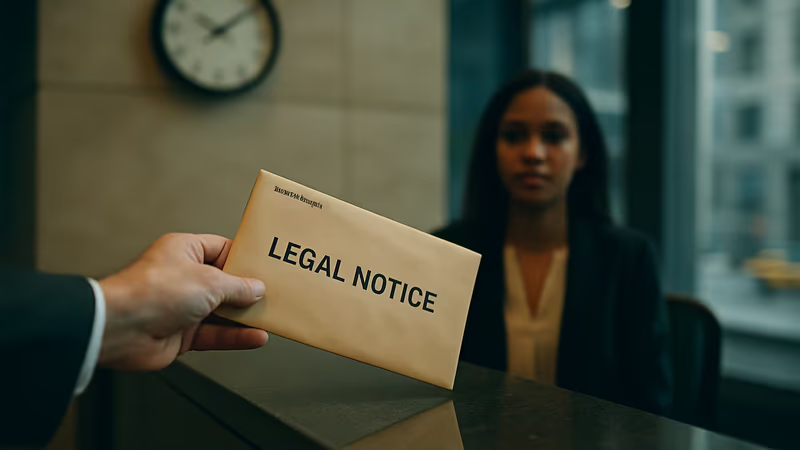
Key Takeaway
Court ruling reinforces 30-day notice requirement for no-fault claims, with insurance company successfully defending late notice denial under 11 NYCRR 65-1.1.
This article is part of our ongoing timely notice of claim coverage, with 15 published articles analyzing timely notice of claim issues across New York State. Attorney Jason Tenenbaum brings 24+ years of hands-on experience to this analysis, drawing from his work on more than 1,000 appeals, over 100,000 no-fault cases, and recovery of over $100 million for clients throughout Nassau County, Suffolk County, Queens, Brooklyn, Manhattan, and the Bronx. For personalized legal advice about how these principles apply to your specific situation, contact our Long Island office at (516) 750-0595 for a free consultation.
New York’s no-fault insurance system operates under strict procedural requirements, and one of the most fundamental is the 30-day notice rule. Medical providers and other parties seeking reimbursement under no-fault policies must submit written notice of an accident within 30 days of its occurrence, as mandated by 11 NYCRR 65-1.1. When this deadline is missed, insurance companies can deny claims based solely on late notice, shifting the burden to the claimant to demonstrate reasonable excuse for the delay.
The Dynasty Med. Care case exemplifies how courts analyze these timing disputes. Here, the insurance company received the required NF-2 form more than 30 days after the accident, providing clear grounds for denial. The insurer properly followed protocol by timely mailing denial forms and advising that late notice could be excused only with reasonable justification under 11 NYCRR 65-3.3.
Jason Tenenbaum’s Analysis:
Dynasty Med. Care, P.C. v 21st Century Sec. Ins. Co., 2018 NY Slip Op 51550(U)(App. Term 2d Dept. 2018)
“Contrary to plaintiff’s contentions, defendant established that it had first learned of the accident on the date it had received an NF-2 form, which form had been submitted more than 30 days after the accident had occurred, and that it had timely mailed (see St. Vincent’s Hosp. of Richmond v Government Empls. Ins. Co., 50 AD3d 1123 ) its denial of claim forms, which denied plaintiff’s claims on the ground that written notice of the accident had not been submitted to defendant within 30 days of its occurrence (see 11 NYCRR 65-1.1 ). The denial of claim forms further advised plaintiff that late notice would be excused if reasonable justification for the failure to give timely notice was provided (see 11 NYCRR 65-3.3 ). As defendant established its prima facie entitlement to judgment as a matter of law ”
Always interesting.
Key Takeaway
This decision reinforces that insurance companies can successfully defend no-fault claims by proving they received written notice more than 30 days after an accident occurred. The court emphasized that timely written notice is required - oral notice alone may not suffice - and that insurers must properly advise claimants about potential exceptions for late notice with reasonable justification.
Legal Update (February 2026): Since this post’s publication in 2018, the no-fault insurance regulations cited (11 NYCRR 65-1 and 11 NYCRR 65-3) may have been amended, and New York’s no-fault fee schedules and procedural requirements have undergone periodic updates. Additionally, subsequent case law may have refined the analysis of timely notice requirements and reasonable excuse standards. Practitioners should verify current regulatory provisions and recent judicial interpretations when advising on notice timing issues.
Related Articles
Legal Context
Why This Matters for Your Case
New York law is among the most complex and nuanced in the country, with distinct procedural rules, substantive doctrines, and court systems that differ significantly from other jurisdictions. The Civil Practice Law and Rules (CPLR) governs every stage of civil litigation, from service of process through trial and appeal. The Appellate Division, Appellate Term, and Court of Appeals create a rich and ever-evolving body of case law that practitioners must follow.
Attorney Jason Tenenbaum has practiced across these areas for over 24 years, writing more than 1,000 appellate briefs and publishing over 2,353 legal articles that attorneys and clients rely on for guidance. The analysis in this article reflects real courtroom experience — from motion practice in Civil Court and Supreme Court to oral arguments before the Appellate Division — and a deep understanding of how New York courts actually apply the law in practice.
Keep Reading
More Timely notice of claim Analysis

Reasonable excuse?
New York appellate court rules that clerical error alone cannot justify sending no-fault forms to wrong insurer, emphasizing strict compliance with 45-day claim requirements.
Dec 18, 2018
Some doors have swung open
Court case analysis on timely notice requirements for no-fault insurance claims, examining whether NF-3 forms can serve as proper accident notice to carriers.
Jan 24, 2017
The Court of Appeals discusses a condition precedent
Court of Appeals ruling on hospital NF-5 submissions and 30-day notification requirements under New York no-fault insurance condition precedent rules.
Oct 14, 2011
The first appellate case interpretting the one year rule
First appellate case interpreting New York's no-fault one year rule for treatment requirements - Marc Habif v Kemper Auto case analysis and key takeaways.
Jun 10, 2010
Written proof of loss is when it is mailed
Court rules that mailing written proof of loss satisfies 30-day notice requirement under NY no-fault insurance regulations, even if insurer receives it later.
Mar 21, 2016
An oral notice of claim is deemed sufficient notice?
New York court rules oral notification sufficient for no-fault claims, raising questions about written notice requirements and trial strategy in insurance disputes.
Aug 28, 2014Common Questions
Frequently Asked Questions
What are the notice of claim requirements in New York?
For claims against municipalities, General Municipal Law §50-e requires a notice of claim within 90 days of the incident. For insurance claims, timely notice to the insurer is a condition precedent to coverage. Late notice can result in denial of benefits or dismissal of the claim, though courts may grant extensions in limited circumstances.
Can a late notice of claim be excused?
Under GML §50-e(5), courts have discretion to grant leave to serve a late notice of claim. Factors include whether the claimant was an infant or incapacitated, whether the municipality had actual knowledge of the claim, and whether the delay caused prejudice. For insurance claims, late notice is harder to excuse and typically requires demonstrating reasonable justification.
What happens if I fail to give timely notice to my insurer?
Failure to provide timely notice to your insurer can result in denial of your claim. In no-fault cases, the 30-day deadline for the NF-2 application is strictly enforced. For other insurance claims, the policy typically requires notice "as soon as practicable." Late notice gives the insurer a strong defense unless you can demonstrate a valid excuse.
Was this article helpful?

About the Author
Jason Tenenbaum, Esq.
Jason Tenenbaum is the founding attorney of the Law Office of Jason Tenenbaum, P.C., headquartered at 326 Walt Whitman Road, Suite C, Huntington Station, New York 11746. With over 24 years of experience since founding the firm in 2002, Jason has written more than 1,000 appeals, handled over 100,000 no-fault insurance cases, and recovered over $100 million for clients across Long Island, Nassau County, Suffolk County, Queens, Brooklyn, Manhattan, the Bronx, and Staten Island. He is one of the few attorneys in the state who both writes his own appellate briefs and tries his own cases.
Jason is admitted to practice in New York, New Jersey, Florida, Texas, Georgia, and Michigan state courts, as well as multiple federal courts. His 2,353+ published legal articles analyzing New York case law, procedural developments, and litigation strategy make him one of the most prolific legal commentators in the state. He earned his Juris Doctor from Syracuse University College of Law.
Disclaimer: This article is published by the Law Office of Jason Tenenbaum, P.C. for informational and educational purposes only. It does not constitute legal advice, and no attorney-client relationship is formed by reading this content. The legal principles discussed may not apply to your specific situation, and the law may have changed since this article was last updated.
New York law varies by jurisdiction — court decisions in one Appellate Division department may not be followed in another, and local court rules in Nassau County Supreme Court differ from those in Suffolk County Supreme Court, Kings County Civil Court, or Queens County Supreme Court. The Appellate Division, Second Department (which covers Long Island, Brooklyn, Queens, and Staten Island) and the Appellate Term (which hears appeals from lower courts) each have distinct procedural requirements and precedents that affect litigation strategy.
If you need legal help with a timely notice of claim matter, contact our office at (516) 750-0595 for a free consultation. We serve clients throughout Long Island (Huntington, Babylon, Islip, Brookhaven, Smithtown, Riverhead, Southampton, East Hampton), Nassau County (Hempstead, Garden City, Mineola, Great Neck, Manhasset, Freeport, Long Beach, Rockville Centre, Valley Stream, Westbury, Hicksville, Massapequa), Suffolk County (Hauppauge, Deer Park, Bay Shore, Central Islip, Patchogue, Brentwood), Queens, Brooklyn, Manhattan, the Bronx, Staten Island, and Westchester County. Prior results do not guarantee a similar outcome.