Key Takeaway
New York court clarifies that defendants can be served with legal papers even inside courtrooms, rejecting the misconception that courthouse appearances provide immunity from service.
This article is part of our ongoing jurisdiction coverage, with 12 published articles analyzing jurisdiction issues across New York State. Attorney Jason Tenenbaum brings 24+ years of hands-on experience to this analysis, drawing from his work on more than 1,000 appeals, over 100,000 no-fault cases, and recovery of over $100 million for clients throughout Nassau County, Suffolk County, Queens, Brooklyn, Manhattan, and the Bronx. For personalized legal advice about how these principles apply to your specific situation, contact our Long Island office at (516) 750-0595 for a free consultation.
The Myth of Courthouse Immunity from Service of Process
Many defendants mistakenly believe that appearing in court provides them with some form of immunity from being served with legal papers in other cases. This misconception stems from a misunderstanding of New York’s service of process rules and jurisdictional requirements. The reality is that courthouses are public spaces where service of process remains entirely permissible, and defendants who attend court proceedings for one matter can lawfully be served with papers related to entirely different legal disputes.
The widespread but incorrect notion of “courthouse sanctuary” has led some litigants to avoid service by simply declining to physically accept papers handed to them in courtrooms. However, New York law recognizes alternative methods of service when defendants resist or refuse to accept process. Understanding these jurisdictional concepts is crucial for anyone involved in litigation, as improper assumptions about service can result in default judgments and other serious legal consequences.
This decision also touches on broader issues of personal jurisdiction and the various methods courts use to establish authority over defendants, particularly when jurisdictional defenses are raised. The Second Department’s analysis provides important guidance on both the permissibility of courtroom service and the application of long-arm jurisdiction statutes.
Sandella v Hill, 2018 NY Slip Op 08051 (2d Dept. 2018)
Case Background
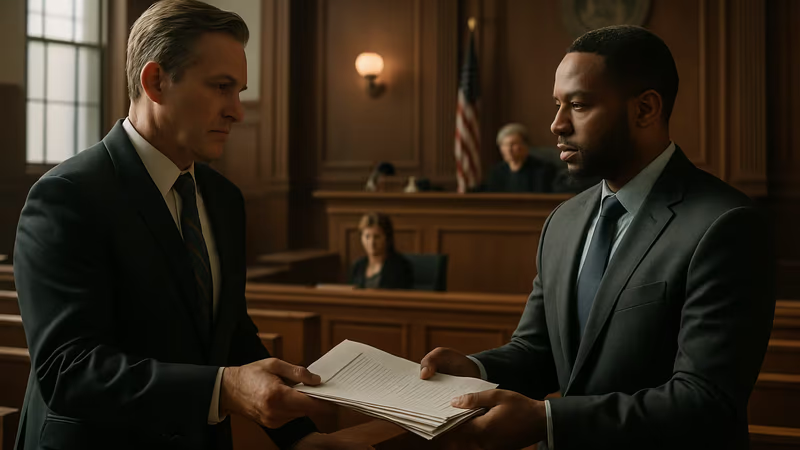
The defendant in Sandella v Hill was waiting for his case to be called in a courtroom when someone entered, called out his name, and dropped legal papers on the floor near him. The defendant indicated that he did not pick up the papers because his attorney had advised him that service could not be effected in a courtroom. The defendant later moved to vacate a default judgment that had been entered against him, arguing that he had never been properly served.
The Supreme Court denied the defendant’s motion to vacate the default judgment without conducting a hearing. The defendant appealed, arguing both that service in the courtroom was improper and that, as a non-domiciliary, he could not be served in New York based solely on a court appearance. The Second Department addressed both the validity of service within the courtroom itself and the broader question of whether the defendant’s presence in New York for court proceedings subjected him to personal jurisdiction in an unrelated matter.
Jason’s Analysis
“According to the defendant, as he was waiting for his case to be called, an unknown person came into the courtroom, called out his name, and dropped some papers on the floor. The defendant indicated that he did not pick the papers up because his attorney told him that he could not be served in court. The Supreme Court, without a hearing, denied the defendant’s motion to vacate the default judgment.”
“If a defendant resists service of process, service may be effected pursuant to CPLR 308(1) by leaving a copy of the summons in the defendant’s general vicinity, provided that the defendant is made aware that this is being done”
(This case rested upon the notion that a non-domiciliary could not be served due a special appearance in New York. The Court held that even if this was true, defendant could have been served outside of New York on a Touza theory pCPLR 302; 313])
Legal Significance
The Sandella decision definitively rejects the notion that courtrooms provide sanctuary from service of process. The Second Department’s holding clarifies that there is no prohibition against serving defendants with legal papers while they are present in court for unrelated matters. This ruling aligns with the general principle that courthouses are public spaces where the normal rules of civil procedure apply, and parties cannot avoid service simply by being present for judicial proceedings.
Furthermore, the decision provides important guidance on resisting service. When defendants refuse to accept papers, process servers need not physically place documents in the defendant’s hands. Instead, service can be accomplished by leaving papers in the defendant’s general vicinity and making the defendant aware that service is being attempted. This prevents defendants from defeating service through the simple expedient of refusing to accept papers offered to them.
Practical Implications
For process servers and plaintiffs’ attorneys, this case confirms that courtrooms remain viable locations for service of process. When defendants are identifiable and present in court, servers can effect service by announcing the defendant’s name, making clear that service is being attempted, and leaving the papers in the defendant’s vicinity. This method satisfies CPLR 308(1) requirements even when defendants refuse to physically accept the documents.
Defendants and their attorneys should understand that appearing in court provides no protection from service in other cases. The erroneous advice given to the defendant in Sandella—that he could not be served in court—resulted in a default judgment that the appellate court upheld. Attorneys who provide such incorrect guidance potentially expose their clients to serious adverse consequences, including judgments entered without opportunity to defend on the merits.
Key Takeaway
The court’s decision reinforces that there is no “courthouse sanctuary” rule protecting defendants from service of process. When defendants resist service, courts will allow alternative methods as long as the defendant is made aware that papers are being served, even if they refuse to accept them directly.
Legal Context
Why This Matters for Your Case
New York law is among the most complex and nuanced in the country, with distinct procedural rules, substantive doctrines, and court systems that differ significantly from other jurisdictions. The Civil Practice Law and Rules (CPLR) governs every stage of civil litigation, from service of process through trial and appeal. The Appellate Division, Appellate Term, and Court of Appeals create a rich and ever-evolving body of case law that practitioners must follow.
Attorney Jason Tenenbaum has practiced across these areas for over 24 years, writing more than 1,000 appellate briefs and publishing over 2,353 legal articles that attorneys and clients rely on for guidance. The analysis in this article reflects real courtroom experience — from motion practice in Civil Court and Supreme Court to oral arguments before the Appellate Division — and a deep understanding of how New York courts actually apply the law in practice.
Keep Reading
More Jurisdiction Analysis
Place a call and your jurisdictional defense will fall
New York court ruling shows how defendants can waive jurisdictional defenses through conduct, even when challenging court jurisdiction years later.
Sep 25, 2020
The lack of value of a notice of appearance
New York's CPLR requires defendants to challenge personal jurisdiction within 60 days or risk waiver, even with protective language in notices of appearance.
Nov 3, 2019
Fraudulent procurement of insurance has serious consequences
New Jersey's strict insurance compliance requirements bar claims when drivers fail to maintain state-approved coverage, highlighting jurisdictional challenges in auto accident...
Oct 20, 2018
Default denied based upon quirk of NYCCCA 403 and 404
New York City Civil Court Act sections 403 and 404 create jurisdictional quirk that can defeat default judgments when service of process is made outside NYC limits.
May 6, 2017
No jurisdiction
New York courts lack jurisdiction over out-of-state insurance carriers not licensed or authorized to conduct business in the state, as demonstrated in this appellate case.
Mar 18, 2014
CAN-O
New York court rejects hospital's jurisdictional challenge in no-fault insurance declaratory judgment action, establishing important precedent for provider liability cases.
Jun 23, 2012Common Questions
Frequently Asked Questions
How is jurisdiction determined in New York civil cases?
New York has several court systems with different jurisdictional limits. Supreme Court has unlimited jurisdiction. Civil Court handles claims up to $25,000 in NYC, while District Courts handle claims up to $15,000 in Nassau and Suffolk counties. Small Claims Court handles claims up to $10,000.
What is personal jurisdiction and how is it established in New York?
Personal jurisdiction requires that the defendant has sufficient contacts with New York. Under CPLR 301, a defendant domiciled in NY is subject to jurisdiction. Under CPLR 302 (long-arm statute), jurisdiction exists if the claim arises from the defendant's business in NY, tortious act in NY, or ownership of NY property.
Can venue affect my no-fault or personal injury case?
Yes. Venue determines which county hears your case. Under CPLR 503, venue is typically proper in the county where a party resides. For no-fault cases, this often means the county where the provider or insurer is located. Strategic venue selection can impact the outcome.
Was this article helpful?

About the Author
Jason Tenenbaum, Esq.
Jason Tenenbaum is the founding attorney of the Law Office of Jason Tenenbaum, P.C., headquartered at 326 Walt Whitman Road, Suite C, Huntington Station, New York 11746. With over 24 years of experience since founding the firm in 2002, Jason has written more than 1,000 appeals, handled over 100,000 no-fault insurance cases, and recovered over $100 million for clients across Long Island, Nassau County, Suffolk County, Queens, Brooklyn, Manhattan, the Bronx, and Staten Island. He is one of the few attorneys in the state who both writes his own appellate briefs and tries his own cases.
Jason is admitted to practice in New York, New Jersey, Florida, Texas, Georgia, and Michigan state courts, as well as multiple federal courts. His 2,353+ published legal articles analyzing New York case law, procedural developments, and litigation strategy make him one of the most prolific legal commentators in the state. He earned his Juris Doctor from Syracuse University College of Law.
Disclaimer: This article is published by the Law Office of Jason Tenenbaum, P.C. for informational and educational purposes only. It does not constitute legal advice, and no attorney-client relationship is formed by reading this content. The legal principles discussed may not apply to your specific situation, and the law may have changed since this article was last updated.
New York law varies by jurisdiction — court decisions in one Appellate Division department may not be followed in another, and local court rules in Nassau County Supreme Court differ from those in Suffolk County Supreme Court, Kings County Civil Court, or Queens County Supreme Court. The Appellate Division, Second Department (which covers Long Island, Brooklyn, Queens, and Staten Island) and the Appellate Term (which hears appeals from lower courts) each have distinct procedural requirements and precedents that affect litigation strategy.
If you need legal help with a jurisdiction matter, contact our office at (516) 750-0595 for a free consultation. We serve clients throughout Long Island (Huntington, Babylon, Islip, Brookhaven, Smithtown, Riverhead, Southampton, East Hampton), Nassau County (Hempstead, Garden City, Mineola, Great Neck, Manhasset, Freeport, Long Beach, Rockville Centre, Valley Stream, Westbury, Hicksville, Massapequa), Suffolk County (Hauppauge, Deer Park, Bay Shore, Central Islip, Patchogue, Brentwood), Queens, Brooklyn, Manhattan, the Bronx, Staten Island, and Westchester County. Prior results do not guarantee a similar outcome.