Key Takeaway
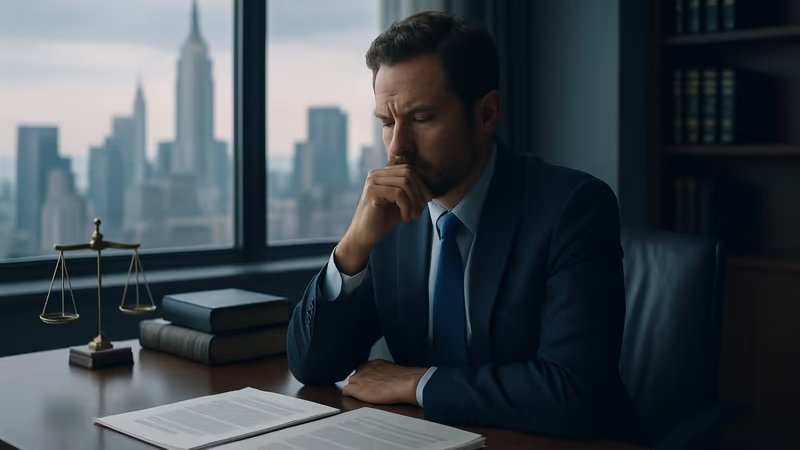
Attorney reflects on a difficult MAPFRE v Callahan case where opposing counsel failed to appear, resulting in default judgment and denied vacatur motion.
This article is part of our ongoing law office failure coverage, with 17 published articles analyzing law office failure issues across New York State. Attorney Jason Tenenbaum brings 24+ years of hands-on experience to this analysis, drawing from his work on more than 1,000 appeals, over 100,000 no-fault cases, and recovery of over $100 million for clients throughout Nassau County, Suffolk County, Queens, Brooklyn, Manhattan, and the Bronx. For personalized legal advice about how these principles apply to your specific situation, contact our Long Island office at (516) 750-0595 for a free consultation.
Matter of MAPFRE Ins. Co. of NY v Callahan, 2018 NY Slip Op 06016 (2d Dept 2018)
Facts:
“The Supreme Court ordered a framed-issue hearing to resolve the various issues raised by MAPFRE. Following a lengthy period of delay during which numerous adjournments of the hearing were granted, the matter was marked final and scheduled to be heard on May 19, 2016. MAPFRE’s counsel and a witness for MAPFRE appeared for the hearing. Callahan failed to appear on that date, despite having been subpoenaed. Moreover, although her attorney answered the calendar call that morning and indicated his readiness to proceed, he did not appear when the court convened the hearing less than two hours later, despite his receipt of text messages from opposing counsel requesting his presence, and he did not advise the court in advance that he might be delayed due to appearances on other matters. The court granted the petition on Callahan’s default and subsequently denied her motion pursuant to CPLR 5015(a)(1) to vacate the default.”
This is the decision denying vacatur of the order. Maybe I am getting too soft in my second decade of practicing because I would probably have not taken the default or consented to vacate the order if the facts as presented by Respondent in his order to show cause are true. But I cannot necessarily fault Petitioner’s counsel since he was sitting there for two hours twitting his thumbs after being sent out, and he was probably pissed as he had other things to do that day. It is a judgment call and, again, I hate to see other attorneys get jammed up for stuff like this.
For what its worth, I think my second employer would have fired me if I did not take the default in this situation. Thus, I cannot even pretend to tell you the reader what the right answer is in this case.
But let this be a lesson and I am taking note here that if you have to run around Court or various courts (heaven knows we all do) and you have a hearing, tell the part clerk you have three other things. That looks to be the difference in this case as to why the OSC was not grated.
Related Articles
Legal Context
Why This Matters for Your Case
New York law is among the most complex and nuanced in the country, with distinct procedural rules, substantive doctrines, and court systems that differ significantly from other jurisdictions. The Civil Practice Law and Rules (CPLR) governs every stage of civil litigation, from service of process through trial and appeal. The Appellate Division, Appellate Term, and Court of Appeals create a rich and ever-evolving body of case law that practitioners must follow.
Attorney Jason Tenenbaum has practiced across these areas for over 24 years, writing more than 1,000 appellate briefs and publishing over 2,353 legal articles that attorneys and clients rely on for guidance. The analysis in this article reflects real courtroom experience — from motion practice in Civil Court and Supreme Court to oral arguments before the Appellate Division — and a deep understanding of how New York courts actually apply the law in practice.
Keep Reading
More Law Office Failure Analysis

Law Office failure established through associate attorney deception
Court ruling shows how associate attorney deception and misconduct can establish law office failure, providing grounds for relief from missed depositions.
Nov 28, 2016
Rocket docket at the First Department
First Department appeal challenging rocket docket preclusion in no-fault case, examining law office failure standards and interest of justice review procedures.
Oct 18, 2016
Excusable neglect not acceptable
Court rejects attorney's heavy workload as excuse for missing deadline, emphasizing that mere neglect cannot justify vacating default orders in legal proceedings.
Mar 19, 2015
Default granted where answer is 6 months later
First Department demonstrates lenient approach to vacating default judgments based on law office failure, contrasting with Second Department's stricter stance on defaults.
Nov 14, 2014
More excusable law office failure
Law office failure case where First Department found excuse reasonable for restoring dismissed no-fault action despite paralegal's misunderstanding of case status on court website.
Nov 30, 2010
The proper mecanism to vacate a motion for summary judgment granted on default is through 5015(a)
Learn the proper mechanism to vacate summary judgment granted on default through CPLR 5015(a) motions vs renewal motions in NY no-fault insurance cases.
Oct 18, 2010Common Questions
Frequently Asked Questions
What is the "law office failure" defense in New York?
Law office failure is a recognized basis for excusable default under CPLR 5015(a)(1). It applies when an attorney's office experiences systemic failures — such as misplaced files, missed deadlines, or administrative breakdowns — that cause a default. Courts may vacate the default if the party shows a reasonable excuse and a meritorious defense.
When will courts accept law office failure as an excuse?
Courts evaluate law office failure on a case-by-case basis. Isolated mistakes, clerical errors, or staffing disruptions may be accepted. However, repeated negligence, willful disregard of deadlines, or patterns of defaults will not be excused. The moving party must also demonstrate a meritorious defense to the underlying claim.
How do I move to vacate a default based on law office failure?
File a motion under CPLR 5015(a)(1) demonstrating (1) a reasonable excuse for the default (the law office failure) and (2) a meritorious defense to the claim. Include a detailed affidavit explaining the office failure and an attorney affirmation outlining the defense. Move promptly — delay weakens your argument for relief.
Was this article helpful?

About the Author
Jason Tenenbaum, Esq.
Jason Tenenbaum is the founding attorney of the Law Office of Jason Tenenbaum, P.C., headquartered at 326 Walt Whitman Road, Suite C, Huntington Station, New York 11746. With over 24 years of experience since founding the firm in 2002, Jason has written more than 1,000 appeals, handled over 100,000 no-fault insurance cases, and recovered over $100 million for clients across Long Island, Nassau County, Suffolk County, Queens, Brooklyn, Manhattan, the Bronx, and Staten Island. He is one of the few attorneys in the state who both writes his own appellate briefs and tries his own cases.
Jason is admitted to practice in New York, New Jersey, Florida, Texas, Georgia, and Michigan state courts, as well as multiple federal courts. His 2,353+ published legal articles analyzing New York case law, procedural developments, and litigation strategy make him one of the most prolific legal commentators in the state. He earned his Juris Doctor from Syracuse University College of Law.
Disclaimer: This article is published by the Law Office of Jason Tenenbaum, P.C. for informational and educational purposes only. It does not constitute legal advice, and no attorney-client relationship is formed by reading this content. The legal principles discussed may not apply to your specific situation, and the law may have changed since this article was last updated.
New York law varies by jurisdiction — court decisions in one Appellate Division department may not be followed in another, and local court rules in Nassau County Supreme Court differ from those in Suffolk County Supreme Court, Kings County Civil Court, or Queens County Supreme Court. The Appellate Division, Second Department (which covers Long Island, Brooklyn, Queens, and Staten Island) and the Appellate Term (which hears appeals from lower courts) each have distinct procedural requirements and precedents that affect litigation strategy.
If you need legal help with a law office failure matter, contact our office at (516) 750-0595 for a free consultation. We serve clients throughout Long Island (Huntington, Babylon, Islip, Brookhaven, Smithtown, Riverhead, Southampton, East Hampton), Nassau County (Hempstead, Garden City, Mineola, Great Neck, Manhasset, Freeport, Long Beach, Rockville Centre, Valley Stream, Westbury, Hicksville, Massapequa), Suffolk County (Hauppauge, Deer Park, Bay Shore, Central Islip, Patchogue, Brentwood), Queens, Brooklyn, Manhattan, the Bronx, Staten Island, and Westchester County. Prior results do not guarantee a similar outcome.