Key Takeaway
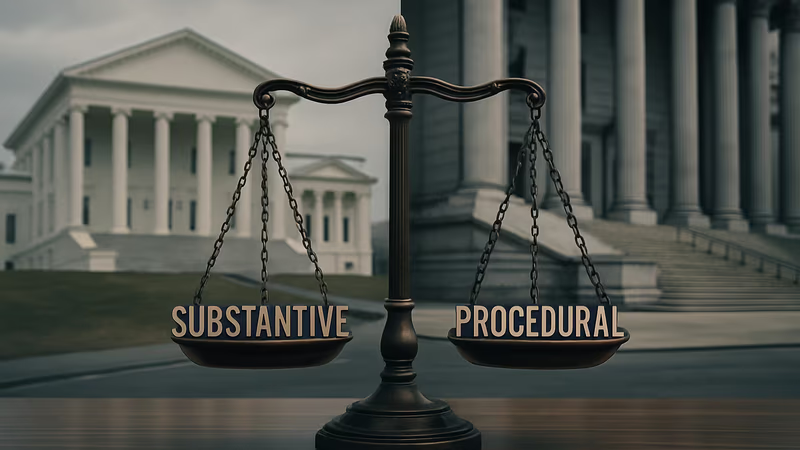
New York courts apply substantive law from other states but use NY procedural law, as shown in this GEICO case involving Virginia insurance law and mailing requirements.
This article is part of our ongoing choice of law coverage, with 87 published articles analyzing choice of law issues across New York State. Attorney Jason Tenenbaum brings 24+ years of hands-on experience to this analysis, drawing from his work on more than 1,000 appeals, over 100,000 no-fault cases, and recovery of over $100 million for clients throughout Nassau County, Suffolk County, Queens, Brooklyn, Manhattan, and the Bronx. For personalized legal advice about how these principles apply to your specific situation, contact our Long Island office at (516) 750-0595 for a free consultation.
When insurance disputes cross state lines, New York courts must address the complex intersection of different states’ laws. This challenge becomes particularly evident when dealing with insurance policies issued in other states but litigated in New York courts. The distinction between substantive and procedural law plays a crucial role in determining which state’s rules apply to specific aspects of a case.
Choice of law doctrine requires courts to identify which jurisdiction’s law governs particular issues in multi-state disputes. Generally, substantive law—which defines parties’ rights and obligations—comes from the jurisdiction with the most significant relationship to the dispute. Procedural law—which governs how courts conduct proceedings and evaluate evidence—typically comes from the forum state where litigation occurs. This division reflects the principle that while parties’ substantive rights should not change based on where they litigate, courts apply their own procedural rules to manage cases efficiently.
In insurance litigation, substantive law typically governs the terms and conditions of coverage, while procedural law controls how evidence must be presented and proven in court. This division can create interesting scenarios where courts apply one state’s insurance statutes but another state’s evidentiary requirements. Understanding this distinction is essential for practitioners handling multi-jurisdictional insurance matters, particularly in no-fault insurance cases where proper notice and procedural compliance are critical.
The Appellate Term’s decision in Acupuncture Now, P.C. v GEICO Insurance Co. demonstrates how New York courts navigate the substantive-procedural divide in insurance coverage disputes. The case involved a Virginia insurance policy litigated in New York courts, requiring analysis of which state’s law governed both the cancellation requirements and the proof of mailing compliance.
Case Background
Acupuncture Now, P.C. sought to recover no-fault benefits from GEICO Insurance Company for healthcare services rendered to an injured patient. GEICO denied coverage on grounds that it had properly cancelled the insurance policy before the accident occurred, leaving no coverage in effect. The insurance policy at issue had been obtained in Virginia, insuring a Virginia resident and vehicle. GEICO asserted that Virginia law applied to the coverage dispute.
Under Virginia law, insurance carriers must mail cancellation notices “by registered or certified mail” to effectuate policy cancellations. GEICO moved for summary judgment, asserting that it had cancelled the policy in accordance with Virginia statutory requirements. However, GEICO apparently failed to demonstrate that it had mailed the cancellation notice by registered or certified mail as Virginia law required, or that its office practices and procedures ensured such compliance.
Jason Tenenbaum’s Analysis
Acupuncture Now, P.C. v GEICO Ins. Co., 2018 NY Slip Op 51084(U)(App. Term 2d Dept. 2018)
“While defendant asserts that Virginia law applies to this case, as the insurance policy had been obtained in Virginia, and it insured a Virginia resident and vehicle, defendant failed to demonstrate that it had mailed its cancellation notice in accordance with its office practices and procedures (see St. Vincent’s Hosp. of Richmond v Government Empls. Ins. Co., 50 AD3d 1123 ) “by registered or certified mail,” as required by the applicable statute (Va. Code Ann. § 38.2-2208 ). Consequently, the Civil Court should have denied the branch of defendant’s cross motion seeking summary judgment dismissing the complaint on the ground that defendant had properly cancelled the policy and that there was, therefore, no coverage at the time of the accident at issue.”
What is interesting here is that Civil Courts will apply substantive law from sister states but then apply NY procedural law. This has been displayed many times (this is nothing new). It appears “mailing” is procedural at best.
Legal Significance
The Appellate Term’s decision clarifies the persistent application of New York’s procedural requirements even when out-of-state substantive law governs insurance coverage issues. While GEICO correctly identified Virginia law as controlling the policy cancellation requirements, the carrier remained subject to New York’s evidentiary standards for proving compliance with those requirements. This framework means that parties must satisfy both the substantive requirements of the governing state’s law and New York’s procedural requirements for establishing compliance.
The classification of mailing proof as procedural rather than substantive carries significant practical implications. Even when substantive law from other states establishes specific mailing methods for effectuating cancellations or denials, New York courts require parties to prove compliance through evidence satisfying New York’s business record and mailing proof standards. This dual requirement can make establishing out-of-state insurance defenses more challenging than applying purely New York law, as parties must navigate two distinct legal frameworks.
Practical Implications
For insurance carriers defending claims based on out-of-state policies, this decision emphasizes the necessity of understanding both the substantive requirements of the policy’s home state and New York’s procedural requirements for proving compliance. Carriers cannot simply establish that out-of-state law permits certain cancellation or denial procedures; they must also demonstrate compliance through evidence meeting New York evidentiary standards. This typically requires affidavits from custodians of records familiar with office mailing practices and procedures.
Healthcare providers challenging coverage defenses based on out-of-state policies should scrutinize both substantive compliance with other states’ insurance requirements and procedural compliance with New York proof standards. When carriers assert cancellations or denials under other states’ laws, providers can challenge whether carriers have established compliance through admissible evidence satisfying New York procedural requirements. The intersection of substantive and procedural law creates opportunities for challenging defenses that might succeed under pure choice of law analysis.
Key Takeaway
This case demonstrates the consistent approach New York courts take in choice of law scenarios: applying other states’ substantive insurance law while maintaining New York’s procedural requirements for proving compliance. The classification of mailing requirements as procedural rather than substantive can significantly impact litigation outcomes, as seen in this GEICO case where proper mailing procedures became the decisive factor.
Related Articles
Legal Context
Why This Matters for Your Case
New York law is among the most complex and nuanced in the country, with distinct procedural rules, substantive doctrines, and court systems that differ significantly from other jurisdictions. The Civil Practice Law and Rules (CPLR) governs every stage of civil litigation, from service of process through trial and appeal. The Appellate Division, Appellate Term, and Court of Appeals create a rich and ever-evolving body of case law that practitioners must follow.
Attorney Jason Tenenbaum has practiced across these areas for over 24 years, writing more than 1,000 appellate briefs and publishing over 2,353 legal articles that attorneys and clients rely on for guidance. The analysis in this article reflects real courtroom experience — from motion practice in Civil Court and Supreme Court to oral arguments before the Appellate Division — and a deep understanding of how New York courts actually apply the law in practice.
About This Topic
Choice of Law in New York Insurance & Injury Cases
When an accident or insurance dispute involves multiple states, New York courts must determine which state's law governs the claim. Choice-of-law analysis in New York uses an interest analysis approach for tort claims and a grouping-of-contacts test for contract-based insurance disputes. The choice between New York and another state's law can dramatically affect the outcome — particularly regarding no-fault thresholds, damage caps, and procedural requirements. These articles examine the analytical framework New York courts apply to resolve choice-of-law disputes.
87 published articles in Choice of law
Keep Reading
More Choice of law Analysis

Putting the wrong floor is not fatal
Court rules that incorrect floor designation in IME notice mailing address is not fatal when building address is otherwise correct and proper mailing procedures followed.
Mar 22, 2021
Choice of law?
Court applies New York no-fault law over New Jersey law based on most significant relationship test, despite accident occurring in New Jersey.
Mar 17, 2021
There is no need to specify the particular date a denial was mailed on the affidavit
Court rules that insurance companies don't need to specify exact mailing dates in affidavits when proving timely denial of no-fault claims under standard office procedures.
Oct 8, 2010
State Farm and Georgia – passes Appellate Term scrutiny
State Farm's Georgia mail processing system passes Appellate Term scrutiny despite mailing challenges in no-fault insurance case Maiga v State Farm.
Jun 3, 2018
Failure to comply with PA law
New York court applies Pennsylvania insurance law requiring strict compliance with cancellation notice requirements, including proof of proper mailing address.
Dec 28, 2015
A choice of law analysis – PA law controls
New York court applies Pennsylvania law to auto insurance dispute, finding PA's protection for innocent third parties prevents policy rescission against assignor.
Dec 19, 2013Common Questions
Frequently Asked Questions
How do New York courts decide which state's law applies?
New York follows an 'interest analysis' approach to choice-of-law questions, examining which jurisdiction has the greatest interest in having its law applied. In insurance and personal injury cases, relevant factors include where the accident occurred, where the policy was issued, where the insured resides, and where the insurer is domiciled. Choice-of-law issues frequently arise in cross-border accidents and when out-of-state insurance policies cover New York accidents.
Why is proof of mailing important in no-fault litigation?
Proof of mailing is critical in no-fault cases because many defenses depend on whether documents were properly sent — including denial letters, EUO scheduling notices, IME appointment letters, and verification requests. To establish proof of mailing, the insurer typically must show standard office mailing procedures through affidavit testimony and documentary evidence such as mailing logs or certified mail receipts. A failure to prove proper mailing can be fatal to the insurer's defense.
Was this article helpful?

About the Author
Jason Tenenbaum, Esq.
Jason Tenenbaum is the founding attorney of the Law Office of Jason Tenenbaum, P.C., headquartered at 326 Walt Whitman Road, Suite C, Huntington Station, New York 11746. With over 24 years of experience since founding the firm in 2002, Jason has written more than 1,000 appeals, handled over 100,000 no-fault insurance cases, and recovered over $100 million for clients across Long Island, Nassau County, Suffolk County, Queens, Brooklyn, Manhattan, the Bronx, and Staten Island. He is one of the few attorneys in the state who both writes his own appellate briefs and tries his own cases.
Jason is admitted to practice in New York, New Jersey, Florida, Texas, Georgia, and Michigan state courts, as well as multiple federal courts. His 2,353+ published legal articles analyzing New York case law, procedural developments, and litigation strategy make him one of the most prolific legal commentators in the state. He earned his Juris Doctor from Syracuse University College of Law.
Disclaimer: This article is published by the Law Office of Jason Tenenbaum, P.C. for informational and educational purposes only. It does not constitute legal advice, and no attorney-client relationship is formed by reading this content. The legal principles discussed may not apply to your specific situation, and the law may have changed since this article was last updated.
New York law varies by jurisdiction — court decisions in one Appellate Division department may not be followed in another, and local court rules in Nassau County Supreme Court differ from those in Suffolk County Supreme Court, Kings County Civil Court, or Queens County Supreme Court. The Appellate Division, Second Department (which covers Long Island, Brooklyn, Queens, and Staten Island) and the Appellate Term (which hears appeals from lower courts) each have distinct procedural requirements and precedents that affect litigation strategy.
If you need legal help with a choice of law matter, contact our office at (516) 750-0595 for a free consultation. We serve clients throughout Long Island (Huntington, Babylon, Islip, Brookhaven, Smithtown, Riverhead, Southampton, East Hampton), Nassau County (Hempstead, Garden City, Mineola, Great Neck, Manhasset, Freeport, Long Beach, Rockville Centre, Valley Stream, Westbury, Hicksville, Massapequa), Suffolk County (Hauppauge, Deer Park, Bay Shore, Central Islip, Patchogue, Brentwood), Queens, Brooklyn, Manhattan, the Bronx, Staten Island, and Westchester County. Prior results do not guarantee a similar outcome.