Key Takeaway
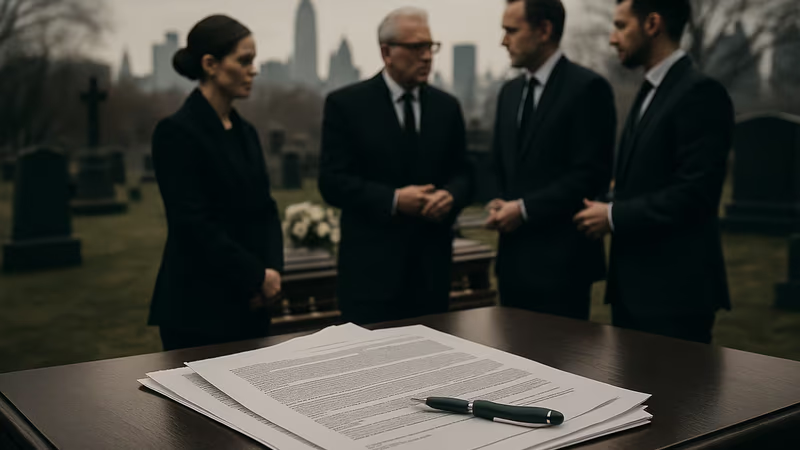
Court reverses default judgment after plaintiff couldn't prove witness attended funeral to get trial adjournment, remanding for hearing on proof requirement.
This article is part of our ongoing adjournments coverage, with 10 published articles analyzing adjournments issues across New York State. Attorney Jason Tenenbaum brings 24+ years of hands-on experience to this analysis, drawing from his work on more than 1,000 appeals, over 100,000 no-fault cases, and recovery of over $100 million for clients throughout Nassau County, Suffolk County, Queens, Brooklyn, Manhattan, and the Bronx. For personalized legal advice about how these principles apply to your specific situation, contact our Long Island office at (516) 750-0595 for a free consultation.
V.S. Med. Servs., P.C. v Allstate Ins. Co., 2018 NY Slip Op 51124(U)(App. Term 2d Dept. 2018)
‘We note that, although no appeal lies from a judgment entered on the default of the appealing party (see CPLR 5511), an appeal from such a judgment brings up for review those matters which were the subject of contest below (see James v Powell, 19 NY2d 249, 256 n 3 ), which, in this case, was the Civil Court’s determination that plaintiff had defaulted by failing to satisfy the condition for the granting of an adjournment (see Park Lane N. Owners, Inc. v Gengo, 151 AD3d 874 ; Delijani v Delijani, 100 AD3d 823 ; Matter of Branch v Cole-Lacy, 96 AD3d 741 ; Sarlo-Pinzur v Pinzur, 59 AD3d 607 ).
“The granting of an adjournment for any purpose is a matter resting within the sound discretion of the trial court” (Matter of Anthony M., 63 NY2d 270, 283 ), and the Civil Court acted within its discretion in conditioning the granting of an adjournment of the trial upon plaintiff’s providing proof of the funeral that its witness had allegedly been attending. However, we find that, in the circumstances presented, the Civil Court improvidently exercised its discretion in not allowing plaintiff’s witness to testify in order to try to provide the required proof. Consequently, we remit the matter to the Civil Court for a hearing to give plaintiff such an opportunity, following which the court shall determine whether it is satisfied with plaintiff’s proof.
Accordingly, the judgment, insofar as reviewed, is reversed, the determination that plaintiff had defaulted by failing to comply with a condition for the granting of an adjournment is vacated, and the matter is remitted to the Civil Court for a new determination, following a hearing, of whether plaintiff had satisfied the condition for the granting of an adjournment and for any and all further proceedings.”
Here’s a first. A plaintiff could not prove its prima facie case because its biller failed to present proof (s)he had a funeral on the date of the trial. Should Plaintiff prove its case, can Allstate prove they mailed the documents?
Related Articles
Legal Context
Why This Matters for Your Case
New York law is among the most complex and nuanced in the country, with distinct procedural rules, substantive doctrines, and court systems that differ significantly from other jurisdictions. The Civil Practice Law and Rules (CPLR) governs every stage of civil litigation, from service of process through trial and appeal. The Appellate Division, Appellate Term, and Court of Appeals create a rich and ever-evolving body of case law that practitioners must follow.
Attorney Jason Tenenbaum has practiced across these areas for over 24 years, writing more than 1,000 appellate briefs and publishing over 2,353 legal articles that attorneys and clients rely on for guidance. The analysis in this article reflects real courtroom experience — from motion practice in Civil Court and Supreme Court to oral arguments before the Appellate Division — and a deep understanding of how New York courts actually apply the law in practice.
Keep Reading
More Adjournments Analysis

Improvident to examine papers
Court rules that vague "law office failure" excuse doesn't justify late opposition papers, but defendants still failed to prove their summary judgment case.
Sep 25, 2020
Who is the attorney?
Civil Kings court case on attorney representation requirements and default judgment appeals in no-fault insurance litigation.
Feb 1, 2020
Adjournments not granted as a matter of course
New York courts have discretion to deny adjournments when attorneys lack due diligence. Learn about court adjournment standards and legal requirements.
Dec 15, 2016
Motion Return Date Adjournments in New York Courts – Expert Legal Guidance
Learn when New York courts will grant motion adjournments and the consequences of appearing unprepared. Expert legal guidance for Nassau & Suffolk County cases.
Nov 26, 2009
Understanding Foundation Requirements in Medical Malpractice Expert Testimony
New York medical malpractice expert testimony foundation requirements. Learn critical standards for expert witness preparation in Nassau and Suffolk County cases.
Dec 28, 2008
New trial ordered due to physician unavailability
New trial ordered when treating physician expert arrived without required original medical file and was unavailable for rescheduled testimony dates.
Jun 11, 2018Common Questions
Frequently Asked Questions
What happens when a court case is adjourned in New York?
An adjournment postpones a court proceeding to a later date. In New York, adjournments may be granted for reasonable cause, but courts have discretion to deny them. Repeated adjournment requests can result in sanctions, preclusion orders, or even default judgments.
Can a no-fault arbitration be adjourned?
Yes, but no-fault arbitrations under the American Arbitration Association rules have strict scheduling requirements. Adjournments must be requested in advance and approved by the arbitrator. Failure to appear without a granted adjournment can result in a default award.
How many adjournments can I get in a New York court case?
There is no fixed limit, but courts look at the reasons for the request, the number of prior adjournments, and whether the delay prejudices the opposing party. Under the court's Individual Part Rules, judges may impose specific limits on adjournments in their courtrooms.
Was this article helpful?

About the Author
Jason Tenenbaum, Esq.
Jason Tenenbaum is the founding attorney of the Law Office of Jason Tenenbaum, P.C., headquartered at 326 Walt Whitman Road, Suite C, Huntington Station, New York 11746. With over 24 years of experience since founding the firm in 2002, Jason has written more than 1,000 appeals, handled over 100,000 no-fault insurance cases, and recovered over $100 million for clients across Long Island, Nassau County, Suffolk County, Queens, Brooklyn, Manhattan, the Bronx, and Staten Island. He is one of the few attorneys in the state who both writes his own appellate briefs and tries his own cases.
Jason is admitted to practice in New York, New Jersey, Florida, Texas, Georgia, and Michigan state courts, as well as multiple federal courts. His 2,353+ published legal articles analyzing New York case law, procedural developments, and litigation strategy make him one of the most prolific legal commentators in the state. He earned his Juris Doctor from Syracuse University College of Law.
Disclaimer: This article is published by the Law Office of Jason Tenenbaum, P.C. for informational and educational purposes only. It does not constitute legal advice, and no attorney-client relationship is formed by reading this content. The legal principles discussed may not apply to your specific situation, and the law may have changed since this article was last updated.
New York law varies by jurisdiction — court decisions in one Appellate Division department may not be followed in another, and local court rules in Nassau County Supreme Court differ from those in Suffolk County Supreme Court, Kings County Civil Court, or Queens County Supreme Court. The Appellate Division, Second Department (which covers Long Island, Brooklyn, Queens, and Staten Island) and the Appellate Term (which hears appeals from lower courts) each have distinct procedural requirements and precedents that affect litigation strategy.
If you need legal help with a adjournments matter, contact our office at (516) 750-0595 for a free consultation. We serve clients throughout Long Island (Huntington, Babylon, Islip, Brookhaven, Smithtown, Riverhead, Southampton, East Hampton), Nassau County (Hempstead, Garden City, Mineola, Great Neck, Manhasset, Freeport, Long Beach, Rockville Centre, Valley Stream, Westbury, Hicksville, Massapequa), Suffolk County (Hauppauge, Deer Park, Bay Shore, Central Islip, Patchogue, Brentwood), Queens, Brooklyn, Manhattan, the Bronx, Staten Island, and Westchester County. Prior results do not guarantee a similar outcome.