Key Takeaway
New York court reinforces that expert opinions must be based on properly admitted evidence, not unfounded photographs or materials.
This article is part of our ongoing experts coverage, with 80 published articles analyzing experts issues across New York State. Attorney Jason Tenenbaum brings 24+ years of hands-on experience to this analysis, drawing from his work on more than 1,000 appeals, over 100,000 no-fault cases, and recovery of over $100 million for clients throughout Nassau County, Suffolk County, Queens, Brooklyn, Manhattan, and the Bronx. For personalized legal advice about how these principles apply to your specific situation, contact our Long Island office at (516) 750-0595 for a free consultation.
In New York personal injury litigation, expert testimony plays a crucial role in establishing causation, damages, and the standard of care. However, courts maintain strict rules about what evidence experts can rely upon when forming their opinions. The foundation requirement ensures that expert testimony is based on reliable, admissible evidence rather than speculation or improperly introduced materials.
This evidentiary principle becomes particularly important when experts attempt to base opinions on photographs, medical records, or other documentary evidence. Without proper foundation establishing the authenticity, accuracy, and relevance of such materials, courts will exclude expert opinions that rely on them. This requirement protects the integrity of the judicial process and ensures that juries receive reliable expert testimony.
The foundation requirement is especially critical in personal injury cases where biomechanical evidence or photographic evidence might be used to reconstruct accident scenarios or demonstrate injury mechanisms. Courts have consistently held that experts cannot simply rely on any materials without proper evidentiary support, as seen in cases involving foundation requirements.
Jason Tenenbaum’s Analysis:
Pascocello v Jibone, 2018 NY Slip Op 03466 (1st Dept. 2018)
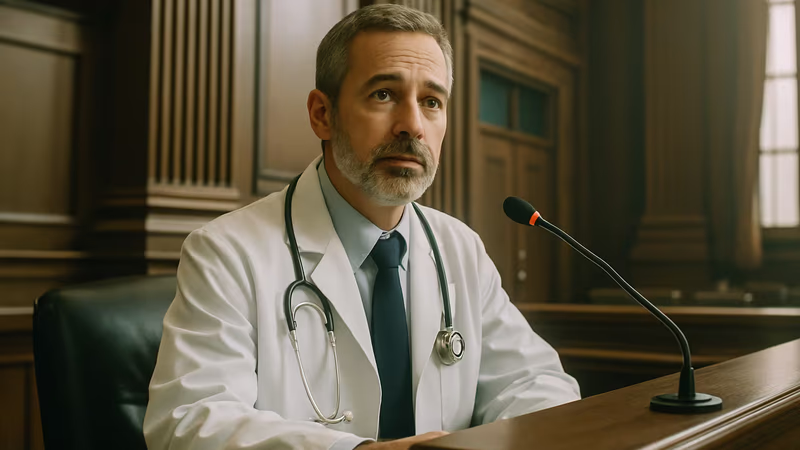
“An expert’s opinion “must be based on facts in the record or personally known to the witness” (Hambsch v New York City Tr. Auth., 63 NY2d 723, 725 ; see Roques v Noble, 73 AD3d 204, 206 ), and in the absence of such record support, an expert’s opinion is without probative force (see Diaz v New York Downtown Hosp., 99 NY2d 542, 544 ). Here, Supreme Court properly precluded Dr. Toosi from offering an opinion based on photographs for which no proper foundation had been established.
Key Takeaway
This decision reinforces a fundamental principle of expert testimony in New York courts: opinions must be grounded in properly admitted evidence or the expert’s personal knowledge. Attorneys cannot simply introduce photographs or other materials through expert witnesses without first establishing proper foundation through other testimony or evidence. This rule ensures that expert opinions have genuine probative value rather than being based on unverified or inadmissible materials.
Related Articles
Legal Context
Why This Matters for Your Case
New York law is among the most complex and nuanced in the country, with distinct procedural rules, substantive doctrines, and court systems that differ significantly from other jurisdictions. The Civil Practice Law and Rules (CPLR) governs every stage of civil litigation, from service of process through trial and appeal. The Appellate Division, Appellate Term, and Court of Appeals create a rich and ever-evolving body of case law that practitioners must follow.
Attorney Jason Tenenbaum has practiced across these areas for over 24 years, writing more than 1,000 appellate briefs and publishing over 2,353 legal articles that attorneys and clients rely on for guidance. The analysis in this article reflects real courtroom experience — from motion practice in Civil Court and Supreme Court to oral arguments before the Appellate Division — and a deep understanding of how New York courts actually apply the law in practice.
About This Topic
Expert Testimony in New York Litigation
Expert testimony is essential in most personal injury and no-fault cases — from medical experts establishing causation and damages to accident reconstructionists and economic experts calculating lost earnings. New York courts apply specific rules governing expert qualifications, the foundation for expert opinions, the use of medical journals and treatises, and the sufficiency of expert evidence on summary judgment. These articles analyze the legal standards for expert testimony and practical strategies for presenting and challenging expert evidence.
80 published articles in Experts
Keep Reading
More Experts Analysis

Expert Witness in Car Accident Lawsuits
Learn how expert witnesses in New York car accident lawsuits help establish fault, causation, and damages through accident reconstruction, medical testimony, and economic analysis.
May 14, 2025
Expert opinion
Court reminds attorneys that expert opinions must address specific assertions with cited evidence, not just conclusory statements, in personal injury litigation.
Mar 22, 2021
Biomechanical Engineer allowed to testify
Landmark 2014 Vargas v Sabri case allows biomechanical engineers to testify on motor vehicle accident causation without medical credentials in New York courts.
Mar 18, 2014
I was wrong about the necessity of annexing the reports that the peer doctor relied upon
Analysis of Active Imaging v Progressive case where Appellate Term rejected challenge to medical necessity motion based on peer report without underlying medical records.
Oct 28, 2010
The Future is Bright for Medical Necessity Summary Judgment Motions in New York
New York medical necessity summary judgment motions are evolving with stricter expert testimony standards, creating opportunities for skilled no-fault insurance attorneys.
Dec 28, 2008
The expert opinion
New York courts clarify when medical experts can testify outside their specialty area and the foundation required for reliable expert testimony in personal injury cases.
Apr 1, 2017Common Questions
Frequently Asked Questions
How are expert witnesses used in New York personal injury cases?
Expert witnesses provide specialized opinion testimony that helps the court or jury understand complex issues like medical causation, injury severity, future care needs, economic losses, and engineering defects. Under New York law, expert testimony must be based on facts in evidence, the expert's professional knowledge, or a combination of both. The expert must be qualified by training, education, or experience in the relevant field. Expert disclosure requirements under CPLR 3101(d)(1)(i) require parties to identify their experts and provide detailed summaries before trial.
Was this article helpful?

About the Author
Jason Tenenbaum, Esq.
Jason Tenenbaum is the founding attorney of the Law Office of Jason Tenenbaum, P.C., headquartered at 326 Walt Whitman Road, Suite C, Huntington Station, New York 11746. With over 24 years of experience since founding the firm in 2002, Jason has written more than 1,000 appeals, handled over 100,000 no-fault insurance cases, and recovered over $100 million for clients across Long Island, Nassau County, Suffolk County, Queens, Brooklyn, Manhattan, the Bronx, and Staten Island. He is one of the few attorneys in the state who both writes his own appellate briefs and tries his own cases.
Jason is admitted to practice in New York, New Jersey, Florida, Texas, Georgia, and Michigan state courts, as well as multiple federal courts. His 2,353+ published legal articles analyzing New York case law, procedural developments, and litigation strategy make him one of the most prolific legal commentators in the state. He earned his Juris Doctor from Syracuse University College of Law.
Disclaimer: This article is published by the Law Office of Jason Tenenbaum, P.C. for informational and educational purposes only. It does not constitute legal advice, and no attorney-client relationship is formed by reading this content. The legal principles discussed may not apply to your specific situation, and the law may have changed since this article was last updated.
New York law varies by jurisdiction — court decisions in one Appellate Division department may not be followed in another, and local court rules in Nassau County Supreme Court differ from those in Suffolk County Supreme Court, Kings County Civil Court, or Queens County Supreme Court. The Appellate Division, Second Department (which covers Long Island, Brooklyn, Queens, and Staten Island) and the Appellate Term (which hears appeals from lower courts) each have distinct procedural requirements and precedents that affect litigation strategy.
If you need legal help with a experts matter, contact our office at (516) 750-0595 for a free consultation. We serve clients throughout Long Island (Huntington, Babylon, Islip, Brookhaven, Smithtown, Riverhead, Southampton, East Hampton), Nassau County (Hempstead, Garden City, Mineola, Great Neck, Manhasset, Freeport, Long Beach, Rockville Centre, Valley Stream, Westbury, Hicksville, Massapequa), Suffolk County (Hauppauge, Deer Park, Bay Shore, Central Islip, Patchogue, Brentwood), Queens, Brooklyn, Manhattan, the Bronx, Staten Island, and Westchester County. Prior results do not guarantee a similar outcome.