Key Takeaway
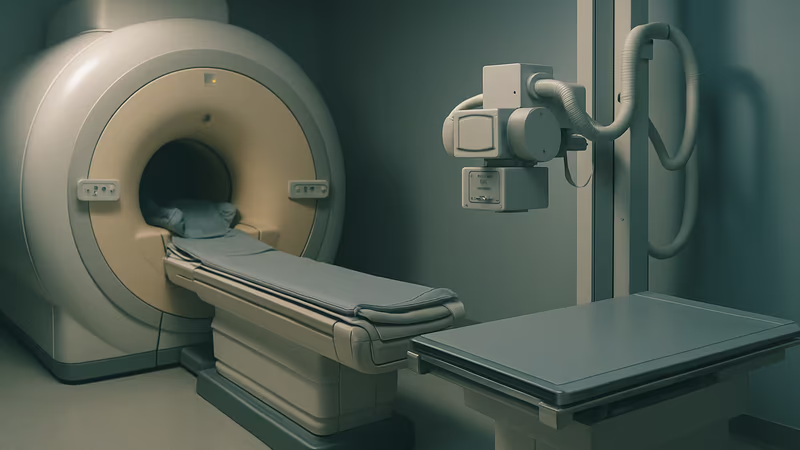
Court dismisses personal injury case where plaintiff failed to prove spinal injuries caused by accident rather than degeneration, highlighting critical causation requirements.
This article is part of our ongoing causation coverage, with 51 published articles analyzing causation issues across New York State. Attorney Jason Tenenbaum brings 24+ years of hands-on experience to this analysis, drawing from his work on more than 1,000 appeals, over 100,000 no-fault cases, and recovery of over $100 million for clients throughout Nassau County, Suffolk County, Queens, Brooklyn, Manhattan, and the Bronx. For personalized legal advice about how these principles apply to your specific situation, contact our Long Island office at (516) 750-0595 for a free consultation.
In personal injury litigation, proving that your injuries were caused by the accident rather than pre-existing conditions is fundamental to a successful claim. The Campbell v Drammeh decision from New York’s First Department demonstrates how courts scrutinize medical evidence and the critical importance of establishing a clear causal connection between the incident and claimed injuries.
This case illustrates common pitfalls that can doom an otherwise legitimate personal injury claim. When plaintiffs cannot distinguish between accident-related trauma and natural degeneration, or when they fail to provide adequate medical documentation, courts will dismiss their cases. The decision also highlights how gaps in treatment or unexplained medical findings can undermine causation arguments, even when some medical evidence initially appears favorable.
Jason Tenenbaum’s Analysis:
Campbell v Drammeh, 2018 NY Slip Op 03643 (1st Dept. 2018)
In opposition, plaintiff failed to raise an issue of fact as to his claimed spinal injuries, since he submitted no opinion about whether those injuries were caused by the accident, rather than degeneration (see Walker, 132 AD3d at 478—79), and no evidence of treatment (see Pommells, 4 NY3d at 572). As for his right shoulder claim, plaintiff’s orthopedic surgeon opined before performing surgery that any injuries were causally related to the accident. However, he failed to address or explain either the findings in plaintiff’s own MRI of hypertrophic changes and of no acute fracture or dislocation. He also did not address his own operative finding of bursitis (see Franklin v Gareyua, 136 AD3d at 465-466; Walker, 132 AD3d at 478—479). Moreover, plaintiff provided no explanation for his complete cessation of treatment after the surgery (see Pommells, 4 NY3d at 574; Baez v Rahamatali, 24 AD3d 256 , affd 6 NY3d 868 ; Frias v Son Tien Liu, 107 AD3d 589, 590 ).
Key Takeaway
This decision emphasizes that medical opinions supporting causation must address all relevant findings, including pre-existing conditions and conflicting diagnostic evidence. Unexplained gaps in treatment and failure to distinguish between degenerative changes and acute trauma will result in dismissal, even when some medical evidence initially appears supportive of the personal injury claim.
Related Articles
Legal Context
Why This Matters for Your Case
New York law is among the most complex and nuanced in the country, with distinct procedural rules, substantive doctrines, and court systems that differ significantly from other jurisdictions. The Civil Practice Law and Rules (CPLR) governs every stage of civil litigation, from service of process through trial and appeal. The Appellate Division, Appellate Term, and Court of Appeals create a rich and ever-evolving body of case law that practitioners must follow.
Attorney Jason Tenenbaum has practiced across these areas for over 24 years, writing more than 1,000 appellate briefs and publishing over 2,353 legal articles that attorneys and clients rely on for guidance. The analysis in this article reflects real courtroom experience — from motion practice in Civil Court and Supreme Court to oral arguments before the Appellate Division — and a deep understanding of how New York courts actually apply the law in practice.
About This Topic
Causation in New York Personal Injury & No-Fault Law
Causation — proving that the defendant's negligence or the accident caused the plaintiff's injuries — is an essential element of every personal injury and no-fault claim. New York courts distinguish between proximate cause, intervening causes, and pre-existing conditions that may have been aggravated by an accident. The legal standards for establishing causation through medical evidence and the defenses available to challenge causal connection are analyzed in depth across these articles.
51 published articles in Causation
Keep Reading
More Causation Analysis

Collateral Estoppel?
Explore collateral estoppel: why default judgments don't preclude later suits & when courts can depart from other departments' rulings.
Sep 28, 2020
New York Personal Injury Law: Proving Causation in Accident Cases
Learn how to prove causation in NY personal injury cases. Expert analysis of Parisien v Allstate case and causation challenges. Call 516-750-0595.
Aug 10, 2019
Another arbitration only rule bites the dust
NY Appellate Division vacates arbitral award in no-fault insurance case, requiring de novo hearing on causation for post-accident medical equipment claims.
Mar 23, 2019
Lack of causation not established on a peer review
Court rules IME doctor's contradictory causation statements and failure to review key medical records insufficient to establish lack of causation in no-fault case.
Aug 17, 2017
Permanent consequential v. Significant limitaton – the value of early surgery
Analysis of Sutliff v Qadar case examining permanent consequential vs significant limitation standards under 5102(d), highlighting the importance of early surgical intervention for...
Nov 14, 2014
Broke the chain of causation
New York appellate court ruling demonstrates how a patient's failure to follow medical instructions can break the chain of causation in malpractice cases.
May 1, 2010Common Questions
Frequently Asked Questions
How is causation established in New York personal injury cases?
Causation requires proof that the defendant's conduct was a substantial factor in causing the plaintiff's injuries. In motor vehicle and slip-and-fall cases, medical experts typically establish causation through review of the patient's medical history, diagnostic imaging, clinical examination findings, and the temporal relationship between the accident and the onset of symptoms. The plaintiff must also address any pre-existing conditions and demonstrate that the accident was a proximate cause of the current complaints.
Was this article helpful?

About the Author
Jason Tenenbaum, Esq.
Jason Tenenbaum is the founding attorney of the Law Office of Jason Tenenbaum, P.C., headquartered at 326 Walt Whitman Road, Suite C, Huntington Station, New York 11746. With over 24 years of experience since founding the firm in 2002, Jason has written more than 1,000 appeals, handled over 100,000 no-fault insurance cases, and recovered over $100 million for clients across Long Island, Nassau County, Suffolk County, Queens, Brooklyn, Manhattan, the Bronx, and Staten Island. He is one of the few attorneys in the state who both writes his own appellate briefs and tries his own cases.
Jason is admitted to practice in New York, New Jersey, Florida, Texas, Georgia, and Michigan state courts, as well as multiple federal courts. His 2,353+ published legal articles analyzing New York case law, procedural developments, and litigation strategy make him one of the most prolific legal commentators in the state. He earned his Juris Doctor from Syracuse University College of Law.
Disclaimer: This article is published by the Law Office of Jason Tenenbaum, P.C. for informational and educational purposes only. It does not constitute legal advice, and no attorney-client relationship is formed by reading this content. The legal principles discussed may not apply to your specific situation, and the law may have changed since this article was last updated.
New York law varies by jurisdiction — court decisions in one Appellate Division department may not be followed in another, and local court rules in Nassau County Supreme Court differ from those in Suffolk County Supreme Court, Kings County Civil Court, or Queens County Supreme Court. The Appellate Division, Second Department (which covers Long Island, Brooklyn, Queens, and Staten Island) and the Appellate Term (which hears appeals from lower courts) each have distinct procedural requirements and precedents that affect litigation strategy.
If you need legal help with a causation matter, contact our office at (516) 750-0595 for a free consultation. We serve clients throughout Long Island (Huntington, Babylon, Islip, Brookhaven, Smithtown, Riverhead, Southampton, East Hampton), Nassau County (Hempstead, Garden City, Mineola, Great Neck, Manhasset, Freeport, Long Beach, Rockville Centre, Valley Stream, Westbury, Hicksville, Massapequa), Suffolk County (Hauppauge, Deer Park, Bay Shore, Central Islip, Patchogue, Brentwood), Queens, Brooklyn, Manhattan, the Bronx, Staten Island, and Westchester County. Prior results do not guarantee a similar outcome.