
Key Takeaway
New York court rules minor impact evidence combined with expert testimony can prove lack of causation in personal injury cases. Key Long Island and NYC case analysis.
This article is part of our ongoing causation coverage, with 51 published articles analyzing causation issues across New York State. Attorney Jason Tenenbaum brings 24+ years of hands-on experience to this analysis, drawing from his work on more than 1,000 appeals, over 100,000 no-fault cases, and recovery of over $100 million for clients throughout Nassau County, Suffolk County, Queens, Brooklyn, Manhattan, and the Bronx. For personalized legal advice about how these principles apply to your specific situation, contact our Long Island office at (516) 750-0595 for a free consultation.
The Minor Impact Defense: Proving Lack of Causation in Personal Injury Cases
Causation lies at the heart of personal injury litigation. Plaintiffs must demonstrate not only that they sustained injuries, but that those injuries resulted from the defendant’s tortious conduct rather than pre-existing conditions, degenerative processes, or other intervening causes. In automobile accident cases, defendants frequently challenge causation by presenting evidence that accidents involved minimal force insufficient to cause the claimed injuries.
Key Takeaway
Photographic evidence of minimal vehicle damage combined with defense expert testimony attributing injuries to degenerative processes creates a valid evidentiary basis for juries to find the accident was not a substantial factor in causing claimed injuries — and appellate courts will not disturb such verdicts.
When combined with expert medical testimony attributing plaintiff’s conditions to pre-existing degeneration, these “minor impact” defenses can defeat otherwise viable car accident claims. The Second Department’s decision in Frank v. Gengler provides important guidance on the evidentiary foundation necessary to establish lack of causation through minor impact evidence and defense medical opinions.
Case Background
Frank v Gengler, 2017 NY Slip Op 04423 (2d Dept. 2017)
Frank arose from a motor vehicle accident in which the plaintiff claimed to have sustained significant injuries requiring ongoing medical treatment. Following a trial, the jury returned a verdict in favor of the defendant, finding that the plaintiff had failed to prove that the accident was a substantial factor in causing the alleged injuries.
The Trial Court’s Error
The trial court, dissatisfied with the jury’s verdict, granted the plaintiff’s post-trial motion to set aside the verdict as against the weight of the evidence and ordered a new trial.
The defendant appealed, arguing that legally sufficient evidence supported the jury’s causation determination.
The Defense Evidence at Trial
At trial, the defendant had presented:
- Photographic evidence and witness testimony documenting the relatively minor nature of the collision, showing minimal vehicle damage and low-speed impact
- Expert medical testimony from a physician who reviewed the plaintiff’s diagnostic studies and opined that symptoms and objective findings stemmed entirely from degenerative processes unrelated to traumatic injury
The plaintiff’s medical evidence, by contrast, attributed the claimed injuries and ongoing symptoms to the subject accident. This created competing expert opinions on the causation question, which the jury resolved in favor of the defendant’s position.
Jason Tenenbaum’s Analysis
Frank v Gengler, 2017 NY Slip Op 04423 (2d Dept. 2017)
“Here, the Supreme Court erred in determining that the jury verdict in favor of the defendant was not supported by legally sufficient evidence. The evidence presented at trial included photographic evidence and witness testimony indicating the relatively minor nature of the motor vehicle accident, and expert testimony presented by the defendant indicating that the plaintiff’s alleged injuries were solely the result of degenerative processes and were not caused by traumatic injury. Contrary to the court’s conclusion, on the basis of the evidence presented at trial, there was a valid line of reasoning by which the jury could conclude that the motor vehicle accident was not a substantial factor in causing the injuries allegedly sustained by the plaintiff (see Wilson v Philie, 107 AD3d 700, 701; Rubino v Scherrer, 68 AD3d 1090, 1092; cf. Jilani v Palmer, 83 AD3d 786, 787; see generally Imbrey v Prudential Ins. Co., 286 NY 434, 440). Accordingly, the court, upon reargument, should have adhered to its prior denial of that branch of the plaintiff’ motion which was pursuant to CPLR 4404(a) to set aside the jury verdict in favor of the defendant and for judgment as a matter of law.”
Personally, I think this case has huge repercussions. Never have I seen a court lay out such a simple road-map for getting to a determination of lack of causation between the accident and injury. It is the same thought process, regardless of whether we are litigating first-party lack of causation of third-party causation,
Legal Significance
The Two-Pronged Causation Framework
Frank establishes a clear evidentiary framework for proving lack of causation in personal injury cases through the combination of minor impact evidence and defense medical expert testimony. The Second Department’s analysis validates a two-pronged approach:
- Physical evidence demonstrating low-force impact
- Medical opinions attributing plaintiff’s conditions to non-traumatic etiologies
This framework applies across different procedural postures, from summary judgment motions to post-trial review of jury verdicts.
Deference to Jury Verdicts
The decision’s emphasis on “valid lines of reasoning” reflects New York’s deferential standard for reviewing jury verdicts. Appellate courts do not reweigh evidence or substitute their judgment for that of juries. When defendants present credible evidence of minor impact and expert testimony excluding traumatic causation, juries may rationally conclude that accidents did not substantially contribute to claimed injuries, even when plaintiffs offer contrary medical opinions.
Causation as a Question of Fact
Frank also reinforces that causation determinations involve questions of fact generally reserved for juries rather than courts. Competing expert opinions create credibility assessments and weight-of-evidence judgments that fall within the jury’s province. Trial courts should not disturb jury verdicts simply because the court might have weighed evidence differently or found plaintiff’s experts more persuasive.
Application to No-Fault Insurance Disputes
The decision has significant implications for no-fault insurance causation disputes. While no-fault cases typically resolve through summary judgment rather than jury trial, the causation principles remain identical. Insurance carriers defending claims based on lack of causal relationship must present similar evidence: accident reports, photographs, or repair estimates demonstrating minor impact combined with peer review opinions attributing claimants’ conditions to degenerative changes or pre-existing pathology.
Practical Implications
For Defense Counsel
For defense counsel in personal injury and no-fault cases, Frank provides a validated template for establishing lack of causation. Attorneys should gather comprehensive physical evidence of accident severity, including:
- Photographs from multiple angles
- Vehicle damage estimates
- Impact speed calculations
- Witness observations about post-accident vehicle condition
Defense medical experts should provide detailed analysis explaining why claimed injuries do not stem from accident trauma. Effective expert opinions identify specific degenerative findings on diagnostic studies, correlate those findings with expected age-related changes, note absence of acute traumatic indicators, and explain inconsistencies between accident mechanism and injury patterns.
For Plaintiff’s Counsel
Plaintiff’s counsel must recognize that minor impact evidence, while not dispositive, creates significant hurdles for proving causation. When photographic evidence shows minimal damage, plaintiffs need particularly strong medical testimony explaining how low-force impacts nonetheless caused their injuries. Biomechanical experts may be necessary to rebut assumptions that minor damage correlates with minor forces.
Additionally, plaintiffs should emphasize:
- Immediate post-accident symptoms
- Prompt medical treatment
- Absence of prior complaints in the same body areas
For No-Fault Insurance Carriers
For no-fault insurance carriers, Frank reinforces the viability of lack of causation defenses in appropriate cases. Carriers should implement protocols for identifying cases where minor impact and degenerative findings support causation challenges. Early referral for independent medical examinations focused on causation issues allows carriers to develop peer review opinions while claims remain within administrative denial windows.
However, carriers must ensure peer reviewers address causation specifically rather than offering only medical necessity opinions.
Related Articles
- Causation in Personal Injury Cases: Understanding 5102(d) Standards in New York
- New York Personal Injury Law: Proving Causation in Accident Cases
- Understanding Causal Relationship in New York Personal Injury Cases: Legal Guide
- Medical causation expert opinions in NY personal injury cases
- Personal Injury
Legal Context
Why This Matters for Your Case
New York law is among the most complex and nuanced in the country, with distinct procedural rules, substantive doctrines, and court systems that differ significantly from other jurisdictions. The Civil Practice Law and Rules (CPLR) governs every stage of civil litigation, from service of process through trial and appeal. The Appellate Division, Appellate Term, and Court of Appeals create a rich and ever-evolving body of case law that practitioners must follow.
Attorney Jason Tenenbaum has practiced across these areas for over 24 years, writing more than 1,000 appellate briefs and publishing over 2,353 legal articles that attorneys and clients rely on for guidance. The analysis in this article reflects real courtroom experience — from motion practice in Civil Court and Supreme Court to oral arguments before the Appellate Division — and a deep understanding of how New York courts actually apply the law in practice.
About This Topic
Causation in New York Personal Injury & No-Fault Law
Causation — proving that the defendant's negligence or the accident caused the plaintiff's injuries — is an essential element of every personal injury and no-fault claim. New York courts distinguish between proximate cause, intervening causes, and pre-existing conditions that may have been aggravated by an accident. The legal standards for establishing causation through medical evidence and the defenses available to challenge causal connection are analyzed in depth across these articles.
51 published articles in Causation
Keep Reading
More Causation Analysis

Collateral Estoppel?
Explore collateral estoppel: why default judgments don't preclude later suits & when courts can depart from other departments' rulings.
Sep 28, 2020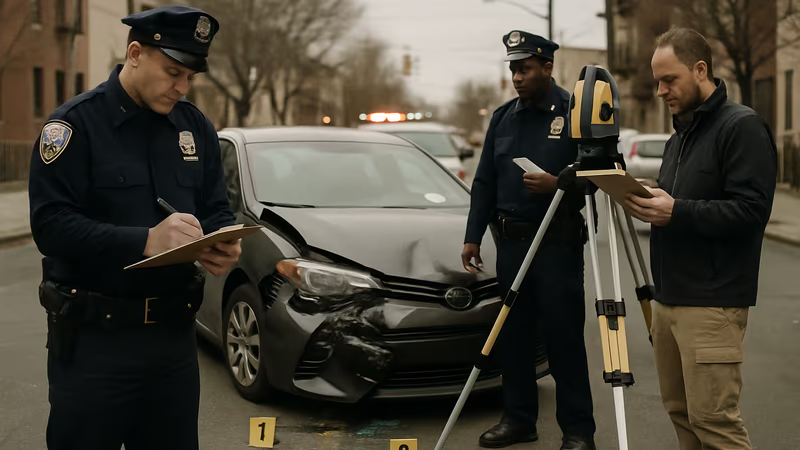
New York Personal Injury Law: Proving Causation in Accident Cases
Learn how to prove causation in NY personal injury cases. Expert analysis of Parisien v Allstate case and causation challenges. Call 516-750-0595.
Aug 10, 2019
Trial De Novo granted and declaration of non-coverage granted
Nassau County court grants trial de novo and declares no coverage in Allstate v. Phelps case, finding stroke treatment unrelated to motor vehicle accident.
Feb 21, 2014
Understanding New York’s One Year Rule in No-Fault Insurance Claims
Expert analysis of New York's one year rule in no-fault insurance claims. Nassau County & NYC personal injury lawyer explains ascertainability requirements. Call 516-750-0595.
Mar 10, 2010
Junk science?
Court case analyzing biomechanical expert testimony and causation standards in New York personal injury law, focusing on delta-v calculations and serious injury thresholds.
Dec 27, 2018
Failure to review actual images insufficient to defeat causation MSJ
Court grants summary judgment where plaintiff's expert failed to review actual ultrasound images, only relying on reports in medical malpractice causation dispute.
Aug 10, 2017Common Questions
Frequently Asked Questions
How is causation established in New York personal injury cases?
Causation requires proof that the defendant's conduct was a substantial factor in causing the plaintiff's injuries. In motor vehicle and slip-and-fall cases, medical experts typically establish causation through review of the patient's medical history, diagnostic imaging, clinical examination findings, and the temporal relationship between the accident and the onset of symptoms. The plaintiff must also address any pre-existing conditions and demonstrate that the accident was a proximate cause of the current complaints.
Was this article helpful?

About the Author
Jason Tenenbaum, Esq.
Jason Tenenbaum is the founding attorney of the Law Office of Jason Tenenbaum, P.C., headquartered at 326 Walt Whitman Road, Suite C, Huntington Station, New York 11746. With over 24 years of experience since founding the firm in 2002, Jason has written more than 1,000 appeals, handled over 100,000 no-fault insurance cases, and recovered over $100 million for clients across Long Island, Nassau County, Suffolk County, Queens, Brooklyn, Manhattan, the Bronx, and Staten Island. He is one of the few attorneys in the state who both writes his own appellate briefs and tries his own cases.
Jason is admitted to practice in New York, New Jersey, Florida, Texas, Georgia, and Michigan state courts, as well as multiple federal courts. His 2,353+ published legal articles analyzing New York case law, procedural developments, and litigation strategy make him one of the most prolific legal commentators in the state. He earned his Juris Doctor from Syracuse University College of Law.
Disclaimer: This article is published by the Law Office of Jason Tenenbaum, P.C. for informational and educational purposes only. It does not constitute legal advice, and no attorney-client relationship is formed by reading this content. The legal principles discussed may not apply to your specific situation, and the law may have changed since this article was last updated.
New York law varies by jurisdiction — court decisions in one Appellate Division department may not be followed in another, and local court rules in Nassau County Supreme Court differ from those in Suffolk County Supreme Court, Kings County Civil Court, or Queens County Supreme Court. The Appellate Division, Second Department (which covers Long Island, Brooklyn, Queens, and Staten Island) and the Appellate Term (which hears appeals from lower courts) each have distinct procedural requirements and precedents that affect litigation strategy.
If you need legal help with a causation matter, contact our office at (516) 750-0595 for a free consultation. We serve clients throughout Long Island (Huntington, Babylon, Islip, Brookhaven, Smithtown, Riverhead, Southampton, East Hampton), Nassau County (Hempstead, Garden City, Mineola, Great Neck, Manhasset, Freeport, Long Beach, Rockville Centre, Valley Stream, Westbury, Hicksville, Massapequa), Suffolk County (Hauppauge, Deer Park, Bay Shore, Central Islip, Patchogue, Brentwood), Queens, Brooklyn, Manhattan, the Bronx, Staten Island, and Westchester County. Prior results do not guarantee a similar outcome.