
Key Takeaway
New York court applies Pennsylvania insurance law requiring strict compliance with cancellation notice requirements, including proof of proper mailing address.
This article is part of our ongoing cancellation of policy coverage, with 43 published articles analyzing cancellation of policy issues across New York State. Attorney Jason Tenenbaum brings 24+ years of hands-on experience to this analysis, drawing from his work on more than 1,000 appeals, over 100,000 no-fault cases, and recovery of over $100 million for clients throughout Nassau County, Suffolk County, Queens, Brooklyn, Manhattan, and the Bronx. For personalized legal advice about how these principles apply to your specific situation, contact our Long Island office at (516) 750-0595 for a free consultation.
New Way Med. Supply Corp. v Infinity Group, 2015 NY Slip Op 51880(U)(App. Term 2d Dept. 2015)
“In Pennsylvania, in order for an insurance policy to be cancelled due to the nonpayment of premiums, the “notice of cancellation must be in strict accordance with the provisions of Act 68. An insurance policy may be cancelled by mailing to the named insured, at the address shown in the policy, a written notice of cancellation. If the notice sets forth a time period in which intervening action may negate the cancellation, the cancellation shall not become effective until the expiration of the time period” (Nationwide Ins. Co. v Pennsylvania Ins. Dept., 779 A2d 14, 17 ; see Donegal Mut. Ins. Co. v Pennsylvania Dept. of Ins., 694 A2d 391 ; see also 40 P.S. § 991.2006). Inasmuch as defendant failed to attach a copy of the insurance policy, or the declaration page of the policy, to its motion papers, it is impossible to determine whether the notice of cancellation was mailed to the insured “at the address shown in the policy” (40 P.S. § 991.2006). Consequently, defendant failed to establish as a matter of law that the insurance policy had been properly cancelled as of May 12, 2011 in accordance with [*2]Pennsylvania law and that, therefore, no coverage existed when the accident in question occurred on May 19, 2011.”
Does defense counsel have to refund the carrier when they make this type of mistake?
Related Articles
- Pennsylvania Insurance Law in New York Courts: Navigating Choice of Law and the Innocent Third Party Doctrine
- Mailing affidavit requirements for insurance policy cancellation
- Understanding Choice of Law in Multi-State Personal Injury Cases
- When NY and NJ Insurance Laws Collide: Understanding Cross-State Claims
Legal Context
Why This Matters for Your Case
New York law is among the most complex and nuanced in the country, with distinct procedural rules, substantive doctrines, and court systems that differ significantly from other jurisdictions. The Civil Practice Law and Rules (CPLR) governs every stage of civil litigation, from service of process through trial and appeal. The Appellate Division, Appellate Term, and Court of Appeals create a rich and ever-evolving body of case law that practitioners must follow.
Attorney Jason Tenenbaum has practiced across these areas for over 24 years, writing more than 1,000 appellate briefs and publishing over 2,353 legal articles that attorneys and clients rely on for guidance. The analysis in this article reflects real courtroom experience — from motion practice in Civil Court and Supreme Court to oral arguments before the Appellate Division — and a deep understanding of how New York courts actually apply the law in practice.
Keep Reading
More Cancellation of policy Analysis

Choice of law?
Court applies New York no-fault law over New Jersey law based on most significant relationship test, despite accident occurring in New Jersey.
Mar 17, 2021
Retroactive rescission
A Florida choice of law analysis leads to successful retroactive rescission, highlighting the importance of understanding different state laws in no-fault insurance cases.
Sep 25, 2020
Reargument granted and complaint dismissed under PA law
New York court applies Pennsylvania insurance law to dismiss no-fault benefits claim where injured party was complicit in insurance fraud scheme.
Aug 13, 2014
Default vacated on CPLR 317 grounds
Expert analysis of successful CPLR 317 motion to vacate default judgment in New York. Learn how proper legal strategy defeated challenging default in Second Department.
Mar 18, 2010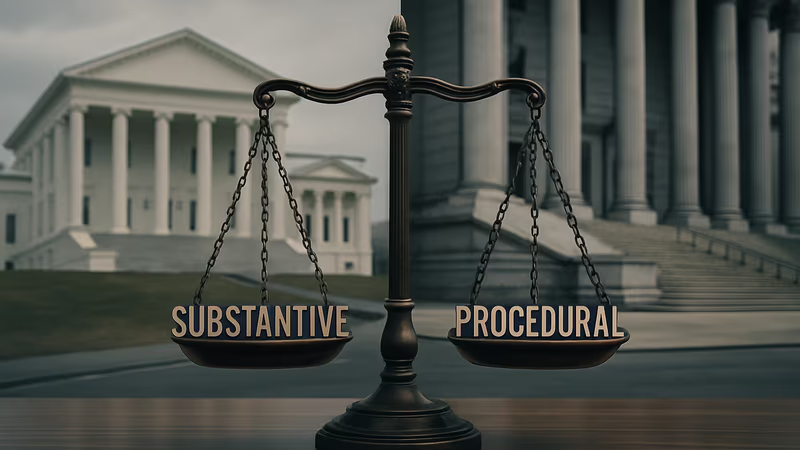
VA substantive law; NY Procedural law
New York courts apply substantive law from other states but use NY procedural law, as shown in this GEICO case involving Virginia insurance law and mailing requirements.
Jul 21, 2018
AAA is licensed to transact business in NY – and recission not allowed
NY court rules AAA Michigan must follow NY law despite out-of-state status, blocking policy rescission to protect innocent third parties in no-fault claims.
May 3, 2016Common Questions
Frequently Asked Questions
Can an insurer cancel a no-fault policy in New York?
Yes, but strict notice requirements apply. Under Insurance Law §3426, the insurer must provide written notice of cancellation and may only cancel for specific reasons including non-payment of premium, material misrepresentation, or fraud. The cancellation must follow regulatory procedures.
What happens to pending no-fault claims if a policy is cancelled?
Claims for accidents that occurred while the policy was in force remain valid even after cancellation. The insurer must honor claims for incidents during the coverage period. If the policy is voided ab initio (retroactively), all claims may be affected.
How do I challenge an insurance policy cancellation?
You can challenge a cancellation by filing a complaint with the New York Department of Financial Services, commencing a declaratory judgment action, or raising the improper cancellation as a defense in litigation. The insurer must prove it followed all statutory notice and procedural requirements.
How do New York courts decide which state's law applies?
New York follows an 'interest analysis' approach to choice-of-law questions, examining which jurisdiction has the greatest interest in having its law applied. In insurance and personal injury cases, relevant factors include where the accident occurred, where the policy was issued, where the insured resides, and where the insurer is domiciled. Choice-of-law issues frequently arise in cross-border accidents and when out-of-state insurance policies cover New York accidents.
Was this article helpful?

About the Author
Jason Tenenbaum, Esq.
Jason Tenenbaum is the founding attorney of the Law Office of Jason Tenenbaum, P.C., headquartered at 326 Walt Whitman Road, Suite C, Huntington Station, New York 11746. With over 24 years of experience since founding the firm in 2002, Jason has written more than 1,000 appeals, handled over 100,000 no-fault insurance cases, and recovered over $100 million for clients across Long Island, Nassau County, Suffolk County, Queens, Brooklyn, Manhattan, the Bronx, and Staten Island. He is one of the few attorneys in the state who both writes his own appellate briefs and tries his own cases.
Jason is admitted to practice in New York, New Jersey, Florida, Texas, Georgia, and Michigan state courts, as well as multiple federal courts. His 2,353+ published legal articles analyzing New York case law, procedural developments, and litigation strategy make him one of the most prolific legal commentators in the state. He earned his Juris Doctor from Syracuse University College of Law.
Disclaimer: This article is published by the Law Office of Jason Tenenbaum, P.C. for informational and educational purposes only. It does not constitute legal advice, and no attorney-client relationship is formed by reading this content. The legal principles discussed may not apply to your specific situation, and the law may have changed since this article was last updated.
New York law varies by jurisdiction — court decisions in one Appellate Division department may not be followed in another, and local court rules in Nassau County Supreme Court differ from those in Suffolk County Supreme Court, Kings County Civil Court, or Queens County Supreme Court. The Appellate Division, Second Department (which covers Long Island, Brooklyn, Queens, and Staten Island) and the Appellate Term (which hears appeals from lower courts) each have distinct procedural requirements and precedents that affect litigation strategy.
If you need legal help with a cancellation of policy matter, contact our office at (516) 750-0595 for a free consultation. We serve clients throughout Long Island (Huntington, Babylon, Islip, Brookhaven, Smithtown, Riverhead, Southampton, East Hampton), Nassau County (Hempstead, Garden City, Mineola, Great Neck, Manhasset, Freeport, Long Beach, Rockville Centre, Valley Stream, Westbury, Hicksville, Massapequa), Suffolk County (Hauppauge, Deer Park, Bay Shore, Central Islip, Patchogue, Brentwood), Queens, Brooklyn, Manhattan, the Bronx, Staten Island, and Westchester County. Prior results do not guarantee a similar outcome.