Key Takeaway
Attorney Jason Tenenbaum critiques a case where counsel failed to research applicable Rhode Island law before proceeding to trial, highlighting the importance of thorough legal preparation.
This article is part of our ongoing choice of law coverage, with 35 published articles analyzing choice of law issues across New York State. Attorney Jason Tenenbaum brings 24+ years of hands-on experience to this analysis, drawing from his work on more than 1,000 appeals, over 100,000 no-fault cases, and recovery of over $100 million for clients throughout Nassau County, Suffolk County, Queens, Brooklyn, Manhattan, and the Bronx. For personalized legal advice about how these principles apply to your specific situation, contact our Long Island office at (516) 750-0595 for a free consultation.
Choice of law determinations can make or break a case, particularly in no-fault insurance disputes where different states have vastly different legal frameworks. The recent decision in 37 Ave Med., P.C. v Metlife Auto & Home Ins. Co. serves as a cautionary tale about the critical importance of thorough legal research before advising clients to proceed to trial.
This case highlights a fundamental misstep: proceeding without adequately researching which state’s law would apply and how that choice would impact the client’s position. In insurance coverage disputes, attorneys must carefully analyze whether the law of the policy’s issuance state or the accident state will govern, as this determination can dramatically affect the outcome. The distinction becomes even more complex when dealing with states that have different approaches to no-fault insurance requirements, such as the policy voided scenarios that can arise under various state frameworks.
Jason Tenenbaum’s Analysis:
How do you not research core issues before you tell a client you want to take a case to trial? I hope the client was told that Rhode Island law would not support their position and the client voluntarily opted to take a chance the issue. Also, if you are going to apply Rhode Island law, what is the standard for collection of medical bills? Is there a requirement that the provider prove the services are necessary and related to injury at hand. Alternatively, if the policy issuance state is not a no-fault state (neither compulsory or through election), wouldn’t the better argument be that New York law should apply viz the deemer, including the fraudulent procurement rules? Certain things never cease to amaze me.
Good job to Evan Polansky- we have something in two weeks right?
Understanding Choice of Law in Insurance Cases
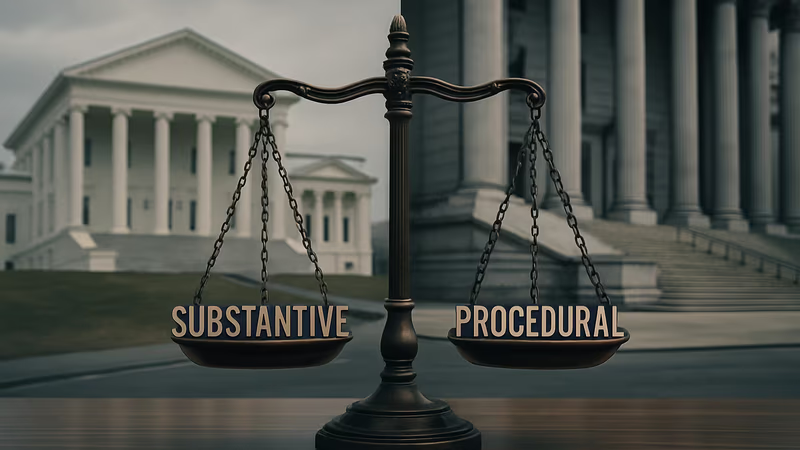
Choice of law analysis requires careful consideration of multiple factors, including where the policy was issued, where the accident occurred, and the domicile of the parties involved. As we’ve seen in other contexts, such as VA substantive law; NY Procedural law applications, courts must balance competing interests when determining which jurisdiction’s laws should govern.
When dealing with no-fault insurance cases, attorneys must also consider whether the applicable state has mandatory no-fault coverage or operates under an elective system. This distinction can significantly impact available remedies and procedural requirements, including standards for proving medical necessity and relatedness of treatment to the underlying injury.
Key Takeaway
Thorough legal research before trial is not optional—it’s essential. Attorneys must fully understand which state’s law will apply and how that choice affects their client’s position. Failure to conduct this analysis can result in pursuing unwinnable cases and potentially exposing clients to unnecessary costs and adverse outcomes.
Related Articles
Legal Context
Why This Matters for Your Case
New York law is among the most complex and nuanced in the country, with distinct procedural rules, substantive doctrines, and court systems that differ significantly from other jurisdictions. The Civil Practice Law and Rules (CPLR) governs every stage of civil litigation, from service of process through trial and appeal. The Appellate Division, Appellate Term, and Court of Appeals create a rich and ever-evolving body of case law that practitioners must follow.
Attorney Jason Tenenbaum has practiced across these areas for over 24 years, writing more than 1,000 appellate briefs and publishing over 2,353 legal articles that attorneys and clients rely on for guidance. The analysis in this article reflects real courtroom experience — from motion practice in Civil Court and Supreme Court to oral arguments before the Appellate Division — and a deep understanding of how New York courts actually apply the law in practice.
About This Topic
Choice of Law in New York Insurance & Injury Cases
When an accident or insurance dispute involves multiple states, New York courts must determine which state's law governs the claim. Choice-of-law analysis in New York uses an interest analysis approach for tort claims and a grouping-of-contacts test for contract-based insurance disputes. The choice between New York and another state's law can dramatically affect the outcome — particularly regarding no-fault thresholds, damage caps, and procedural requirements. These articles examine the analytical framework New York courts apply to resolve choice-of-law disputes.
35 published articles in Choice of law
Keep Reading
More Choice of law Analysis

Choice of law?
Court applies New York no-fault law over New Jersey law based on most significant relationship test, despite accident occurring in New Jersey.
Mar 17, 2021
Retroactive rescission
A Florida choice of law analysis leads to successful retroactive rescission, highlighting the importance of understanding different state laws in no-fault insurance cases.
Sep 25, 2020
Policy voided
New York court upholds insurance company's retroactive policy rescission under Florida law, demonstrating how choice of law principles apply in multi-state insurance disputes.
Jan 26, 2018
An appeal for the sake of an appeal?
New York appellate court reverses summary judgment in no-fault insurance case due to missing affidavit, raising questions about the necessity of the appeal.
Mar 21, 2016
Policy can be rescined under PA law; proof insufficient as to particular Assignor
PA law policy rescission case - insufficient proof against assignor in NY no-fault insurance fraud claim. Delta Diagnostic v Infinity Group 2014 decision analysis.
Apr 19, 2014
When NY and NJ Insurance Laws Collide: Understanding Cross-State Claims
Expert legal guidance on NY-NJ cross-state insurance claims. Long Island attorney explains choice of law implications. Call 516-750-0595.
Mar 22, 2009Common Questions
Frequently Asked Questions
How do New York courts decide which state's law applies?
New York follows an 'interest analysis' approach to choice-of-law questions, examining which jurisdiction has the greatest interest in having its law applied. In insurance and personal injury cases, relevant factors include where the accident occurred, where the policy was issued, where the insured resides, and where the insurer is domiciled. Choice-of-law issues frequently arise in cross-border accidents and when out-of-state insurance policies cover New York accidents.
Was this article helpful?

About the Author
Jason Tenenbaum, Esq.
Jason Tenenbaum is the founding attorney of the Law Office of Jason Tenenbaum, P.C., headquartered at 326 Walt Whitman Road, Suite C, Huntington Station, New York 11746. With over 24 years of experience since founding the firm in 2002, Jason has written more than 1,000 appeals, handled over 100,000 no-fault insurance cases, and recovered over $100 million for clients across Long Island, Nassau County, Suffolk County, Queens, Brooklyn, Manhattan, the Bronx, and Staten Island. He is one of the few attorneys in the state who both writes his own appellate briefs and tries his own cases.
Jason is admitted to practice in New York, New Jersey, Florida, Texas, Georgia, and Michigan state courts, as well as multiple federal courts. His 2,353+ published legal articles analyzing New York case law, procedural developments, and litigation strategy make him one of the most prolific legal commentators in the state. He earned his Juris Doctor from Syracuse University College of Law.
Disclaimer: This article is published by the Law Office of Jason Tenenbaum, P.C. for informational and educational purposes only. It does not constitute legal advice, and no attorney-client relationship is formed by reading this content. The legal principles discussed may not apply to your specific situation, and the law may have changed since this article was last updated.
New York law varies by jurisdiction — court decisions in one Appellate Division department may not be followed in another, and local court rules in Nassau County Supreme Court differ from those in Suffolk County Supreme Court, Kings County Civil Court, or Queens County Supreme Court. The Appellate Division, Second Department (which covers Long Island, Brooklyn, Queens, and Staten Island) and the Appellate Term (which hears appeals from lower courts) each have distinct procedural requirements and precedents that affect litigation strategy.
If you need legal help with a choice of law matter, contact our office at (516) 750-0595 for a free consultation. We serve clients throughout Long Island (Huntington, Babylon, Islip, Brookhaven, Smithtown, Riverhead, Southampton, East Hampton), Nassau County (Hempstead, Garden City, Mineola, Great Neck, Manhasset, Freeport, Long Beach, Rockville Centre, Valley Stream, Westbury, Hicksville, Massapequa), Suffolk County (Hauppauge, Deer Park, Bay Shore, Central Islip, Patchogue, Brentwood), Queens, Brooklyn, Manhattan, the Bronx, Staten Island, and Westchester County. Prior results do not guarantee a similar outcome.