Key Takeaway
New York court dismisses injury case where plaintiff failed to prove accident caused knee surgery, highlighting importance of objective medical evidence in causation claims.
This article is part of our ongoing 5102(d) issues coverage, with 89 published articles analyzing 5102(d) issues issues across New York State. Attorney Jason Tenenbaum brings 24+ years of hands-on experience to this analysis, drawing from his work on more than 1,000 appeals, over 100,000 no-fault cases, and recovery of over $100 million for clients throughout Nassau County, Suffolk County, Queens, Brooklyn, Manhattan, and the Bronx. For personalized legal advice about how these principles apply to your specific situation, contact our Long Island office at (516) 750-0595 for a free consultation.
Personal injury cases in New York often hinge on establishing a clear causal connection between an accident and claimed injuries. This becomes particularly challenging when plaintiffs have pre-existing medical conditions that complicate the analysis. The recent decision in Campbell v Fischetti demonstrates how courts scrutinize medical evidence when determining whether an accident truly caused subsequent medical treatment, especially when objective signs of continuing disability are absent.
The case illustrates a common scenario where immediate post-accident medical records may actually work against a plaintiff’s claim. When initial medical examinations reveal only minor injuries while later surgical interventions are attributed to pre-existing conditions, establishing the necessary causal link becomes nearly impossible without compelling objective evidence.
Jason Tenenbaum’s Analysis:
Campbell v Fischetti, 2015 NY Slip Op 01898 (1st Dept. 2015)
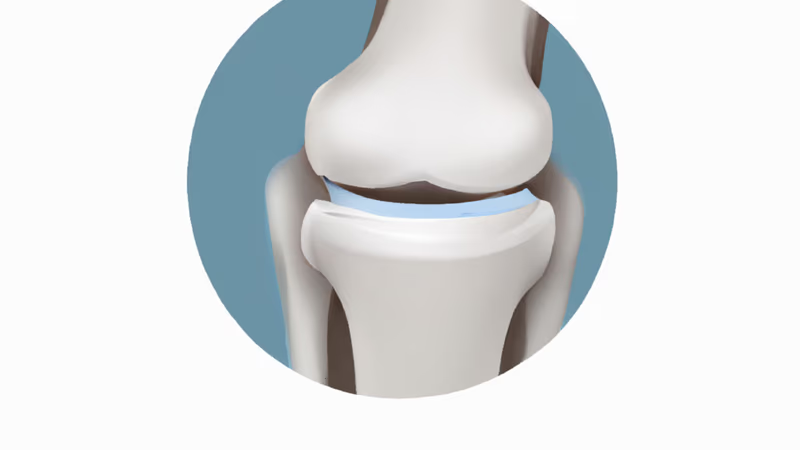
“Furthermore, an X ray taken on the accident date revealed that plaintiff had sustained only a contusion, and had chronic degenerative changes with severe medial joint space narrowing.
In opposition, plaintiff failed to raise a triable issue of fact. Her orthopedic surgeon diagnosed her with left knee osteoarthritis before and after surgery, and provided “no objective basis or reason, other than the history provided by plaintiff,” in support of his opinion that the accident was causally related to the knee surgery nine months later (_see Farmer_at 562 ). Moreover, plaintiff failed to provide evidence of any injuries that were different from her preexisting arthritic condition (see Kamara v Ajlan, 107 AD3d 575, 576 ).”
Key Takeaway
This decision emphasizes that medical opinions based solely on a plaintiff’s subjective history are insufficient to establish causation in personal injury cases. Courts require objective medical evidence showing how an accident meaningfully altered or exacerbated pre-existing conditions. Without such evidence, cases often fail at the summary judgment stage, as plaintiff’s own hospital records can undermine their claims.
Related Articles
Legal Context
Why This Matters for Your Case
New York law is among the most complex and nuanced in the country, with distinct procedural rules, substantive doctrines, and court systems that differ significantly from other jurisdictions. The Civil Practice Law and Rules (CPLR) governs every stage of civil litigation, from service of process through trial and appeal. The Appellate Division, Appellate Term, and Court of Appeals create a rich and ever-evolving body of case law that practitioners must follow.
Attorney Jason Tenenbaum has practiced across these areas for over 24 years, writing more than 1,000 appellate briefs and publishing over 2,353 legal articles that attorneys and clients rely on for guidance. The analysis in this article reflects real courtroom experience — from motion practice in Civil Court and Supreme Court to oral arguments before the Appellate Division — and a deep understanding of how New York courts actually apply the law in practice.
Keep Reading
More 5102(d) issues Analysis

Significant limitation v. permanent consequential, again
New York court ruling creates apparent contradiction in no-fault threshold requirements for significant limitation vs. permanent consequential limitation cases.
May 22, 2021
NY Serious Injury Threshold: When Suboptimal Effort Derails Personal Injury Cases
Learn how NY's serious injury threshold works and why suboptimal effort can destroy your personal injury case. Expert Long Island attorney guidance. Call 516-750-0595.
Nov 25, 2019
A Prima facie showing of lack of serious injury does not require a review of plaintiff’s records
New York court ruling confirms insurance medical experts don't need to review all plaintiff records to establish prima facie case for lack of serious injury.
Jun 20, 2013
Exageration of symptoms beats a threshold motion
New York court ruling shows that medical experts claiming symptom exaggeration must provide objective evidence to support their conclusions in no-fault threshold cases.
Sep 23, 2010
Another must read in the battle involving “significant limitation” and “permanent consequential”
Tejada v LKQ case analysis: Court finds triable issue for significant limitation but not permanent consequential limitation in lumbar spine injury claim.
Nov 14, 2018
Mild, minor, slight
New York Court of Appeals case analysis on serious injury threshold: when mild deficits and full range of motion doom personal injury claims under Insurance Law 5102(d).
Jun 29, 2017Common Questions
Frequently Asked Questions
What is the serious injury threshold under Insurance Law §5102(d)?
New York Insurance Law §5102(d) defines 'serious injury' as a personal injury that results in death, dismemberment, significant disfigurement, a fracture, loss of a fetus, permanent loss of use of a body organ, member, function or system, permanent consequential limitation of use of a body organ or member, significant limitation of use of a body function or system, or a medically determined injury that prevents the person from performing substantially all of their daily activities for at least 90 of the first 180 days following the accident.
Why does the serious injury threshold matter?
In New York, you cannot sue for pain and suffering damages in a motor vehicle accident case unless your injuries meet the serious injury threshold. This is a critical hurdle in every car accident lawsuit. Insurance companies aggressively challenge whether plaintiffs meet this threshold, often relying on IME doctors who find no objective limitations. Successfully establishing a serious injury requires detailed medical evidence, including quantified range-of-motion findings and correlation to the accident.
Was this article helpful?

About the Author
Jason Tenenbaum, Esq.
Jason Tenenbaum is the founding attorney of the Law Office of Jason Tenenbaum, P.C., headquartered at 326 Walt Whitman Road, Suite C, Huntington Station, New York 11746. With over 24 years of experience since founding the firm in 2002, Jason has written more than 1,000 appeals, handled over 100,000 no-fault insurance cases, and recovered over $100 million for clients across Long Island, Nassau County, Suffolk County, Queens, Brooklyn, Manhattan, the Bronx, and Staten Island. He is one of the few attorneys in the state who both writes his own appellate briefs and tries his own cases.
Jason is admitted to practice in New York, New Jersey, Florida, Texas, Georgia, and Michigan state courts, as well as multiple federal courts. His 2,353+ published legal articles analyzing New York case law, procedural developments, and litigation strategy make him one of the most prolific legal commentators in the state. He earned his Juris Doctor from Syracuse University College of Law.
Disclaimer: This article is published by the Law Office of Jason Tenenbaum, P.C. for informational and educational purposes only. It does not constitute legal advice, and no attorney-client relationship is formed by reading this content. The legal principles discussed may not apply to your specific situation, and the law may have changed since this article was last updated.
New York law varies by jurisdiction — court decisions in one Appellate Division department may not be followed in another, and local court rules in Nassau County Supreme Court differ from those in Suffolk County Supreme Court, Kings County Civil Court, or Queens County Supreme Court. The Appellate Division, Second Department (which covers Long Island, Brooklyn, Queens, and Staten Island) and the Appellate Term (which hears appeals from lower courts) each have distinct procedural requirements and precedents that affect litigation strategy.
If you need legal help with a 5102(d) issues matter, contact our office at (516) 750-0595 for a free consultation. We serve clients throughout Long Island (Huntington, Babylon, Islip, Brookhaven, Smithtown, Riverhead, Southampton, East Hampton), Nassau County (Hempstead, Garden City, Mineola, Great Neck, Manhasset, Freeport, Long Beach, Rockville Centre, Valley Stream, Westbury, Hicksville, Massapequa), Suffolk County (Hauppauge, Deer Park, Bay Shore, Central Islip, Patchogue, Brentwood), Queens, Brooklyn, Manhattan, the Bronx, Staten Island, and Westchester County. Prior results do not guarantee a similar outcome.