Key Takeaway
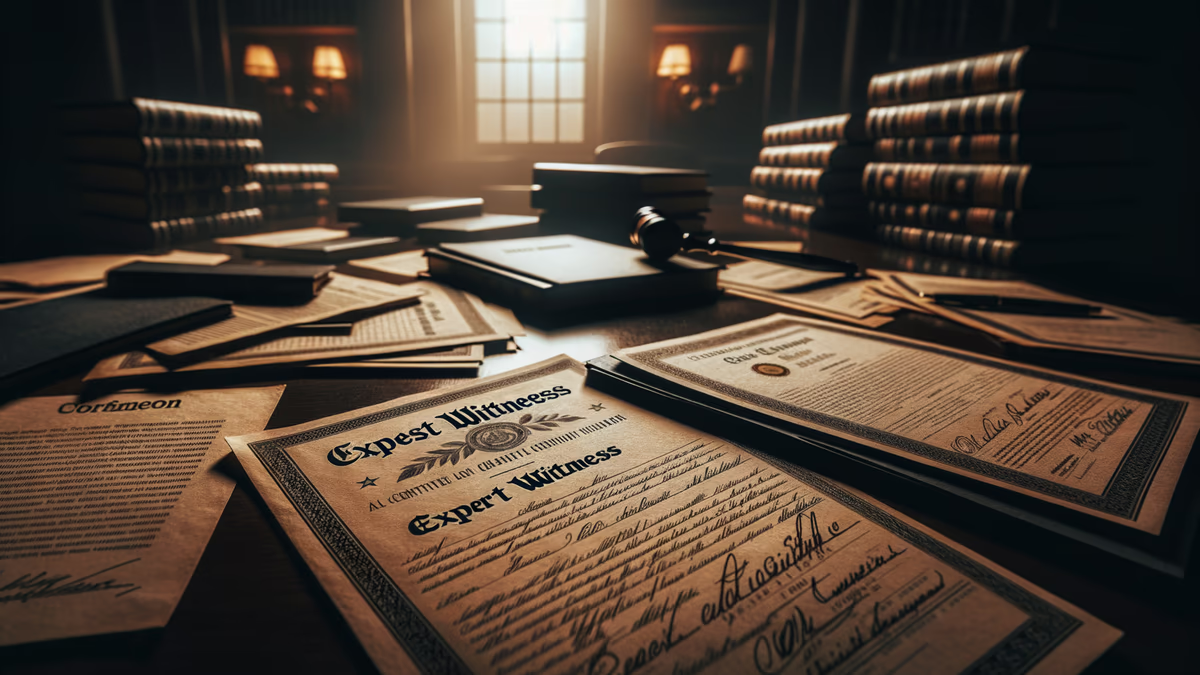
New York court ruling on expert witness qualification requirements - what must be included in expert affidavits and CVs to establish admissibility in personal injury cases.
This article is part of our ongoing evidence coverage, with 160 published articles analyzing evidence issues across New York State. Attorney Jason Tenenbaum brings 24+ years of hands-on experience to this analysis, drawing from his work on more than 1,000 appeals, over 100,000 no-fault cases, and recovery of over $100 million for clients throughout Nassau County, Suffolk County, Queens, Brooklyn, Manhattan, and the Bronx. For personalized legal advice about how these principles apply to your specific situation, contact our Long Island office at (516) 750-0595 for a free consultation.
Flanger v 2461 Elm Realty Corp., 2014 NY Slip Op 08532 (3d Dept. 2014)
“Defendant also submitted the affidavit of an alleged expert engineer who opined that the sidewalk and curb complied with all state and local building and fire codes and the sidewalk was in a good state of repair. A precondition to the admissibility of expert testimony is that the proposed expert is “possessed of the requisite skill, training, education, knowledge or experience from which it can be assumed that the information imparted or the opinion rendered is reliable” (Matott v Ward, 48 NY2d 455, 459 ;see Hofmann v Toys “R” Us, NY Ltd. Partnership, 272 AD2d 296, 296 ). Defendant’s proffered expert affidavit does not include the information necessary to permit a court to reach such a determination. In his affidavit, defendant’s proffered expert listed the initials “P.E.” after his name, stated that he is a principal in a specific engineering firm, and stated his opinion based on his inspection, review of codes and his “experience as an engineer.” While the “P.E.” would indicate that he is licensed as a professional engineer (see Education Law § 7202), the expert did not explicitly state whether he is licensed in any particular state. He also did not mention anything about his education, what type of engineer he is (e.g., mechanical, chemical, electrical), or any experience he may have that would be relevant to the design and maintenance of curbs and sidewalks. Nor did he attach a curriculum vitae that presumably would have included some or all of that information (see Bova v County of Saratoga, 258 AD2d 748, 750 ; compare Winney v County of Saratoga, 8 AD3d 944, 945 ).”
This is an interesting case as to what must be included in the expert report or CV. I am left to assume that a peer report or IME that states the name of the person, that he is a doctor with a specialty OR a chiropractor, acupuncture with a credential should be sufficient. On the other hand, a nurse, engineer, coder or other person would have to set forth their credentials in the report (or have a CV attached). An interesting case.
Related Articles
Legal Context
Why This Matters for Your Case
New York law is among the most complex and nuanced in the country, with distinct procedural rules, substantive doctrines, and court systems that differ significantly from other jurisdictions. The Civil Practice Law and Rules (CPLR) governs every stage of civil litigation, from service of process through trial and appeal. The Appellate Division, Appellate Term, and Court of Appeals create a rich and ever-evolving body of case law that practitioners must follow.
Attorney Jason Tenenbaum has practiced across these areas for over 24 years, writing more than 1,000 appellate briefs and publishing over 2,353 legal articles that attorneys and clients rely on for guidance. The analysis in this article reflects real courtroom experience — from motion practice in Civil Court and Supreme Court to oral arguments before the Appellate Division — and a deep understanding of how New York courts actually apply the law in practice.
About This Topic
Evidentiary Issues in New York Litigation
The rules of evidence determine what information a court or arbitrator may consider in deciding a case. In New York no-fault and personal injury practice, evidentiary issues arise constantly — from the admissibility of business records and medical reports to the foundation requirements for expert testimony and the application of hearsay exceptions. These articles examine how New York courts apply evidentiary rules in insurance and injury litigation, with practical guidance for building admissible evidence at every stage of a case.
160 published articles in Evidence
Keep Reading
More Evidence Analysis

CPLR § 2106 Amendment Eliminates Affidavit Notarization Requirement: What This Means for New York Litigation
NY CPLR 2106 amendment eliminates notarized affidavits and certificates of conformity. Learn how this changes litigation practice. Call 516-750-0595.
Feb 18, 2026
Expert Witness in Car Accident Lawsuits
Learn how expert witnesses in New York car accident lawsuits help establish fault, causation, and damages through accident reconstruction, medical testimony, and economic analysis.
May 14, 2025
CPLR 4518(a) Business Records: Key Admissibility Rules for New York Litigation
Key CPLR 4518(a) business records admissibility rules after Rodriguez decision. Expert analysis for Long Island & NYC attorneys handling evidence issues.
Feb 21, 2011
Affirmation of opposing expert sufficient to thwart summary judgment in a malpractice case
Court affirms opposing expert affidavit sufficient to defeat summary judgment in medical malpractice when expert has proper credentials and specialty certification.
Jan 13, 2010
By-Report
Court rules insurers must request additional documentation for "By Report" CPT codes before denying no-fault claims, addressing proper claim procedures.
Nov 4, 2017
Jules said he is not bound by the Appellate Term’s holdings
NYC Civil Court judge refuses expert testimony on hearsay grounds despite Appellate Term precedent requiring such testimony in no-fault medical necessity cases.
Aug 20, 2014Common Questions
Frequently Asked Questions
What types of evidence are important in no-fault and personal injury cases?
Key types of evidence include medical records and bills, police accident reports, diagnostic imaging (MRI, X-ray, CT scans), expert medical opinions, business records from insurance companies and providers, witness statements, photographs of injuries and the accident scene, and employment records for lost wage claims. The rules of evidence under New York CPLR and the Evidence Rules govern what is admissible in court proceedings.
What is the business records exception to hearsay in New York?
Under CPLR 4518(a), a business record is admissible if it was made in the regular course of business, it was the regular course of business to make such a record, and the record was made at or near the time of the event recorded. This exception is crucial in no-fault litigation because insurers' denial letters, claim logs, and peer review reports are often offered as business records. The foundation for the business record must be established through testimony or a certification.
What role does diagnostic imaging play as evidence in injury cases?
Diagnostic imaging — MRIs, CT scans, X-rays, and EMG/NCV studies — provides objective evidence of injuries such as herniated discs, fractures, ligament tears, and nerve damage. Courts and arbitrators give significant weight to imaging evidence because it is less subjective than physical examination findings. In serious injury threshold cases under §5102(d), imaging evidence corroborating clinical findings strengthens the plaintiff's case considerably.
How do New York courts handle surveillance evidence in personal injury cases?
Insurance companies frequently hire investigators to conduct video surveillance of plaintiffs to challenge injury claims. Under CPLR 3101(i), a party must disclose surveillance materials prior to trial, including films, photographs, and videotapes. Surveillance evidence can be powerful for impeachment if it contradicts the plaintiff's testimony about limitations. However, courts may preclude surveillance that was not properly disclosed or that is misleadingly edited.
How are expert witnesses used in New York personal injury cases?
Expert witnesses provide specialized opinion testimony that helps the court or jury understand complex issues like medical causation, injury severity, future care needs, economic losses, and engineering defects. Under New York law, expert testimony must be based on facts in evidence, the expert's professional knowledge, or a combination of both. The expert must be qualified by training, education, or experience in the relevant field. Expert disclosure requirements under CPLR 3101(d)(1)(i) require parties to identify their experts and provide detailed summaries before trial.
Was this article helpful?

About the Author
Jason Tenenbaum, Esq.
Jason Tenenbaum is the founding attorney of the Law Office of Jason Tenenbaum, P.C., headquartered at 326 Walt Whitman Road, Suite C, Huntington Station, New York 11746. With over 24 years of experience since founding the firm in 2002, Jason has written more than 1,000 appeals, handled over 100,000 no-fault insurance cases, and recovered over $100 million for clients across Long Island, Nassau County, Suffolk County, Queens, Brooklyn, Manhattan, the Bronx, and Staten Island. He is one of the few attorneys in the state who both writes his own appellate briefs and tries his own cases.
Jason is admitted to practice in New York, New Jersey, Florida, Texas, Georgia, and Michigan state courts, as well as multiple federal courts. His 2,353+ published legal articles analyzing New York case law, procedural developments, and litigation strategy make him one of the most prolific legal commentators in the state. He earned his Juris Doctor from Syracuse University College of Law.
Disclaimer: This article is published by the Law Office of Jason Tenenbaum, P.C. for informational and educational purposes only. It does not constitute legal advice, and no attorney-client relationship is formed by reading this content. The legal principles discussed may not apply to your specific situation, and the law may have changed since this article was last updated.
New York law varies by jurisdiction — court decisions in one Appellate Division department may not be followed in another, and local court rules in Nassau County Supreme Court differ from those in Suffolk County Supreme Court, Kings County Civil Court, or Queens County Supreme Court. The Appellate Division, Second Department (which covers Long Island, Brooklyn, Queens, and Staten Island) and the Appellate Term (which hears appeals from lower courts) each have distinct procedural requirements and precedents that affect litigation strategy.
If you need legal help with a evidence matter, contact our office at (516) 750-0595 for a free consultation. We serve clients throughout Long Island (Huntington, Babylon, Islip, Brookhaven, Smithtown, Riverhead, Southampton, East Hampton), Nassau County (Hempstead, Garden City, Mineola, Great Neck, Manhasset, Freeport, Long Beach, Rockville Centre, Valley Stream, Westbury, Hicksville, Massapequa), Suffolk County (Hauppauge, Deer Park, Bay Shore, Central Islip, Patchogue, Brentwood), Queens, Brooklyn, Manhattan, the Bronx, Staten Island, and Westchester County. Prior results do not guarantee a similar outcome.