
Key Takeaway
Court vacates aggravated unlicensed operation conviction due to insufficient proof of proper DMV mailing procedures and lack of personal knowledge testimony.
This article is part of our ongoing mailing coverage, with 53 published articles analyzing mailing issues across New York State. Attorney Jason Tenenbaum brings 24+ years of hands-on experience to this analysis, drawing from his work on more than 1,000 appeals, over 100,000 no-fault cases, and recovery of over $100 million for clients throughout Nassau County, Suffolk County, Queens, Brooklyn, Manhattan, and the Bronx. For personalized legal advice about how these principles apply to your specific situation, contact our Long Island office at (516) 750-0595 for a free consultation.
Aggravated unlicensed operation (AUO) prosecutions in New York require the People to prove not only that the defendant drove without a valid license, but also that the defendant knew or had reason to know of the suspension. This knowledge requirement creates a critical evidentiary burden for prosecutors: they must establish that the Department of Motor Vehicles properly mailed suspension notices to the defendant. Proper mailing creates a presumption that the defendant received notice and therefore knew of the suspension. However, establishing proper mailing requires more than simply producing DMV records—it demands testimony from witnesses with personal knowledge of the mailing procedures actually used.
The personal knowledge requirement stems from foundational evidentiary principles governing proof of routine office practices. When parties seek to establish that a document was mailed according to standard procedures, they cannot rely on generic testimony from employees unfamiliar with the specific office’s practices. Instead, they must present witnesses who can describe from personal experience how that particular office ensures documents are properly addressed, stamped, and deposited in the mail. This requirement prevents the admission of conclusory assertions unsupported by actual knowledge of the procedures employed.
In civil litigation involving mailing issues—whether in no-fault insurance disputes, notice of claim challenges, or service of process questions—courts consistently demand similar foundation. A witness cannot simply assert “we have standard mailing procedures” without demonstrating familiarity with those procedures. The witness must be able to describe the step-by-step process, identify who performs each task, and explain how the office ensures compliance with its stated practices. When witnesses lack this personal knowledge, their testimony fails to establish the necessary foundation for the mailing presumption.
Case Background
The People charged defendant Francis with aggravated unlicensed operation of a motor vehicle in the third degree after she was stopped while driving with a suspended license. At trial, the prosecution sought to prove Francis knew of the suspension by establishing that the DMV mailed suspension notices to her last known address. To prove proper mailing, the People presented testimony from an employee of the Kings County DMV office.
The critical flaw in the People’s case emerged during this testimony: the Kings County DMV employee had no personal knowledge of the mailing procedures used by the Albany DMV office, which actually handled mailing the suspension notices to Francis. The witness could not describe Albany’s standard practices for ensuring notices were properly addressed and mailed. Without this foundation, the People could not establish that the suspension notices were actually mailed to Francis, leaving them unable to prove she knew or had reason to know about the suspension.
Despite the conviction at trial, the Appellate Division reversed, finding the evidence legally insufficient to support the AUO charge. The court emphasized that knowledge of the suspension constitutes an essential element of the offense, and the People failed to meet their burden of proof on this element.
Jason Tenenbaum’s Analysis
People v Francis, 2014 NY Slip Op 00682 (2d Dept. 2014)
In order to support a conviction of aggravated unlicensed operation of a motor vehicle in the third degree, the People must establish that the defendant knew or had reason to know that his or her driving privilege had been revoked, suspended, or otherwise withdrawn by the Commissioner of Motor Vehicles.
Here, the evidence was legally insufficient to prove that the defendant knew or had reason to know that her license had been suspended. The testimony on behalf of the People, given by an employee from the Kings County [*2]office of the New York State Department of Motor Vehicles (hereinafter the DMV), revealed that the employee had no personal knowledge of the procedures utilized by the Albany DMV office, which handled the mailing of the notices of impending and actual suspension of the defendant’s license. Consequently, the People failed to present sufficient proof regarding the standard practice and procedure of the Albany DMV office that were designed to ensure that the suspension orders were properly addressed and mailed, did not establish that the suspension orders were mailed to the defendant, and, thus, failed to prove that the defendant knew, or had reason to know, that her license had been suspended”
Legal Significance
The Francis decision reinforces fundamental principles about proving notice through proper mailing. First, it establishes that testimony about mailing procedures must come from witnesses with personal knowledge of the specific office’s practices, not from employees of different offices within the same agency. The DMV’s organizational structure, with different offices handling different functions, requires careful attention to which office performed the relevant mailing task.
Second, the decision demonstrates that knowledge elements in criminal statutes create substantial evidentiary burdens for prosecutors. The People cannot simply prove the defendant committed the prohibited act—they must also establish the defendant’s mental state through competent evidence. When knowledge depends on receipt of mailed notice, prosecutors must lay proper foundation for the mailing presumption.
Third, the case illustrates how procedural defects in proof can undermine otherwise strong cases. The People presumably had DMV records showing the suspension and likely had evidence of Francis driving. But without proper testimony establishing that notice was mailed, these other elements could not support conviction.
This principle extends well beyond criminal prosecutions. In civil litigation, parties attempting to prove proper mailing face identical foundational requirements. Insurance companies denying claims based on alleged failure to comply with policy requirements must prove they mailed those requirements to the insured. Defendants claiming proper service must establish mailing through witnesses with personal knowledge. Municipalities asserting proper notice must present testimony from employees familiar with the actual mailing procedures employed.
Practical Implications for Practitioners and Prosecutors
Defense attorneys handling AUO cases should carefully examine the People’s proof of proper mailing. Request discovery identifying which DMV office mailed the suspension notices and which witness will testify about mailing procedures. During cross-examination, establish whether the witness has personal knowledge of that specific office’s procedures or is merely testifying based on general DMV policies.
Prosecutors must ensure their witnesses have proper foundation before trial. If Albany DMV mailed the notices, secure testimony from an Albany DMV employee familiar with Albany’s mailing procedures. If that proves impossible, consider alternative proof of the defendant’s knowledge—perhaps admission statements, evidence the defendant appeared at DMV hearings, or proof the defendant renewed vehicle registration after the suspension date.
Civil practitioners should apply these lessons to insurance disputes, notice of claim challenges, and service of process issues. When asserting proper mailing, identify employees with personal knowledge of your office’s procedures and prepare them to describe those procedures in detail. When challenging opponent’s proof of mailing, probe whether their witness actually knows the procedures used or is merely assuming standard practices were followed.
Document management systems should include procedures ensuring that employees who supervised or performed mailing can later testify about it. Create records identifying who handled specific mailings and train those employees to be able to describe the step-by-step process they followed. These preparations enable parties to meet their foundational burden when mailing issues arise in litigation.
Related Articles
Legal Context
Why This Matters for Your Case
New York law is among the most complex and nuanced in the country, with distinct procedural rules, substantive doctrines, and court systems that differ significantly from other jurisdictions. The Civil Practice Law and Rules (CPLR) governs every stage of civil litigation, from service of process through trial and appeal. The Appellate Division, Appellate Term, and Court of Appeals create a rich and ever-evolving body of case law that practitioners must follow.
Attorney Jason Tenenbaum has practiced across these areas for over 24 years, writing more than 1,000 appellate briefs and publishing over 2,353 legal articles that attorneys and clients rely on for guidance. The analysis in this article reflects real courtroom experience — from motion practice in Civil Court and Supreme Court to oral arguments before the Appellate Division — and a deep understanding of how New York courts actually apply the law in practice.
About This Topic
Proof of Mailing in New York No-Fault Practice
Proof of mailing is a foundational issue in no-fault litigation. Insurers must prove timely mailing of denial forms, verification requests, and EUO scheduling letters, while providers and claimants must prove timely submission of claim forms and bills. Establishing a standard office mailing procedure through business records — and the presumption of receipt that follows — is heavily litigated. These articles examine the evidentiary standards for proving and challenging mailing in New York no-fault cases.
53 published articles in Mailing
Keep Reading
More Mailing Analysis
Putting the wrong floor is not fatal
Court rules that incorrect floor designation in IME notice mailing address is not fatal when building address is otherwise correct and proper mailing procedures followed.
Mar 22, 2021
Mailing, again
New York's Second Department reinforces strict RPAPL 1304 mailing requirements in mortgage cases, emphasizing the need for proper evidence of both certified and first-class mail...
Nov 3, 2019
The United States Postal Service at the Appellate Term (again?)
Appellate Term case Vista Surgical v Clarendon shows prima facie mailing case failed when certified mail receipt lacked proper documentation and witness testimony.
Jun 18, 2012
There is no need to specify the particular date a denial was mailed on the affidavit
Court rules that insurance companies don't need to specify exact mailing dates in affidavits when proving timely denial of no-fault claims under standard office procedures.
Oct 8, 2010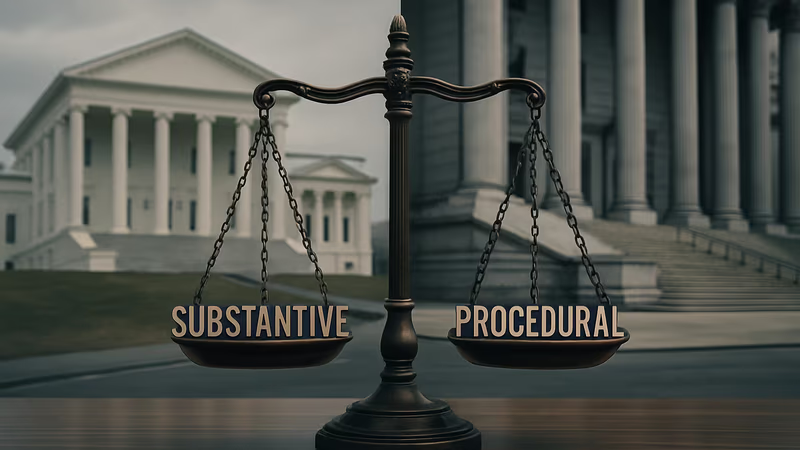
VA substantive law; NY Procedural law
New York courts apply substantive law from other states but use NY procedural law, as shown in this GEICO case involving Virginia insurance law and mailing requirements.
Jul 21, 2018
Make a promise in your papers and fail to keep it? Summary judgment lost
Court case shows how matching the wrong documents to an affidavit can destroy an insurance company's summary judgment motion in no-fault litigation.
Nov 17, 2015Common Questions
Frequently Asked Questions
Why is proof of mailing important in no-fault litigation?
Proof of mailing is critical in no-fault cases because many defenses depend on whether documents were properly sent — including denial letters, EUO scheduling notices, IME appointment letters, and verification requests. To establish proof of mailing, the insurer typically must show standard office mailing procedures through affidavit testimony and documentary evidence such as mailing logs or certified mail receipts. A failure to prove proper mailing can be fatal to the insurer's defense.
Was this article helpful?

About the Author
Jason Tenenbaum, Esq.
Jason Tenenbaum is the founding attorney of the Law Office of Jason Tenenbaum, P.C., headquartered at 326 Walt Whitman Road, Suite C, Huntington Station, New York 11746. With over 24 years of experience since founding the firm in 2002, Jason has written more than 1,000 appeals, handled over 100,000 no-fault insurance cases, and recovered over $100 million for clients across Long Island, Nassau County, Suffolk County, Queens, Brooklyn, Manhattan, the Bronx, and Staten Island. He is one of the few attorneys in the state who both writes his own appellate briefs and tries his own cases.
Jason is admitted to practice in New York, New Jersey, Florida, Texas, Georgia, and Michigan state courts, as well as multiple federal courts. His 2,353+ published legal articles analyzing New York case law, procedural developments, and litigation strategy make him one of the most prolific legal commentators in the state. He earned his Juris Doctor from Syracuse University College of Law.
Disclaimer: This article is published by the Law Office of Jason Tenenbaum, P.C. for informational and educational purposes only. It does not constitute legal advice, and no attorney-client relationship is formed by reading this content. The legal principles discussed may not apply to your specific situation, and the law may have changed since this article was last updated.
New York law varies by jurisdiction — court decisions in one Appellate Division department may not be followed in another, and local court rules in Nassau County Supreme Court differ from those in Suffolk County Supreme Court, Kings County Civil Court, or Queens County Supreme Court. The Appellate Division, Second Department (which covers Long Island, Brooklyn, Queens, and Staten Island) and the Appellate Term (which hears appeals from lower courts) each have distinct procedural requirements and precedents that affect litigation strategy.
If you need legal help with a mailing matter, contact our office at (516) 750-0595 for a free consultation. We serve clients throughout Long Island (Huntington, Babylon, Islip, Brookhaven, Smithtown, Riverhead, Southampton, East Hampton), Nassau County (Hempstead, Garden City, Mineola, Great Neck, Manhasset, Freeport, Long Beach, Rockville Centre, Valley Stream, Westbury, Hicksville, Massapequa), Suffolk County (Hauppauge, Deer Park, Bay Shore, Central Islip, Patchogue, Brentwood), Queens, Brooklyn, Manhattan, the Bronx, Staten Island, and Westchester County. Prior results do not guarantee a similar outcome.