Key Takeaway
Court rules psychologist from Ukraine incompetent to testify as expert witness due to lack of proper credentials in New York no-fault insurance case.
This article is part of our ongoing evidence coverage, with 160 published articles analyzing evidence issues across New York State. Attorney Jason Tenenbaum brings 24+ years of hands-on experience to this analysis, drawing from his work on more than 1,000 appeals, over 100,000 no-fault cases, and recovery of over $100 million for clients throughout Nassau County, Suffolk County, Queens, Brooklyn, Manhattan, and the Bronx. For personalized legal advice about how these principles apply to your specific situation, contact our Long Island office at (516) 750-0595 for a free consultation.
If you are going to spend money on a rebuttal, make sure (s)he has the proper credentials. As many people have told me in life, you get what you pay for. This case, a colossal disaster, proves that point. In fact, I am hoping Plaintiff appeals this…
Five Boro Psychological Servs. v GEICO Ins. Co., 2011 NY Slip Op 50882(U)(Civ. Ct. Kings Co. 2011)
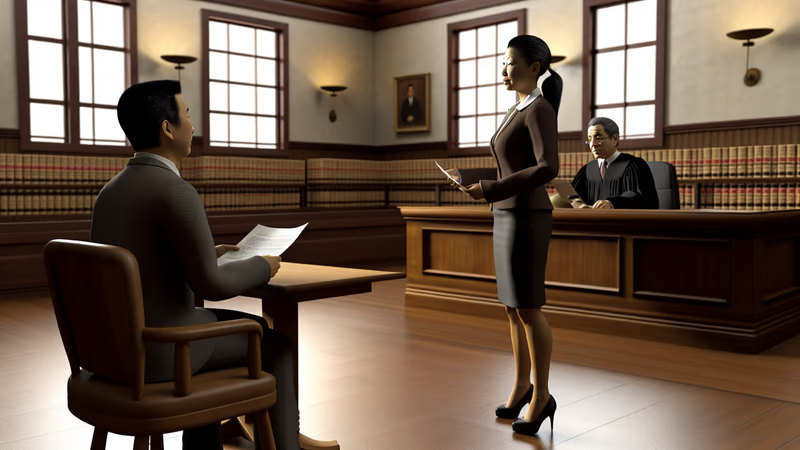
“Plaintiff then called Vladimir Grinsberg (“Grinsberg”) as a rebuttal witness. Grinsberg was a clinical psychologist in the Ukraine where he worked for six years in a psycho – neurological clinic. He claims that he administered the five tests at issue while working in the Ukraine.
Upon arriving in America, he obtained a masters in social work from Adelphi University; he is not a clinical social worker, which requires a doctorate. Ten years ago, Grinsberg worked as a social worker with the Jewish Board of Family and Children’s Services ( “Jewish Board”) doing family psychotherapy and teaching families. While working at the Jewish Board, Grinsberg administered and implemented treatment plans for private patients. He treated patients from the beginning to the end, which included reviewing tests, writing reports and interpreting the results of the test. He got reimbursed by insurance companies as a private practitioner”
There is no talismanic rule defining whether a witness is an expert or not, as “various combinations of education , training, observation or experience” may suffice, although none of the aforementioned criteria, standing alone, are determinative. Mtr. Of R..M. Children, 165 Misc 2d 441 444 ( Family Ct., Kings Co. 1995). See, Steinbach, supra, 2 AD3d at 710. Thus, the fact that a proffered witnesses does not possess an advanced degree from a university that is nationally accredited does not disqualify him when he possesses a doctoral dissertation on the subject at issue (occultism) and has “more than ordinary knowledge of nontraditional groups and the occult. “ Echols v. State., 326 Ark. 917, 936 S.W. 2d 509 (Sup Ct. Ark. 1996). Similarly, the lack of a medical licenses does not, in and of itself, disqualify a witness from testifying as an expert on a medical question, Steinbach supra (podiatrist, while only licensed to treat below the ankles, established that he had professional experience in diagnosing and treating burns both above and below ankle and hence could offer expert testimony as to the respondent podiatrist’s alleged malpractice in treating the plaintiff’s burn injury on the calf). A witness need not possess a special license within a general licensed area in order to testify Smith v. City of NY, 238 AD2d 500 (2d Dept. 1997)(plaintiff’s doctor, while not a psychiatrist, had experience in the area of hysteria conversion and thus could testify about the subject; fact that he was not a psychiatrist went to the weight, but not admissibility of his testimony). Similarly the fact that a doctor obtained a degree in a foreign country as opposed to the U.S. does not constitute an automatic disqualifier. Meiselman v. Crown Heights Hospital, 285 NY 389 (1941).
Based upon the above, the court finds that Grinsberg does not possess the combination of long observation, real experience or sufficient education or training to be qualified as an expert on psychological testing. While Grinsberg testified that he administered the five tests at issue while working as a clinical psychologist in the Ukraine, he did not elaborate upon his experience with these psychological tests or at what frequency he utilized the tests. Although Grinsberg did not testify how long he has been in the United States, it is clear that he has not worked as a psychologist since coming to the United State which, according to his testimony, is at least 10 years . He did not indicate that his studies to earn a masters in social work gave him sufficient experience or familiarity with the psychological tests at issue. During these ten years, he has neither administered these tests nor conducted the diagnostic interviews which Dr. Porter testified are essential in order to ascertain the mental status of a given patient.
Off greater import, since commencing his work with All – Boro some six years ago, Grinsberg has not even worked in the capacity of a social worker but rather administered the day – day administrative aspects of the All – Boro. Furthermore, he blithely dismissed any differences between a psychologist or social worker in New York State although he admitted that he is not [*5]aware of what is required for to be a licensed psychologist in this state.
In fact, there are substantial differences in the licensure requirements and practice of a psychologist as compared to a social worker in this State. Compare Education Law §7601-a (definition of scope of practice of psychology) with Education Law §7701(1) (definition of scope of practice of licensed master social work) and Education Law §7701(2) (definition of scope of licensed clinical social work). See generally, People of State of NY v, RR, 12 Misc 3d 161 (Sup. Ct. NY Co. 2005).
Of even greater significance to the instant matter is the difference in scope of practice between a licensed master social worker and a licensed clinical social worker. Prior to 2002, New York State only protected the use of the titles of psychologist and certified social worker, which meant that anyone could legally practice psychology or social work so long as they did not hold themselves out as social workers or psychologists or describe their services as being psychological in nature. People of State of NY supra, 12 Misc 3d at 168. In 2002, the Legislature enacted news laws licensing the practice of psychology and social work and, in particular distinguished between licensed master social workers and clinical social workers. (Laws, 2002, Ch. 420, §1, eff. 9/1/04).
The social work statute contains “two tiers of social work so that the scope of practice of a licensed master social is included within the larger scope of practice of licensed clinical social work_. People of State of NY, supra,_ 12 Misc 3d at 171. See Education law 7701 (2)(1). “Whereas licensed clinical social workers are authorized to make and render diagnoses and the prognoses which flow from and are intimately related to them, administer and interpret tests and measures of psycho social functioning ( so called psycho diagnostic testing…), develop and implement assessment-based treatment plans and provide all forms of psychotherapy; licensed master social workers are only permitted to perform psycho social assessments and evaluations, and may not make or render diagnoses or prognoses , and may administer but not interpret tests and measures of psycho social functioning.” See Education Law §§7701 1(a) and 2(a). 12 Misc 3d at 172-74. A licensed master social worker may render the clinical functions and perform the clinical functions when then do so under the supervision of a licensed clinical social worker. Education Law §7701(d); 8 NYCRR 74.6 n 25.
It is clear that Grinsberg only possesses a master social worker license and hence is not qualified in this state to either make or render diagnoses or prognosis or interpret tests and measures of psycho social functioning. Hence, he does not possess the licensure or expertise which would qualify him to testify as an expert as to the merit or medical necessity of the five psychological tests at issue in general or how these tests pertained to the assignor. Furthermore, Grinsberg presented no testimony that he actually worked under the supervision of a licensed clinical social worker. In fact, it appears that his social worker license was irrelevant to his main job duty at Five – Boro – to supervise clinical paper work and process the claims.”
Related Articles
Legal Context
Why This Matters for Your Case
New York law is among the most complex and nuanced in the country, with distinct procedural rules, substantive doctrines, and court systems that differ significantly from other jurisdictions. The Civil Practice Law and Rules (CPLR) governs every stage of civil litigation, from service of process through trial and appeal. The Appellate Division, Appellate Term, and Court of Appeals create a rich and ever-evolving body of case law that practitioners must follow.
Attorney Jason Tenenbaum has practiced across these areas for over 24 years, writing more than 1,000 appellate briefs and publishing over 2,353 legal articles that attorneys and clients rely on for guidance. The analysis in this article reflects real courtroom experience — from motion practice in Civil Court and Supreme Court to oral arguments before the Appellate Division — and a deep understanding of how New York courts actually apply the law in practice.
About This Topic
Evidentiary Issues in New York Litigation
The rules of evidence determine what information a court or arbitrator may consider in deciding a case. In New York no-fault and personal injury practice, evidentiary issues arise constantly — from the admissibility of business records and medical reports to the foundation requirements for expert testimony and the application of hearsay exceptions. These articles examine how New York courts apply evidentiary rules in insurance and injury litigation, with practical guidance for building admissible evidence at every stage of a case.
160 published articles in Evidence
Keep Reading
More Evidence Analysis

CPLR § 2106 Amendment Eliminates Affidavit Notarization Requirement: What This Means for New York Litigation
NY CPLR 2106 amendment eliminates notarized affidavits and certificates of conformity. Learn how this changes litigation practice. Call 516-750-0595.
Feb 18, 2026
Expert Witness in Car Accident Lawsuits
Learn how expert witnesses in New York car accident lawsuits help establish fault, causation, and damages through accident reconstruction, medical testimony, and economic analysis.
May 14, 2025
A family court non-payment of child support petition spurs an interesting 4518(a) case
Family court case examining CPLR 4518(a) business records rule for medical documents - distinguishing admissible physician office records from inadmissible expert opinions.
Apr 21, 2010
Expert opinion
Court reminds attorneys that expert opinions must address specific assertions with cited evidence, not just conclusory statements, in personal injury litigation.
Mar 22, 2021
Expert witnesses again
Legal analysis of expert witness qualifications in medical malpractice cases, examining when physicians can testify outside their specialization and foundation requirements.
Dec 4, 2015
Judicial notice applies to e-court website
New York courts can take judicial notice of information on the official E-Courts website, allowing judges to consider publicly available court records without formal evidence...
Apr 8, 2012Common Questions
Frequently Asked Questions
What types of evidence are important in no-fault and personal injury cases?
Key types of evidence include medical records and bills, police accident reports, diagnostic imaging (MRI, X-ray, CT scans), expert medical opinions, business records from insurance companies and providers, witness statements, photographs of injuries and the accident scene, and employment records for lost wage claims. The rules of evidence under New York CPLR and the Evidence Rules govern what is admissible in court proceedings.
What is the business records exception to hearsay in New York?
Under CPLR 4518(a), a business record is admissible if it was made in the regular course of business, it was the regular course of business to make such a record, and the record was made at or near the time of the event recorded. This exception is crucial in no-fault litigation because insurers' denial letters, claim logs, and peer review reports are often offered as business records. The foundation for the business record must be established through testimony or a certification.
What role does diagnostic imaging play as evidence in injury cases?
Diagnostic imaging — MRIs, CT scans, X-rays, and EMG/NCV studies — provides objective evidence of injuries such as herniated discs, fractures, ligament tears, and nerve damage. Courts and arbitrators give significant weight to imaging evidence because it is less subjective than physical examination findings. In serious injury threshold cases under §5102(d), imaging evidence corroborating clinical findings strengthens the plaintiff's case considerably.
How do New York courts handle surveillance evidence in personal injury cases?
Insurance companies frequently hire investigators to conduct video surveillance of plaintiffs to challenge injury claims. Under CPLR 3101(i), a party must disclose surveillance materials prior to trial, including films, photographs, and videotapes. Surveillance evidence can be powerful for impeachment if it contradicts the plaintiff's testimony about limitations. However, courts may preclude surveillance that was not properly disclosed or that is misleadingly edited.
How are expert witnesses used in New York personal injury cases?
Expert witnesses provide specialized opinion testimony that helps the court or jury understand complex issues like medical causation, injury severity, future care needs, economic losses, and engineering defects. Under New York law, expert testimony must be based on facts in evidence, the expert's professional knowledge, or a combination of both. The expert must be qualified by training, education, or experience in the relevant field. Expert disclosure requirements under CPLR 3101(d)(1)(i) require parties to identify their experts and provide detailed summaries before trial.
Was this article helpful?

About the Author
Jason Tenenbaum, Esq.
Jason Tenenbaum is the founding attorney of the Law Office of Jason Tenenbaum, P.C., headquartered at 326 Walt Whitman Road, Suite C, Huntington Station, New York 11746. With over 24 years of experience since founding the firm in 2002, Jason has written more than 1,000 appeals, handled over 100,000 no-fault insurance cases, and recovered over $100 million for clients across Long Island, Nassau County, Suffolk County, Queens, Brooklyn, Manhattan, the Bronx, and Staten Island. He is one of the few attorneys in the state who both writes his own appellate briefs and tries his own cases.
Jason is admitted to practice in New York, New Jersey, Florida, Texas, Georgia, and Michigan state courts, as well as multiple federal courts. His 2,353+ published legal articles analyzing New York case law, procedural developments, and litigation strategy make him one of the most prolific legal commentators in the state. He earned his Juris Doctor from Syracuse University College of Law.
Disclaimer: This article is published by the Law Office of Jason Tenenbaum, P.C. for informational and educational purposes only. It does not constitute legal advice, and no attorney-client relationship is formed by reading this content. The legal principles discussed may not apply to your specific situation, and the law may have changed since this article was last updated.
New York law varies by jurisdiction — court decisions in one Appellate Division department may not be followed in another, and local court rules in Nassau County Supreme Court differ from those in Suffolk County Supreme Court, Kings County Civil Court, or Queens County Supreme Court. The Appellate Division, Second Department (which covers Long Island, Brooklyn, Queens, and Staten Island) and the Appellate Term (which hears appeals from lower courts) each have distinct procedural requirements and precedents that affect litigation strategy.
If you need legal help with a evidence matter, contact our office at (516) 750-0595 for a free consultation. We serve clients throughout Long Island (Huntington, Babylon, Islip, Brookhaven, Smithtown, Riverhead, Southampton, East Hampton), Nassau County (Hempstead, Garden City, Mineola, Great Neck, Manhasset, Freeport, Long Beach, Rockville Centre, Valley Stream, Westbury, Hicksville, Massapequa), Suffolk County (Hauppauge, Deer Park, Bay Shore, Central Islip, Patchogue, Brentwood), Queens, Brooklyn, Manhattan, the Bronx, Staten Island, and Westchester County. Prior results do not guarantee a similar outcome.