
Key Takeaway
Understanding CPLR 3404 differences between NY judicial departments. Long Island and NYC personal injury attorney explains procedural variations and case impact.
This article is part of our ongoing no-fault coverage, with 271 published articles analyzing no-fault issues across New York State. Attorney Jason Tenenbaum brings 24+ years of hands-on experience to this analysis, drawing from his work on more than 1,000 appeals, over 100,000 no-fault cases, and recovery of over $100 million for clients throughout Nassau County, Suffolk County, Queens, Brooklyn, Manhattan, and the Bronx. For personalized legal advice about how these principles apply to your specific situation, contact our Long Island office at (516) 750-0595 for a free consultation.
CPLR 3404 in Civil Court: Understanding the Jurisdictional Divide
For personal injury attorneys practicing throughout Long Island and New York City, few procedural issues create more confusion than the application of CPLR 3404 in Civil Court actions. This critical statute governs the acceleration of trial dates, but its availability in lower courts varies dramatically depending on which judicial department is hearing your case.
At the Law Office of Jason Tenenbaum, we’ve navigated countless cases where understanding these jurisdictional nuances has made the difference between swift resolution and prolonged litigation. The recent decision in Fair Price Med. Supply, Inc. v GEICO Ins. Co. perfectly illustrates how these departmental splits continue to impact no-fault insurance cases across Nassau County, Suffolk County, Queens, Brooklyn, Manhattan, and the Bronx.
The Departmental Split: A Tale of Two Approaches
The Appellate Division First Department has on numerous occasions has held that CPLR 3404 applies to Civil Court actions, while the Second Department has found that otherwise. Compare, Kaufman v Bauer, 36 AD3d 841 (1st Dept. 2007), with Chavez v 407 Seventh Ave. Corp., 39 AD3d 454 (2d Dept. 2007).
The matter of Fair Price Med. Supply, Inc. v GEICO Ins. Co., 2010 NY Slip Op 50120(U)(App. Term 1st Dept. 2010), a First Department case, should not surprise anyone. My only question is why didn’t Geico cross-move to have the case dismissed in accordance with CPLR 3404?
I must conclude this post with my observations, or thoughts. It appears that the application of CPLR 3404 to the Civil Courts is about as haphazard as the application of 2309(c) and the proof necessary to vacate a default in accordance with 5015(a)(1). The relief these statutes offers is really dependent on the judicial department in which the underlying case is pending. This is very scary for a court system that calls itself “uniform”.
What CPLR 3404 Means for Long Island and NYC Cases
CPLR 3404 serves as a powerful tool for expediting litigation, particularly in no-fault insurance disputes that plague accident victims throughout the New York metropolitan area. When available, this statute allows parties to accelerate trial dates in cases where there are no genuine issues of material fact, effectively fast-tracking resolution.
The First Department Approach: Embracing Efficiency
Courts in Manhattan and the Bronx, falling under the First Department’s jurisdiction, have consistently recognized that Civil Court actions can benefit from CPLR 3404’s expedited procedures. This approach recognizes the practical reality that many no-fault insurance cases involve straightforward legal issues that don’t require lengthy discovery periods or complex factual determinations.
For personal injury victims in Manhattan and the Bronx, this means:
- Faster resolution: Cases can move to trial more quickly when there are no disputed facts
- Reduced costs: Less time in litigation means lower attorney fees and costs
- Earlier recovery: Injured parties can receive compensation sooner
The Second Department Dilemma: A More Restrictive View
Unfortunately for residents of Nassau County, Suffolk County, Queens, and Brooklyn, the Second Department has taken a more restrictive approach to CPLR 3404 in Civil Court actions. This creates significant practical challenges for both attorneys and clients in these areas.
The Chavez decision exemplifies this restrictive approach, effectively denying Civil Court litigants in Long Island and certain NYC boroughs access to the same procedural efficiencies available just across jurisdictional lines.
Real-World Impact: The Fair Price Medical Case
The Fair Price Medical Supply decision provides an excellent example of how this departmental split plays out in practice. As a First Department case, the application of CPLR 3404 principles shouldn’t have surprised anyone familiar with that department’s jurisprudence.
Strategic Missed Opportunities
What’s particularly interesting about this case is the apparent strategic oversight by GEICO’s counsel. The failure to cross-move for dismissal under CPLR 3404 suggests either:
- A misunderstanding of the First Department’s position on this issue
- A strategic decision to avoid the statute’s potential application
- Simple oversight in case preparation
For defense counsel, this represents a missed opportunity to potentially resolve the case more favorably and efficiently.
The Broader Problems with New York’s “Uniform” Court System
The inconsistent application of CPLR 3404 across departments highlights a fundamental flaw in New York’s court system. When identical legal standards receive dramatically different treatment based solely on geographic location, the concept of “uniform” justice becomes questionable.
Similar Inconsistencies in Other Areas
As noted in the original analysis, the CPLR 3404 split mirrors similar inconsistencies in:
- CPLR 2309(c) applications: The requirements for default judgment vary by department
- CPLR 5015(a)(1) relief: Standards for vacating defaults differ significantly
These variations create an uneven playing field where the accident of geography can determine legal outcomes.
Practical Strategies for Attorneys
Understanding these departmental differences is crucial for effective representation in no-fault insurance cases. Here are key considerations:
Case Planning and Venue Selection
When possible, consider how departmental differences might affect case strategy. While venue rules limit options, understanding the applicable procedures helps set realistic expectations for clients.
Motion Practice Considerations
In First Department cases, don’t overlook CPLR 3404 opportunities. The statute can provide significant advantages in appropriate cases.
In Second Department cases, prepare for longer timelines and consider alternative strategies for case resolution.
Client Communication
Educate clients about these jurisdictional differences early in representation. Managing expectations prevents disappointment and builds trust.
The Impact on No-Fault Insurance Practice
These procedural differences have particular significance in no-fault insurance litigation, where cases often involve similar legal issues and factual patterns.
Volume and Efficiency Concerns
No-fault insurance disputes comprise a significant portion of Civil Court caseloads throughout the metropolitan area. The inability to utilize CPLR 3404 in Second Department jurisdictions contributes to case backlogs and delays in recovery for injured parties.
Economic Impact on Injured Parties
For accident victims already struggling with medical bills and lost wages, procedural delays can create additional financial hardship. The departmental split effectively creates two tiers of justice based on geographic location.
Looking Forward: Potential Solutions
Several approaches could address these inconsistencies:
Appellate Division Coordination
The Appellate Divisions could work toward greater uniformity in procedural interpretations, particularly for statutes like CPLR 3404 that affect case management efficiency.
Court of Appeals Guidance
A clear ruling from the Court of Appeals on CPLR 3404’s application to Civil Court would eliminate the current uncertainty and create true uniformity.
Legislative Clarification
The legislature could amend CPLR 3404 to explicitly address its application in lower courts, removing interpretive ambiguity.
Frequently Asked Questions
What is CPLR 3404 and why does it matter?
CPLR 3404 allows for accelerated trial dates in cases where there are no genuine issues of material fact. It can significantly speed up case resolution, reducing costs and delays for all parties involved.
Why do the First and Second Departments treat CPLR 3404 differently?
The departments have developed different interpretations of whether this statute applies to Civil Court actions. The First Department allows it, while the Second Department generally does not.
How does this affect my personal injury case on Long Island?
If your case is in Nassau or Suffolk County (Second Department), you likely cannot use CPLR 3404 to expedite proceedings. This may result in longer case timelines compared to similar cases in Manhattan or the Bronx.
Can I choose which court to file in to get CPLR 3404 benefits?
No. Venue rules determine which court has jurisdiction over your case based on where the accident occurred, where parties reside, and other factors. You cannot simply choose a more favorable jurisdiction.
What other procedural differences exist between departments?
Similar splits exist regarding CPLR 2309(c) default judgment applications and CPLR 5015(a)(1) motions to vacate defaults. These inconsistencies affect various aspects of litigation strategy.
How should I prepare for litigation given these differences?
Work with an attorney familiar with your specific jurisdiction’s practices. Understanding local procedures and court preferences can significantly impact case strategy and outcomes.
The Need for Experienced Local Counsel
Given these complex jurisdictional variations, having experienced legal representation familiar with local court practices becomes even more critical. What works in Manhattan may not apply in Nassau County, and vice versa.
At the Law Office of Jason Tenenbaum, we understand these nuances intimately. Our experience handling cases across Long Island and New York City means we know exactly how to navigate the different procedural landscapes in each jurisdiction.
Contact a Personal Injury Attorney Today
Don’t let procedural complexities and jurisdictional differences derail your personal injury case. Whether you’re dealing with a no-fault insurance dispute in Suffolk County or pursuing a personal injury claim in Queens, understanding the applicable procedures is crucial for success.
The attorneys at the Law Office of Jason Tenenbaum have extensive experience navigating the procedural differences between New York’s judicial departments. We know how to maximize your case’s potential regardless of which court system applies to your situation.
From CPLR 3404 applications in First Department cases to alternative strategies in Second Department jurisdictions, we tailor our approach to the specific requirements and opportunities in your case’s venue.
Call us today at 516-750-0595 for a free consultation. Don’t let jurisdictional inconsistencies prevent you from getting the compensation you deserve. Our experienced team understands the complex procedural landscape and will fight to protect your rights under the applicable legal standards in your jurisdiction.
We handle cases throughout Nassau County, Suffolk County, Queens, Brooklyn, Manhattan, and the Bronx, and we understand exactly how procedural differences can impact your case’s timeline and strategy. Contact us today to learn how we can help you address these complex waters and achieve the best possible outcome for your situation.
Related Articles
- Understanding CPLR 3212(a): Critical Timing Rules for Summary Judgment Motions in New York
- The CPLR 3212(g) paradigm
- Reasonable excuse satisfied despite claim of lack of personal jurisdiction
- No-Fault Verification Requirements: When Partial Compliance Isn’t Enough
- New York No-Fault Insurance Law
Legal Update (February 2026): Since this 2010 post, the CPLR provisions discussed, including Rules 3404 and 2309, may have been subject to legislative amendments or judicial clarifications that could affect their application in Civil Court proceedings. The departmental split regarding CPLR 3404’s applicability in lower courts may have been resolved through subsequent appellate decisions or rule changes. Practitioners should verify current CPLR provisions and recent case law to ensure accurate procedural compliance in no-fault insurance litigation.
Legal Context
Why This Matters for Your Case
New York's no-fault insurance system, established under Insurance Law Article 51, is one of the most complex insurance frameworks in the country. Every motorist must carry Personal Injury Protection coverage that pays medical expenses and lost wages regardless of fault, up to $50,000 per person.
But insurers routinely deny valid claims using peer reviews, EUO scheduling tactics, fee schedule reductions, and coverage defenses. The Law Office of Jason Tenenbaum has handled over 100,000 no-fault cases since 2002 — from initial claim submissions through arbitration before the American Arbitration Association, trials in Civil Court and Supreme Court, and appeals to the Appellate Term and Appellate Division. Jason Tenenbaum is one of the few attorneys in the state who both writes his own appellate briefs and tries his own cases.
His 2,353+ published legal articles on no-fault practice are cited by attorneys throughout New York. Whether you are dealing with a medical necessity denial, an EUO no-show defense, a fee schedule dispute, or a coverage question, this article provides the kind of detailed case-law analysis that helps practitioners and claimants understand exactly where the law stands.
About This Topic
New York No-Fault Insurance Law
New York's no-fault insurance system requires every driver to carry Personal Injury Protection (PIP) coverage that pays medical expenses and lost wages regardless of who caused the accident. But insurers routinely deny, delay, and underpay valid claims — using peer reviews, IME no-shows, and fee schedule defenses to avoid paying providers and injured claimants. Attorney Jason Tenenbaum has litigated thousands of no-fault arbitrations and court cases since 2002.
271 published articles in No-Fault
Keep Reading
More No-Fault Analysis
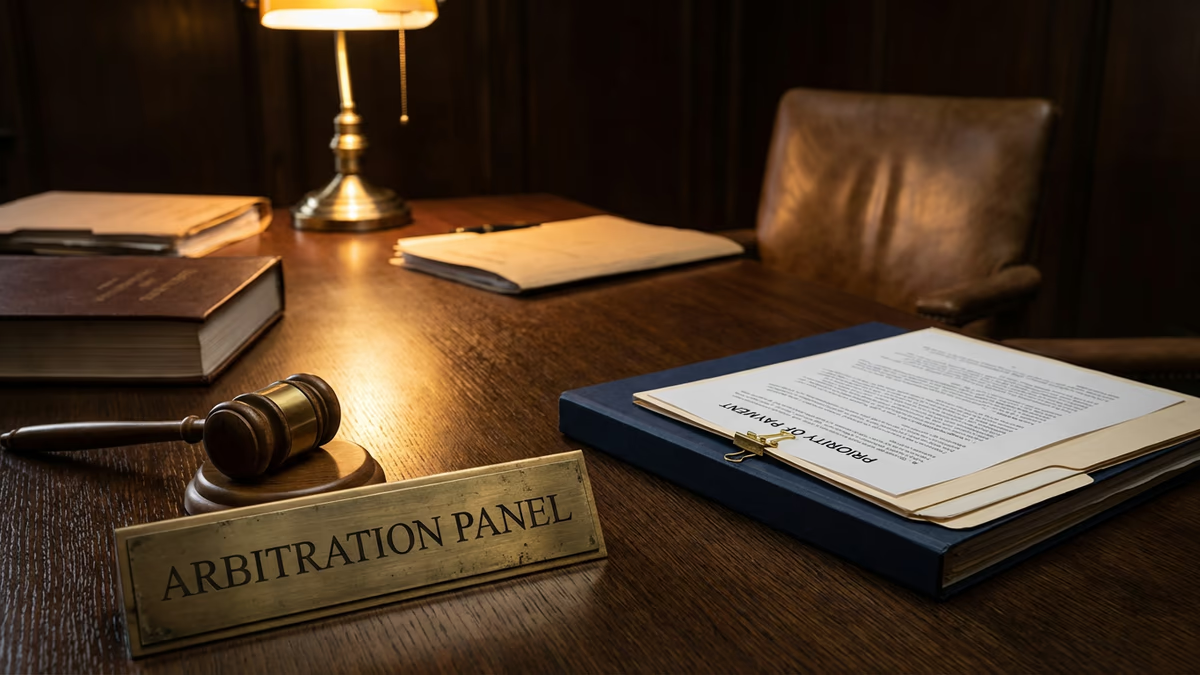
Priority of Payment Regulation Has No Force in Arbitration: First and Second Departments Agree
Both the First and Second Departments have held that the priority of payment regulation under 11 NYCRR 65-3.15 is of no force or effect in no-fault arbitration proceedings....
Feb 25, 2026
How Insurance Companies Use Colossus Software to Undervalue Your Injury Claim
Insurance companies use Colossus software to lowball your injury claim. Learn how this system works and how a Long Island attorney can fight back. Call 516-750-0595.
Feb 18, 2026
TEST UPDATE – Criminal Court Procedure
New York criminal court procedure differences from civil rules - essential knowledge for Long Island and NYC attorneys handling diverse case types.
Dec 26, 2008
The reasonably convenient EUO
New York no-fault insurance case examining "reasonably convenient" EUO scheduling requirements and triable issues of fact in summary judgment motions.
Feb 18, 2022
The Cornona Virus
Long Island personal injury attorney discusses how COVID-19 pandemic may transform court proceedings and no-fault insurance practice in New York.
Mar 18, 2020
Another Golia on the bench
Attorney Jason Tenenbaum reflects on Hon. Donna Marie Golia joining the bench, following in her father Justice Joseph Golia's distinguished judicial footsteps.
Jul 7, 2014Was this article helpful?

About the Author
Jason Tenenbaum, Esq.
Jason Tenenbaum is the founding attorney of the Law Office of Jason Tenenbaum, P.C., headquartered at 326 Walt Whitman Road, Suite C, Huntington Station, New York 11746. With over 24 years of experience since founding the firm in 2002, Jason has written more than 1,000 appeals, handled over 100,000 no-fault insurance cases, and recovered over $100 million for clients across Long Island, Nassau County, Suffolk County, Queens, Brooklyn, Manhattan, the Bronx, and Staten Island. He is one of the few attorneys in the state who both writes his own appellate briefs and tries his own cases.
Jason is admitted to practice in New York, New Jersey, Florida, Texas, Georgia, and Michigan state courts, as well as multiple federal courts. His 2,353+ published legal articles analyzing New York case law, procedural developments, and litigation strategy make him one of the most prolific legal commentators in the state. He earned his Juris Doctor from Syracuse University College of Law.
Disclaimer: This article is published by the Law Office of Jason Tenenbaum, P.C. for informational and educational purposes only. It does not constitute legal advice, and no attorney-client relationship is formed by reading this content. The legal principles discussed may not apply to your specific situation, and the law may have changed since this article was last updated.
New York law varies by jurisdiction — court decisions in one Appellate Division department may not be followed in another, and local court rules in Nassau County Supreme Court differ from those in Suffolk County Supreme Court, Kings County Civil Court, or Queens County Supreme Court. The Appellate Division, Second Department (which covers Long Island, Brooklyn, Queens, and Staten Island) and the Appellate Term (which hears appeals from lower courts) each have distinct procedural requirements and precedents that affect litigation strategy.
If you need legal help with a no-fault matter, contact our office at (516) 750-0595 for a free consultation. We serve clients throughout Long Island (Huntington, Babylon, Islip, Brookhaven, Smithtown, Riverhead, Southampton, East Hampton), Nassau County (Hempstead, Garden City, Mineola, Great Neck, Manhasset, Freeport, Long Beach, Rockville Centre, Valley Stream, Westbury, Hicksville, Massapequa), Suffolk County (Hauppauge, Deer Park, Bay Shore, Central Islip, Patchogue, Brentwood), Queens, Brooklyn, Manhattan, the Bronx, Staten Island, and Westchester County. Prior results do not guarantee a similar outcome.