Key Takeaway
Learn about New York Judiciary Law 470 office requirements for attorneys. Understand risks, recent developments, and compliance.
This article is part of our ongoing legal expertise coverage, with 6 published articles analyzing legal expertise issues across New York State. Attorney Jason Tenenbaum brings 24+ years of hands-on experience to this analysis, drawing from his work on more than 1,000 appeals, over 100,000 no-fault cases, and recovery of over $100 million for clients throughout Nassau County, Suffolk County, Queens, Brooklyn, Manhattan, and the Bronx. For personalized legal advice about how these principles apply to your specific situation, contact our Long Island office at (516) 750-0595 for a free consultation.
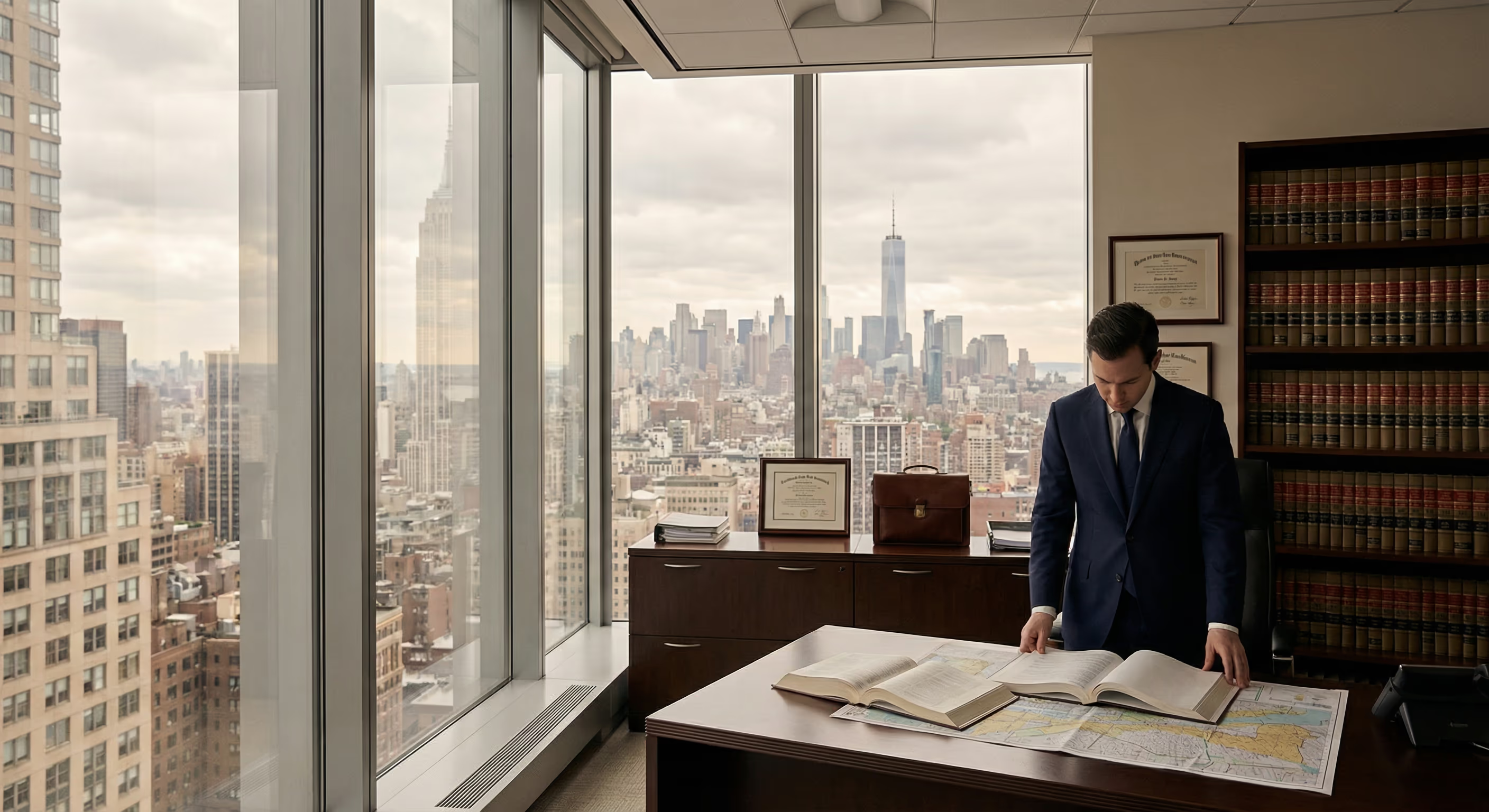
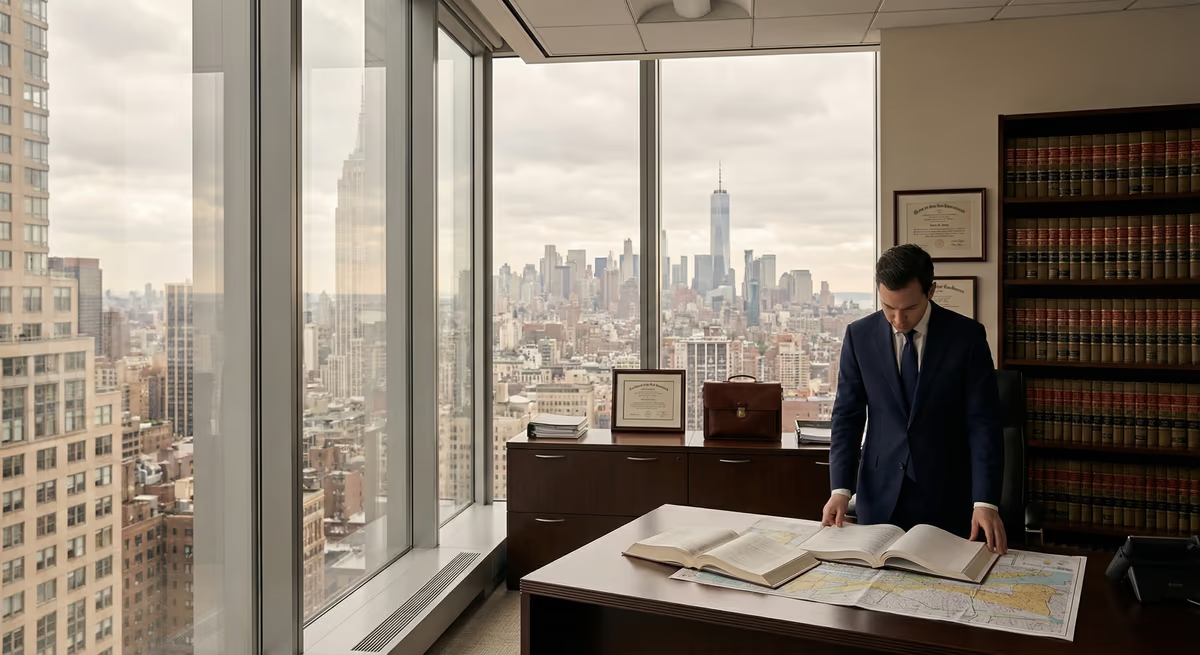
New York Judiciary Law § 470 requires every attorney practicing in New York state courts to maintain a physical office within the state — and failure to comply can result in disqualification from your case, forfeiture of legal fees, and potential disciplinary action. Despite a 2023 legislative effort to modernize the statute, Governor Hochul vetoed the reform bill, leaving this 1862 law fully in effect. Below, we break down what § 470 requires, the risks of non-compliance, and practical steps to protect your practice.
Understanding New York Judiciary Law Section 470
_Edited and updated 1/22/2_5 – New York Judiciary Law 470, a statute originally enacted in 1862, requires that personal injury lawyers, employment lawyers, and other attorneys practicing in New York state courts maintain a physical office within the state. While this law may seem like an obscure relic of a bygone era, it continues to pose risks for lawyers licensed to practice in New York who reside and primarily work outside the state.
Failure to adhere to Section 470 can lead to an attorney being disqualified from cases and unable to collect legal fees, with potentially severe professional consequences. In this article we will take a closer look at this law, its ramifications, and some recent developments.
The Text and Intent of Section 470
Section 470 of the Judiciary Law reads as follows: “A person, regularly admitted to practice as an attorney and counselor, in the courts of record of this state, whose office for the transaction of law business is within the state, may practice as such attorney or counselor, although he resides in an adjoining state.” On its face, this requires any attorney practicing in New York to maintain a physical office in the state, even if they reside elsewhere.
The original intent of the law is somewhat murky, but it likely had protectionist aims – to shield New York lawyers from out-of-state competition back in the 19th century. In the modern era of interstate commerce and virtual offices, many view it as an anachronistic and unduly burdensome restriction. Yet it remains on the books and courts continue to enforce it.
New York is not the only state to currently have this type of law. Many New Yorkers have a relationship with the State of Florida. Florida has a similar bar rule that has trapped many snow-birders who seek to practice law in the Sunshine State. Fla Bar. Rule 4-7.12 states: “ bona fide office is defined as a physical location maintained by the lawyer or law firm where the lawyer or law firm reasonably expects to furnish legal services in a substantial way on a regular and continuing basis.” We will address Florida’s interesting bona fide office rules in a separate post.
Legal Risks and Enforcement
The primary danger of Section 470 is disqualification from representing clients in New York state courts if challenged on not maintaining an in-state office. If an opposing party or judge objects that an attorney has violated Section 470, that attorney may be forced to withdraw as counsel, potentially disrupting their client’s case. This can damage an attorney’s professional standing and client relationships.
The Courts have made clear that virtual offices containing only mailbox services and on-demand conference rental services do not satisfy Section 470 requirements (Mar. Dist. Dev. Co., LLC v Toledano, 174 AD3d 431, 432 ).
Additionally, an attorney disqualified under Section 470 may be unable to collect fees for legal work already performed on a case prior to being challenged. In the 2018 case Arrowhead Capital Finance, Ltd. v. Cheyne Specialty Finance Fund L.P., 32 N.Y.3d 645 (2019), New York’s Court of Appeals affirmed a lower court’s order disqualifying the plaintiff’s counsel under Section 470 and denying a motion to collect over $100,000 in unpaid legal fees. The court held that as a non-resident attorney without a New York office, counsel was unauthorized to represent the plaintiff and thus had no entitlement to fees.
Beyond individual cases, violation of Section 470 could potentially lead to disciplinary action against an attorney by the state bar for the unauthorized practice of law. All told, non-compliance with this statute poses serious financial and professional risks that lawyers would do well to avoid!
Have a personal injury case in New York? The Law Office of Jason Tenenbaum handles personal injury claims across Long Island and New York City. Whether you’re an attorney looking to refer a case or an individual who has been injured, we can help. Call (516) 750-0595 or contact us online.
Recent Developments
In recent years, some New York lawmakers have recognized the outdated nature of Section 470 and its negative impact on attorneys. In 2023, the state legislature passed a bill that would have overhauled the law to allow attorneys to practice in New York without a physical office, so long as they were licensed, in good standing, and complied with the state’s rules of professional conduct. However, in December 2023, Governor Kathy Hochul vetoed the proposed legislation.
In her veto message, Gov. Hochul expressed concern that eliminating the in-state office requirement entirely “would make it harder to sanction attorneys who fail to follow our State’s rules, standards, and procedures.” She argued that the current law “enables the State to hold non-resident attorneys accountable for conduct that harms clients and allows for service of process.” Critics counter that modern electronic service methods make a physical office less necessary, and that the state has other avenues to pursue attorney misconduct.
The governor did indicate willingness to work with the legislature on revising Section 470 in a more targeted manner. Potential changes could include exempting attorneys who don’t appear in state courts or handle trust funds, and allowing greater use of virtual offices. But for now, the in-state office requirement remains in effect, and lawyers without a New York base of operations must tread carefully.
Takeaways for Attorneys
Given the ongoing enforcement of Section 470 and the failure of recent reform efforts, what should New York-licensed attorneys who reside out of state do? First and foremost, consider establishing some form of physical office presence in New York if feasible, even if it is just a nominal location for receiving service of process and other official correspondence. Virtual office setups should be avoided as they only bring about more questions than answers. If you are going to practice law in the State of New York, bite the bullet and rent an actual office, with a desk, computer, a telephone and shared reception areas. Should someone knock on the door, the shared receptionist should acknowledge your presence.
If an attorney genuinely cannot maintain an office in the state, they should consider carefully whether it is worth the risk of running afoul of Section 470 before taking on New York clients and cases. For out-of-state attorneys with New York personal injury, car accident, or medical malpractice cases, partnering with a New York-based firm through a referral arrangement is often the safest path forward.
Attorneys: Refer your New York personal injury cases with confidence. Jason Tenenbaum works with referring attorneys across the country on personal injury, construction accident, and slip and fall matters throughout Long Island and NYC. Learn more about the firm or call (516) 750-0595 to discuss a referral.
Longer-term, attorneys may wish to advocate for clearer statutory guidelines around virtual offices and looser restrictions for lawyers who don’t physically appear in New York courts. But any reforms will likely be incremental. For now, non-resident New York lawyers must vigilantly toe the line of this quite traditional and exacting law, lest they jeopardize their standing and their client’s interests. In an increasingly mobile and networked profession, Section 470 stands as a stubborn reminder of the challenges of practicing across jurisdictions.
For a more detailed analysis of Judiciary Law 470, check out the video below:
Need a New York Personal Injury Attorney?
Whether you’re an individual injured in an accident or an attorney seeking to refer a New York case, the Law Office of Jason Tenenbaum is here to help. With a physical office on Long Island and extensive experience handling personal injury claims across Nassau County, Suffolk County, and all five boroughs, we understand both the substance and the procedural requirements of New York litigation.
We handle a full range of practice areas including car accidents, truck accidents, construction accidents, medical malpractice, slip and fall injuries, and more.
Free consultation — no fee unless we win. Call (516) 750-0595 to speak with Jason Tenenbaum directly, or contact us online to get started. Attorneys: ask about our referral fee arrangements.
Legal Context
Why This Matters for Your Case
New York law is among the most complex and nuanced in the country, with distinct procedural rules, substantive doctrines, and court systems that differ significantly from other jurisdictions. The Civil Practice Law and Rules (CPLR) governs every stage of civil litigation, from service of process through trial and appeal. The Appellate Division, Appellate Term, and Court of Appeals create a rich and ever-evolving body of case law that practitioners must follow.
Attorney Jason Tenenbaum has practiced across these areas for over 24 years, writing more than 1,000 appellate briefs and publishing over 2,353 legal articles that attorneys and clients rely on for guidance. The analysis in this article reflects real courtroom experience — from motion practice in Civil Court and Supreme Court to oral arguments before the Appellate Division — and a deep understanding of how New York courts actually apply the law in practice.
Keep Reading
More Legal Expertise Analysis

Common Legal Pitfalls for Long Island Buisnesses
Discover common legal pitfalls facing Long Island businesses, from corporate liability issues to contract disputes and regulatory compliance challenges.
Jul 18, 2025
Negligence per se: When Laws Trigger Liability
Learn how negligence per se simplifies injury claims by using safety law violations to prove fault automatically. Key elements & examples.
Jan 9, 2025
The Complexity of Emotional Distress Claims in Personal Injury Cases
Understand emotional distress claims in personal injury cases. Learn how to prove psychological trauma and seek compensation in NYC & Long Island. Expert legal guidance.
Dec 9, 2024
NY CPLR 2004: Lessons in Legal Precision and Court Procedures
Learn how the Calderone v. Molloy College case impacts legal deadline extensions and what CPLR 2004 means for court filing procedures.
Dec 17, 2024
Acupuncture Reimbursements and Insurance Legalities Explained
Explore the Forrest Chen v. GEICO case and its impact on acupuncture insurance reimbursements in NY. Key insights for providers and patients.
Dec 11, 2024Common Questions
Frequently Asked Questions
Why is legal expertise important in no-fault and personal injury cases?
No-fault insurance and personal injury law involve complex statutes, regulations, and court procedures that change frequently. An experienced attorney understands the strategic and procedural nuances that can determine whether a claim succeeds or fails.
What makes the Law Office of Jason Tenenbaum different?
Attorney Jason Tenenbaum brings over two decades of experience handling no-fault insurance disputes, personal injury claims, and employment law matters across Long Island and New York City. The firm combines deep legal expertise with practical trial experience.
How do I know if I need a specialist attorney?
If your case involves no-fault insurance denials, complex medical evidence, or employment discrimination, a specialist attorney will have the knowledge to navigate these areas effectively. General practitioners may not be familiar with the specific regulations and court precedents that apply.
Was this article helpful?

About the Author
Jason Tenenbaum, Esq.
Jason Tenenbaum is the founding attorney of the Law Office of Jason Tenenbaum, P.C., headquartered at 326 Walt Whitman Road, Suite C, Huntington Station, New York 11746. With over 24 years of experience since founding the firm in 2002, Jason has written more than 1,000 appeals, handled over 100,000 no-fault insurance cases, and recovered over $100 million for clients across Long Island, Nassau County, Suffolk County, Queens, Brooklyn, Manhattan, the Bronx, and Staten Island. He is one of the few attorneys in the state who both writes his own appellate briefs and tries his own cases.
Jason is admitted to practice in New York, New Jersey, Florida, Texas, Georgia, and Michigan state courts, as well as multiple federal courts. His 2,353+ published legal articles analyzing New York case law, procedural developments, and litigation strategy make him one of the most prolific legal commentators in the state. He earned his Juris Doctor from Syracuse University College of Law.
Disclaimer: This article is published by the Law Office of Jason Tenenbaum, P.C. for informational and educational purposes only. It does not constitute legal advice, and no attorney-client relationship is formed by reading this content. The legal principles discussed may not apply to your specific situation, and the law may have changed since this article was last updated.
New York law varies by jurisdiction — court decisions in one Appellate Division department may not be followed in another, and local court rules in Nassau County Supreme Court differ from those in Suffolk County Supreme Court, Kings County Civil Court, or Queens County Supreme Court. The Appellate Division, Second Department (which covers Long Island, Brooklyn, Queens, and Staten Island) and the Appellate Term (which hears appeals from lower courts) each have distinct procedural requirements and precedents that affect litigation strategy.
If you need legal help with a legal expertise matter, contact our office at (516) 750-0595 for a free consultation. We serve clients throughout Long Island (Huntington, Babylon, Islip, Brookhaven, Smithtown, Riverhead, Southampton, East Hampton), Nassau County (Hempstead, Garden City, Mineola, Great Neck, Manhasset, Freeport, Long Beach, Rockville Centre, Valley Stream, Westbury, Hicksville, Massapequa), Suffolk County (Hauppauge, Deer Park, Bay Shore, Central Islip, Patchogue, Brentwood), Queens, Brooklyn, Manhattan, the Bronx, Staten Island, and Westchester County. Prior results do not guarantee a similar outcome.